
How to Choose the Best Urogynecologist in Georgia – Near Atlanta: Experience, Training, and Why It Matters
Finding the right urogynecologist can be one of the most important healthcare decisions a woman makes.
Whether you’re experiencing urinary incontinence, pelvic organ prolapse, overactive bladder, pelvic pain, complications from previous pelvic surgery, or another pelvic floor disorder, choosing a physician with the appropriate training and experience can make a significant difference in both your treatment options and long-term outcome.
Unfortunately, many women are unfamiliar with the specialty of Female Pelvic Medicine and Reconstructive Surgery (FPMRS) and may not realize that physicians treating similar conditions often have very different levels of education, surgical training, and clinical experience.
If you’ve been searching for the best urogynecologist in Georgia, best urogynecologist near Atlanta, or an experienced pelvic floor specialist in Alpharetta, Roswell, Johns Creek, Milton, Sandy Springs, Buckhead, Duluth, Cumming, Marietta, Kennesaw, Gainesville, Lawrenceville, or surrounding Georgia communities, understanding what separates one specialist from another is an excellent place to begin.
The goal isn’t simply finding a doctor close to home.
It’s finding a physician whose education, experience, and commitment to Female Pelvic Medicine and Reconstructive Surgery align with your individual healthcare needs.
What Is a Urogynecologist?
A urogynecologist is an obstetrician-gynecologist who completes additional fellowship training focused exclusively on Female Pelvic Medicine and Reconstructive Surgery.
Following residency, these physicians undergo years of advanced education dedicated to diagnosing and treating conditions affecting the female pelvic floor, including:
- Urinary incontinence
- Overactive bladder
- Pelvic organ prolapse
- Rectocele
- Cystocele
- Uterine prolapse
- Vaginal vault prolapse
- Pelvic floor dysfunction
- Childbirth-related pelvic injuries
- Recurrent prolapse after previous surgery
- Complications from prior pelvic reconstructive procedures
This advanced fellowship training includes complex reconstructive pelvic surgery, minimally invasive surgery, robotic surgery, laparoscopic surgery, vaginal surgery, and comprehensive nonsurgical management of pelvic floor disorders.
Because urogynecology is a highly specialized field, fellowship-trained physicians devote their careers to conditions that many general gynecologists encounter less frequently.
Why Fellowship Training Matters
Not every physician treating urinary incontinence or pelvic organ prolapse has completed fellowship training in Female Pelvic Medicine and Reconstructive Surgery.
That additional education matters because pelvic floor disorders are often far more complex than they initially appear.
A woman who leaks urine when she exercises may also have early pelvic organ prolapse.
Another may have previously undergone bladder surgery without lasting success.
Others may require revision surgery after unsuccessful procedures performed elsewhere.
These situations often require a comprehensive understanding of pelvic anatomy, reconstructive surgery, pelvic floor biomechanics, and long-term treatment planning.
Fellowship-trained urogynecologists spend years developing these advanced skills.
For women with routine conditions, this specialized training offers access to the latest diagnostic techniques and treatment options.
For women with more complicated pelvic floor disorders, it may provide solutions that are unavailable through less specialized practices.
What Should You Look for When Choosing a Urogynecologist?
Many women begin their search by reading online reviews.
While patient experiences are valuable, they represent only one piece of the picture.
A physician’s qualifications, training, research contributions, and surgical experience are equally important considerations.
Some of the most meaningful credentials include:
Fellowship Training
Completion of an accredited fellowship in Female Pelvic Medicine and Reconstructive Surgery.
Board Certification
Board certification demonstrates that a physician has met rigorous educational, clinical, and professional standards within their specialty.
Years of Dedicated Experience
Physicians who devote decades exclusively to urogynecology often develop expertise in managing both common and highly complex pelvic floor disorders.
Experience With Revision Surgery
Not every pelvic floor surgery is successful the first time.
Women requiring revision surgery frequently seek physicians with extensive reconstructive experience.
Research and Scientific Publications
Doctors actively involved in research contribute to advancing the specialty itself.
Peer-reviewed publications, textbook chapters, and scientific presentations demonstrate ongoing involvement in improving patient care and surgical techniques.
Physician Education
Some specialists not only treat patients but also teach other physicians.
Serving as a surgical educator or invited lecturer reflects recognition by colleagues within the specialty.
Experience Matters—Especially in Complex Pelvic Floor Disorders
Every woman deserves individualized care.
Many patients have relatively straightforward urinary incontinence or mild pelvic organ prolapse.
Others arrive after years of unsuccessful treatment.
Some have undergone previous surgeries.
Others have recurrent prolapse, mesh complications, chronic pelvic pain, or multiple pelvic floor disorders occurring simultaneously.
These more challenging situations often require extensive reconstructive experience and careful surgical planning.
For this reason, physicians whose practices focus exclusively on Female Pelvic Medicine and Reconstructive Surgery often receive referrals from other doctors seeking additional expertise for complex cases.
The Difference Between Treating Symptoms and Identifying the Cause
One of the defining characteristics of experienced urogynecologists is their approach to diagnosis.
Rather than focusing only on the symptom—such as bladder leakage—they work to determine why it is occurring.
For example, urinary incontinence may result from:
- Childbirth-related muscle injury
- Weak pelvic floor support
- Overactive bladder
- Pelvic organ prolapse
- Neurologic disorders
- Previous pelvic surgery
- Hormonal changes associated with menopause
Although these conditions may produce similar symptoms, the most effective treatment differs considerably.
A thorough evaluation helps ensure that treatment addresses the underlying cause rather than simply managing the symptom.
Why Dr. Miklos and Dr. Moore Have Become Leaders in Urogynecology
For more than two decades, Dr. John Miklos and Dr. Robert Moore have devoted their careers exclusively to Female Pelvic Medicine and Reconstructive Surgery.
Their practice in Alpharetta, Georgia, serves women from throughout Atlanta, Roswell, Johns Creek, Milton, Sandy Springs, Buckhead, Duluth, Suwanee, Cumming, Marietta, Kennesaw, Woodstock, Gainesville, Lawrenceville, and communities across Georgia, as well as patients who travel from across the United States and internationally seeking specialized evaluation and treatment for complex pelvic floor disorders.
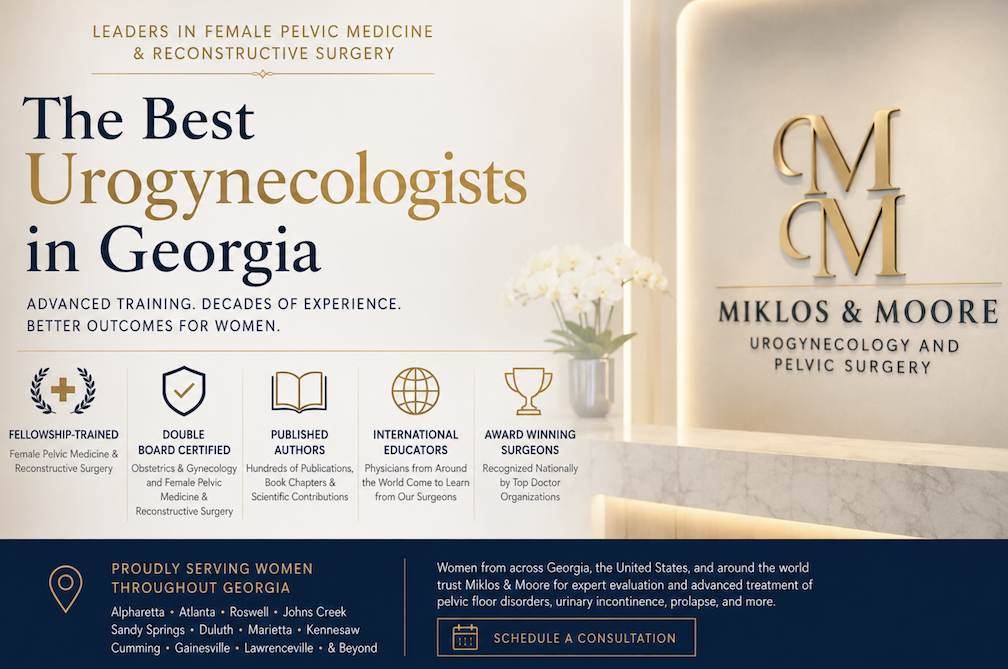
Both physicians are fellowship-trained and double board-certified, with extensive experience in minimally invasive pelvic reconstructive surgery, robotic surgery, vaginal surgery, urinary incontinence, pelvic organ prolapse, and revision pelvic floor procedures.
Beyond clinical practice, Drs. Miklos and Moore have contributed extensively to advancing the specialty through research, education, physician training, and scientific publications. Their work has helped educate surgeons worldwide while advancing modern approaches to pelvic floor reconstruction.
Unlike practices that focus on a single procedure or treatment, Miklos & Moore provide comprehensive care designed around each woman’s diagnosis, anatomy, symptoms, and long-term goals.
Advancing the Field of Urogynecology Through Research and Innovation
One of the characteristics that often distinguishes highly respected urogynecologists is their commitment to advancing the specialty—not only through patient care but also through research, education, and scientific collaboration.
Throughout their careers, Dr. John Miklos and Dr. Robert Moore have contributed extensively to the field of Female Pelvic Medicine and Reconstructive Surgery by publishing scientific research, authoring textbook chapters, presenting at national and international medical meetings, and helping educate physicians around the world.
Scientific publications are more than academic accomplishments. They demonstrate that a physician actively participates in evaluating new techniques, refining surgical procedures, and contributing knowledge that benefits patients everywhere.
Their research has addressed numerous topics involving pelvic organ prolapse, urinary incontinence, minimally invasive pelvic surgery, robotic surgery, vaginal reconstruction, mesh complications, pelvic floor anatomy, and cosmetic gynecology.
For women seeking specialized pelvic floor care, these contributions reflect an ongoing commitment to improving outcomes through evidence-based medicine and surgical innovation.
International Recognition and Physician Education
While most patients understandably focus on finding an experienced surgeon, another important consideration is whether that physician is recognized by colleagues within the specialty.
Throughout their careers, Drs. Miklos and Moore have served as invited faculty members, surgical educators, and lecturers at professional meetings attended by physicians from around the world.
Surgeons have traveled to Alpharetta to observe their surgical techniques and participate in physician training programs focused on advanced pelvic reconstructive surgery.
Teaching other surgeons requires a deep understanding of anatomy, surgical planning, complication management, and evolving treatment techniques. It is a role typically reserved for physicians whose expertise has earned the confidence of their peers.
Their commitment to physician education reflects not only years of experience but also a dedication to advancing the specialty for future generations of urogynecologists.
National Awards and Professional Recognition
Professional recognition is another factor many women consider when choosing a specialist.
Over the years, Dr. Miklos and Dr. Moore have received numerous honors recognizing their contributions to women’s pelvic health, minimally invasive surgery, and reconstructive pelvic surgery.
These recognitions include distinctions such as:
- Castle Connolly Top Doctor
- America’s Best Doctors
- AAGL recognition for excellence in minimally invasive gynecologic surgery
- Invitations to lecture nationally and internationally
- Leadership roles within professional medical organizations
- Recognition for innovation in pelvic reconstructive surgery
While awards alone do not determine the quality of care a patient receives, they often reflect long-term contributions to clinical excellence, education, research, and leadership within the medical community.
Why Experience Matters in Revision Pelvic Surgery
Many women who seek consultation at Miklos & Moore are not visiting because they need their first pelvic floor surgery.
Instead, they arrive after previous treatments have failed to provide lasting relief.
Revision surgery often presents unique challenges.
Scar tissue, altered anatomy, recurrent prolapse, recurrent urinary incontinence, or previous mesh procedures require careful evaluation and individualized surgical planning.
These complex cases frequently benefit from surgeons whose practices include advanced reconstructive pelvic surgery and referral-level care.
Because of their extensive experience, Dr. Miklos and Dr. Moore routinely evaluate women seeking second opinions or treatment after unsuccessful procedures performed elsewhere.
Comprehensive Care for the Full Spectrum of Pelvic Floor Disorders
Female pelvic floor disorders rarely occur in isolation.
A woman experiencing urinary incontinence may also have pelvic organ prolapse.
Another may have prolapse together with vaginal laxity.
Others experience pelvic pain, bladder urgency, recurrent urinary tract infections, or bowel dysfunction.
Rather than focusing on a single symptom, comprehensive urogynecology evaluates how these conditions interact.
Drs. Miklos and Moore routinely diagnose and treat:
- Stress urinary incontinence
- Urge urinary incontinence
- Mixed urinary incontinence
- Overactive bladder
- Pelvic organ prolapse
- Cystocele
- Rectocele
- Uterine prolapse
- Vaginal vault prolapse
- Pelvic floor dysfunction
- Mesh complications
- Childbirth-related pelvic injuries
- Vaginal reconstruction
- Robotic pelvic surgery
- Laparoscopic pelvic surgery
- Cosmetic vaginal surgery
This comprehensive approach allows patients to receive individualized treatment plans that address the underlying condition rather than focusing on only one symptom.
Why Women Throughout Georgia Travel to Alpharetta
Patients seeking specialized urogynecology care often travel farther than they would for routine medical appointments.
Women from Atlanta, Alpharetta, Roswell, Johns Creek, Milton, Sandy Springs, Buckhead, Duluth, Suwanee, Cumming, Marietta, Kennesaw, Woodstock, Gainesville, Lawrenceville, Athens, Macon, Augusta, Columbus, Savannah, and communities throughout Georgia choose Miklos & Moore because they are looking for fellowship-trained specialists with extensive experience treating both routine and highly complex pelvic floor disorders.
Many patients are referred by:
- OB/GYNs
- Primary care physicians
- Urologists
- Gastroenterologists
- Physical therapists
- Other urogynecologists
These referrals reflect the collaborative role fellowship-trained specialists often play in managing difficult or recurrent pelvic floor conditions.
Frequently Asked Questions
What is a urogynecologist?
A urogynecologist is an OB/GYN who completes additional fellowship training in Female Pelvic Medicine and Reconstructive Surgery, specializing in urinary incontinence, pelvic organ prolapse, pelvic floor disorders, and reconstructive pelvic surgery.
When should I see a urogynecologist?
You should consider seeing a urogynecologist if you experience bladder leakage, urinary urgency, pelvic organ prolapse, recurrent urinary tract infections, pelvic floor dysfunction, or persistent pelvic symptoms that interfere with your daily life.
What makes a fellowship-trained urogynecologist different?
Fellowship-trained urogynecologists complete several additional years of advanced education dedicated exclusively to diagnosing and treating female pelvic floor disorders.
Is urinary incontinence a normal part of aging?
No. While bladder leakage becomes more common with age, it should never be considered a normal or unavoidable part of growing older.
Can pelvic organ prolapse be treated without surgery?
Yes. Depending on the severity of prolapse, treatment may include pelvic floor physical therapy, pessaries, lifestyle modifications, or observation. Some women benefit from surgery, while others do well with conservative management.
What causes pelvic organ prolapse?
Pregnancy, childbirth, aging, menopause, genetics, chronic constipation, obesity, and previous pelvic surgery may all contribute to weakening of the pelvic floor support structures.
Why are scientific publications important when choosing a surgeon?
Physicians who publish peer-reviewed research contribute to advancing medical knowledge and often remain actively engaged in evaluating new techniques and improving patient care.
Why does physician education matter?
Surgeons who teach other physicians are often recognized by their peers for their experience and expertise within their specialty.
Can I seek a second opinion before pelvic floor surgery?
Absolutely. Many women seek a second opinion before making decisions about prolapse surgery, urinary incontinence procedures, or revision pelvic surgery.
What is robotic pelvic surgery?
Robotic-assisted surgery is a minimally invasive technique that allows surgeons to perform complex pelvic reconstructive procedures through small incisions using enhanced visualization and precise instrumentation.
Do Dr. Miklos and Dr. Moore perform minimally invasive surgery?
Yes. Their practice offers minimally invasive, laparoscopic, robotic, and vaginal surgical approaches when appropriate based on each patient’s diagnosis and treatment goals.
Do women travel from outside Atlanta for treatment?
Yes. Patients regularly visit the Alpharetta practice from throughout metro Atlanta, across Georgia, and from other states seeking specialized evaluation and treatment for pelvic floor disorders.
Are pelvic floor disorders common?
Yes. Millions of women experience urinary incontinence, pelvic organ prolapse, or other pelvic floor conditions, particularly after pregnancy, childbirth, or menopause.
Can previous pelvic surgery affect future treatment?
Yes. Previous surgeries may alter pelvic anatomy, making comprehensive evaluation and individualized treatment planning especially important.
How do I know which treatment is right for me?
The best treatment begins with an accurate diagnosis. After a thorough evaluation, your urogynecologist can recommend options based on your symptoms, anatomy, lifestyle, and long-term goals.
Choosing Experience, Training, and Compassion
Choosing a urogynecologist is about far more than finding the closest office or the first name that appears in a search result. It is about finding a physician with the advanced training, experience, and judgment to accurately diagnose your condition and recommend the treatment that best fits your individual needs.
Dr. John Miklos and Dr. Robert Moore have dedicated their careers to the care of women with pelvic floor disorders. Through fellowship training, double board certification, decades of surgical experience, scientific publications, physician education, international lectures, and leadership within the specialty of Female Pelvic Medicine and Reconstructive Surgery, they have helped shape the field while caring for women with both common and highly complex conditions.
Whether you are experiencing urinary incontinence, pelvic organ prolapse, overactive bladder, pelvic floor dysfunction, or complications from previous pelvic surgery, seeking care from a fellowship-trained urogynecologist can provide access to specialized expertise and a full range of personalized treatment options.
For women throughout Alpharetta, Atlanta, Roswell, Johns Creek, Milton, Sandy Springs, Buckhead, Duluth, Suwanee, Cumming, Marietta, Kennesaw, Gainesville, Lawrenceville, and communities across Georgia, Miklos & Moore continue their commitment to providing compassionate, evidence-based care grounded in decades of experience and a passion for advancing women’s pelvic health.