
VESICOVAGINAL FISTULA REPAIR
WORLD-RENOWNED EXPERTS IN LAPAROSCOPIC VVF SURGERY
Drs. John Miklos and Robert Moore are internationally recognized, highly experienced surgeons in laparoscopic vesicovaginal fistula repair. Patients from across the United States and around the world have sought their expertise for primary, complex and previously failed VVF repairs.
VESICOVAGINAL FISTULA (VVF) & LAPAROSCOPIC VVF REPAIR
Welcome to two of the most experienced laparoscopic vesicovaginal fistula repair surgeons in the world. Drs. Miklos & Moore are internationally recognized authorities in laparoscopic vesicovaginal fistula (VVF) repair.
In 1998, Miklos & Moore Urogynecology were the second surgical team in the world to report on laparoscopic VVF repair. Today, they have decades of experience performing these highly specialized procedures. They have a documented cure rate of 98%, with an average hospital stay of 1 day and an average blood loss of less than 1 tablespoon. Their experience includes patients with new fistulas as well as women with failed VVF repairs previously performed by other surgeons. VVF patients have traveled to Drs. Miklos & Moore from across the United States and around the world, including Hong Kong, Nigeria, Hawaii and St. Johns Island, seeking their surgical expertise.
Drs. Miklos & Moore have also authored important research on laparoscopic vesicovaginal fistula repair. Their first article, published in 2015, documented their 15-year experience performing laparoscopic VVF repairs. Their second publication provides a comprehensive review of laparoscopic and robotic VVF repair. Both publications are featured below.
The published research below highlights Drs. Miklos & Moore’s extensive experience, surgical techniques and contributions to the advancement of laparoscopic vesicovaginal fistula repair.
VESICOVAGINAL FISTULAS
A vesicovaginal fistula (VVF), also known as a bladder fistula or bladder-to-vagina fistula, is an abnormal passage between the bladder and the vagina. This passage can develop following previous surgery such as a hysterectomy, vaginal surgery or urinary incontinence sling surgery. A vesicovaginal fistula can also result from cancer treatment, radiation therapy, cesarean section or obstetrical trauma.
VESICOVAGINAL FISTULA SYMPTOMS
Patients with a vesicovaginal fistula typically experience continuous urinary leakage or leakage without sensory awareness. Continuous leakage means the urine loss is not necessarily associated with coughing, sneezing or urinary urgency. Instead, urine may continuously or repeatedly leak through the vagina.
Some patients have no sensation or warning that the leakage is about to occur. There may be no urgency or feeling that they need to use the bathroom—the urine simply leaks through the abnormal connection between the bladder and vagina.
VESICOVAGINAL FISTULA TREATMENT
Dr. Miklos and Dr. Moore are among the most experienced surgeons in the world performing laparoscopic vesicovaginal fistula (VVF) repairs. Traditionally, bladder fistulas have often been repaired through larger abdominal incisions known as laparotomies. Minimally invasive laparoscopic surgery allows the surgeon to perform the repair through small abdominal incisions with enhanced visualization of the bladder, vagina and surrounding tissues.
Laparoscopic VVF repair can offer important advantages, including smaller incisions, less postoperative pain, reduced blood loss, excellent surgical visualization and faster recovery compared with traditional open abdominal surgery.
Drs. Miklos and Moore use advanced laparoscopic techniques to obtain detailed visualization of the fistula and surrounding anatomy during repair. Their extensive experience includes both primary vesicovaginal fistulas and complex cases in which previous VVF repair attempts have failed.
STEP-BY-STEP LAPAROSCOPIC VESICOVAGINAL FISTULA REPAIR
Vesicovaginal Fistula
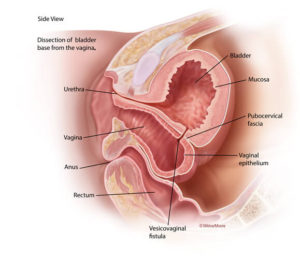
Anatomical illustration of a vesicovaginal fistula connecting the bladder and vagina.
Locating the Fistula
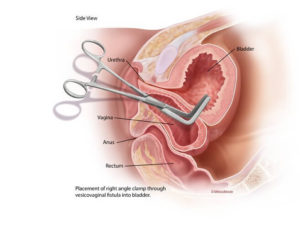
Identification and localization of the vesicovaginal fistula before laparoscopic repair.
Stenting of Fistula
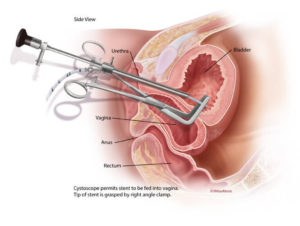
Placement of a stent through the vesicovaginal fistula to identify the fistula tract during repair.
Final Placement of Stent in Fistula
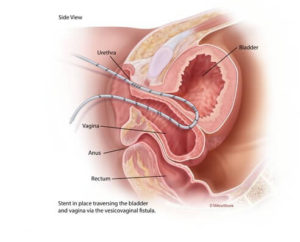
Stent positioned through the bladder and vagina to identify the vesicovaginal fistula tract.
Laparoscopic dissecting
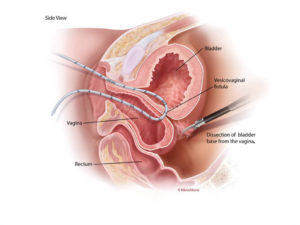
Side-view illustration showing laparoscopic dissection of the bladder from the vagina during VVF repair.
Laparoscopic Dissecting
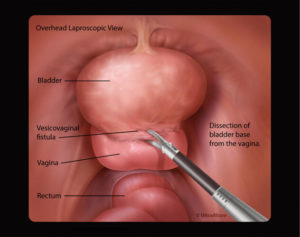
Laparoscopic view showing dissection of the bladder base from the vagina during vesicovaginal fistula repair.
Identifying fistula tract
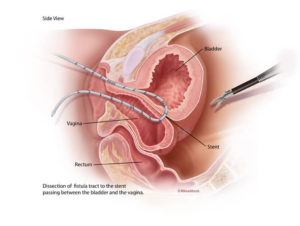
Side-view illustration showing identification and dissection of the vesicovaginal fistula tract.
Identifying fistula tract
Side-view illustration showing identification and dissection of the vesicovaginal fistula tract.
Identifying fistula tract
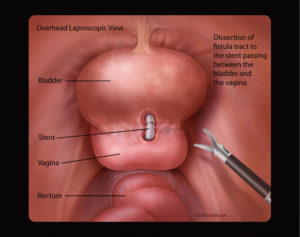
Overhead laparoscopic view showing the fistula tract and stent between the bladder and vagina.
Fistula Repair – Closure of Vagina
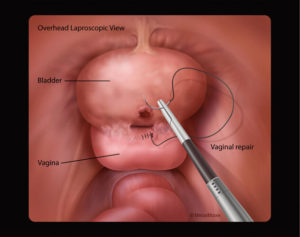
Vaginal closure during laparoscopic vesicovaginal fistula repair.
Fistula Repair – Closure of Bladder
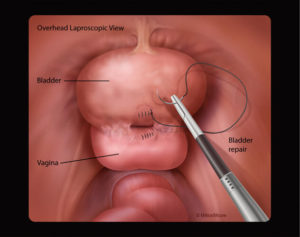
Bladder closure during laparoscopic vesicovaginal fistula repair.
Final closer of bladder
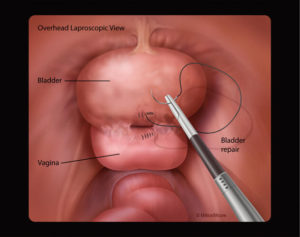
Final bladder closure completing the laparoscopic vesicovaginal fistula repair.