
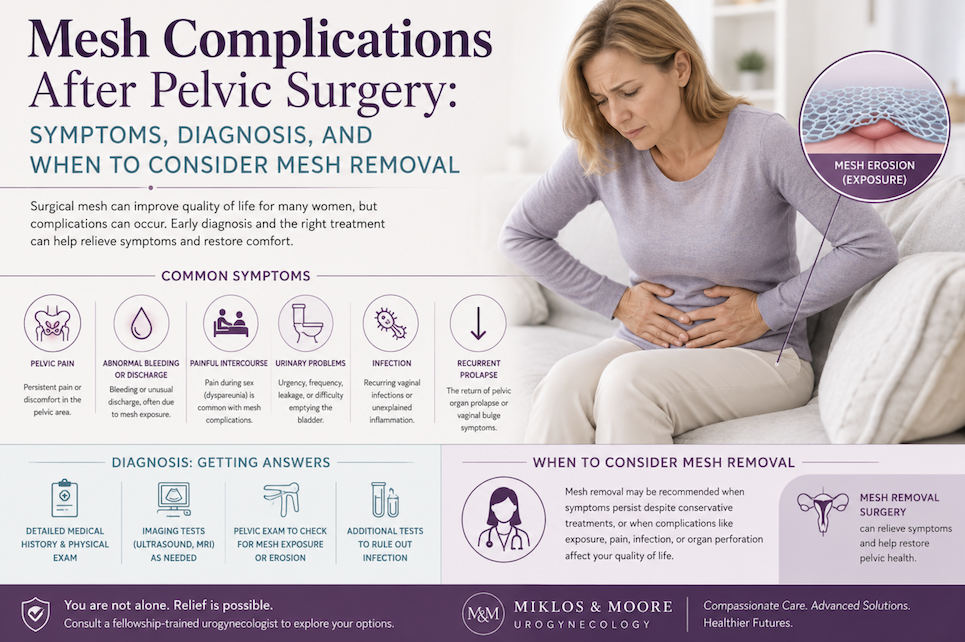
Mesh Complications After Pelvic Surgery: Symptoms, Diagnosis, and When to Consider Mesh Removal
Concerned About Mesh After Pelvic Surgery?
If you’ve had surgery for pelvic organ prolapse or urinary incontinence and are now experiencing pain, urinary problems, bleeding, or discomfort during intercourse, you may be wondering whether surgical mesh could be contributing to your symptoms.
Questions women commonly search include:
- How do I know if my mesh has failed?
- What are the symptoms of mesh erosion?
- Do I need mesh removal surgery?
- Can mesh complications happen years later?
While many women with surgical mesh never develop complications, some do experience symptoms that require evaluation. The important thing is not to assume every pelvic symptom is caused by mesh—but also not to ignore symptoms that deserve medical attention.
A careful evaluation by an experienced pelvic floor specialist can help determine whether mesh is involved or whether another condition is responsible.
What Is Surgical Mesh?
Surgical mesh is a medical implant used in certain pelvic floor procedures to provide additional support to weakened tissues.
Historically, mesh has been used in procedures for:
- Stress urinary incontinence
- Pelvic organ prolapse
- Recurrent prolapse
- Complex reconstructive pelvic surgery
Different types of mesh have been used for different procedures, and not all mesh surgeries are the same.
Understanding the Difference Between Prolapse Mesh and Bladder Slings
One of the biggest misconceptions surrounding surgical mesh is that all mesh procedures are identical.
They are not.
For example:
- Midurethral slings use a narrow strip of mesh to support the urethra in women with stress urinary incontinence.
- Transvaginal mesh kits were previously used for certain pelvic organ prolapse repairs.
- Abdominal or laparoscopic mesh procedures, such as sacrocolpopexy or sacrohysteropexy, use mesh through a different surgical approach.
Each procedure has different indications, surgical techniques, and potential risks. Understanding which type of mesh you have is an important first step in evaluating your symptoms.
Can Mesh Complications Occur Years Later?
Yes.
Some women develop symptoms shortly after surgery, while others remain symptom-free for many years before noticing changes.
Delayed symptoms may occur because of:
- Tissue changes with aging
- Menopause
- Scar tissue formation
- Changes in pelvic support
- Progressive mesh exposure
- Other unrelated pelvic floor conditions
The timing alone does not determine whether mesh is the cause.
Symptoms That May Require Evaluation
Not every symptom is caused by mesh, but certain problems should be assessed by a pelvic floor specialist.
Possible symptoms include:
- Pelvic pain
- Vaginal pain
- Pain during intercourse
- Vaginal bleeding
- Vaginal discharge
- Feeling rough or exposed material in the vagina
- Recurrent urinary tract infections
- Difficulty emptying the bladder
- Persistent urinary leakage
- Pain with sitting
- Partner feeling something during intercourse
These symptoms can have many different causes, making an accurate diagnosis essential.
How Are Mesh Complications Diagnosed?
The evaluation begins with understanding your medical history and the type of surgery you previously had.
Your physician may recommend:
- Comprehensive pelvic examination
- Review of prior operative reports
- Assessment for pelvic organ prolapse
- Bladder evaluation
- Urinalysis
- Cystoscopy when indicated
- Imaging studies in selected situations
Not every woman requires extensive testing. The evaluation is based on your symptoms and clinical findings.
Does Every Mesh Complication Require Removal?
No.
One of the biggest misconceptions is that every woman with mesh-related symptoms automatically needs mesh removal surgery.
In reality, treatment depends on:
- The type of mesh
- Your symptoms
- The location of the mesh
- Whether mesh exposure is present
- The severity of symptoms
- Your overall pelvic floor condition
Some women improve with conservative treatment, while others benefit from surgical revision or partial mesh removal.
What Happens During Mesh Removal Surgery?
Mesh removal is often more technically demanding than the original procedure.
Depending on the situation, surgery may involve:
- Partial mesh removal
- Complete mesh removal when appropriate
- Scar tissue release
- Vaginal reconstruction
- Repair of associated pelvic floor disorders
Every case is different, and complete removal is not always possible or necessary.
The surgical plan depends on the patient’s symptoms, anatomy, and the location of the implanted mesh.
Why Experience Matters in Complex Mesh Cases
Revision pelvic floor surgery often requires navigating scar tissue, altered anatomy, and previous repairs while preserving normal bladder, bowel, and sexual function whenever possible.
Women seeking treatment for possible mesh complications frequently have multiple concerns at the same time, including urinary symptoms, pelvic organ prolapse, chronic pain, or previous unsuccessful surgeries. Addressing only one issue without evaluating the others may leave important problems untreated.
Drs. John Miklos and Robert Moore have extensive experience caring for women with complex pelvic floor disorders, including those seeking evaluation after prior reconstructive surgery. Their approach begins with understanding exactly what procedure was performed, identifying the source of the patient’s symptoms, and discussing whether observation, conservative treatment, revision surgery, or mesh removal is most appropriate. Every recommendation is individualized because no two mesh cases are exactly alike.
You Don’t Have to Guess What’s Causing Your Symptoms
If you’ve had pelvic floor surgery and are now experiencing pain, urinary symptoms, bleeding, or concerns about mesh, the first step is obtaining an accurate diagnosis.
Not every symptom is caused by mesh, and not every mesh-related problem requires surgery. A comprehensive evaluation can help determine the source of your symptoms and guide you toward the treatment option that best fits your individual situation.
Frequently Asked Questions
How do I know if I have a mesh complication?
Symptoms such as pelvic pain, vaginal bleeding, pain during intercourse, recurrent urinary tract infections, exposed mesh, or persistent urinary problems should be evaluated by a pelvic floor specialist. These symptoms can have many causes and do not necessarily indicate a mesh complication.
Can mesh complications occur years after surgery?
Yes. Some women develop symptoms months or even years after pelvic floor surgery, although many women never experience mesh-related problems.
Does all pelvic mesh need to be removed?
No. Mesh removal is recommended only in selected situations. Treatment depends on the patient’s symptoms, examination findings, and the type of mesh that was implanted.
Is mesh removal surgery difficult?
Revision surgery is often more complex than the original procedure because of scar tissue and altered anatomy. The surgical plan is individualized based on the patient’s condition.
What’s the difference between a bladder sling and prolapse mesh?
A bladder sling is a narrow strip of mesh used to treat stress urinary incontinence, while transvaginal prolapse mesh and abdominal mesh procedures are different operations used to treat pelvic organ prolapse. They have different purposes and different risk profiles.
Why should I seek a specialist for mesh-related symptoms?
Women with possible mesh complications often have overlapping pelvic floor conditions that require careful evaluation. A specialist can determine whether symptoms are related to the mesh itself, another pelvic floor disorder, or an unrelated condition before recommending treatment.