
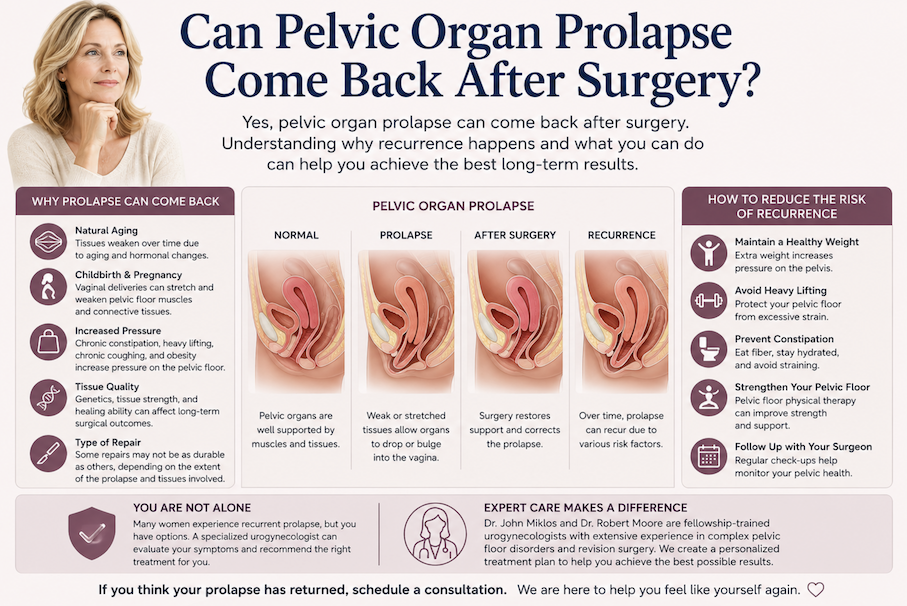
Can Pelvic Organ Prolapse Come Back After Surgery?
One of the most common questions women ask before prolapse surgery is:
“If I have surgery, can the prolapse come back?”
The honest answer is that pelvic organ prolapse can recur, but that does not mean surgery has failed.
Pelvic organ prolapse develops because the muscles, ligaments, and connective tissues supporting the pelvic organs have weakened over time. Surgery restores support and corrects the prolapse that exists today, but it cannot completely stop the natural aging process or eliminate every future stress placed on the pelvic floor.
For many women, prolapse surgery provides years of meaningful improvement in comfort, function, and quality of life.
The goal is to perform the procedure that offers the best long-term outcome based on each woman’s unique anatomy and lifestyle.
What Factors Increase the Risk of Recurrence?
Several factors may influence whether prolapse returns after surgery.
The Severity of the Original Prolapse
Women with more advanced prolapse often require more extensive reconstruction.
Although excellent results are frequently achieved, repairing severe prolapse may present greater long-term challenges than treating milder cases.
Tissue Quality
Every woman’s connective tissues are different.
Some women naturally have stronger collagen and ligament support, while others inherit connective tissues that are more prone to stretching.
Genetics plays a larger role than many people realize.
Future Aging
The pelvic floor continues to age throughout life.
Over time, natural collagen loss and reduced tissue elasticity may contribute to new pelvic floor changes, even after successful surgery.
Chronic Straining
Repeated increases in abdominal pressure place stress on the pelvic floor.
Examples include:
- Chronic constipation
- Heavy lifting
- Chronic coughing
- Obesity
- High-impact exercise in selected patients
Managing these factors when possible may help protect pelvic floor support.
Future Pregnancy
Pregnancy and vaginal childbirth place tremendous stress on the pelvic floor.
For this reason, many women choose to postpone prolapse surgery until they have completed their families.
Does the Type of Surgery Matter?
Yes.
There is no single operation that is appropriate for every woman.
The best procedure depends on:
- Which organs have prolapsed
- The severity of prolapse
- Previous pelvic surgery
- Whether the uterus is present
- Overall pelvic floor support
- Bladder and bowel function
- Your personal goals
For some women, a native tissue repair is appropriate.
Others may benefit from robotic pelvic reconstructive surgery or another advanced procedure.
Selecting the correct operation begins with understanding the entire pelvic floor—not simply repairing the most obvious prolapse.
Why Experience Can Influence Long-Term Success
Successful prolapse surgery involves much more than repositioning a pelvic organ.
The surgeon must determine:
- Which compartments require repair
- Whether multiple prolapse types are present
- If urinary incontinence should be treated simultaneously
- Whether previous childbirth injuries affect surgical planning
- Which reconstructive technique best matches the patient’s anatomy
Missing one contributing condition may leave symptoms unresolved or increase the likelihood that another compartment will become symptomatic later.
This is why experience and comprehensive evaluation are so important.
Why Women Choose Dr. John Miklos & Dr. Robert Moore
Choosing an experienced urogynecologist is one of the most important decisions a woman can make when considering prolapse surgery.
Dr. John Miklos and Dr. Robert Moore are fellowship-trained urogynecologists specializing in Female Pelvic Medicine and Reconstructive Surgery (FPMRS). Their practice is devoted exclusively to diagnosing and treating pelvic organ prolapse, urinary incontinence, childbirth-related pelvic floor injuries, vaginal laxity, and other complex pelvic floor disorders.
Their expertise includes:
- Robotic pelvic reconstructive surgery
- Vaginal prolapse repair
- Native tissue reconstruction
- Bladder prolapse (cystocele)
- Rectocele
- Uterine prolapse
- Vaginal vault prolapse
- Complex recurrent prolapse
- Revision pelvic floor surgery
Rather than recommending a standard operation for every patient, Dr. Miklos and Dr. Moore evaluate the entire pelvic floor to develop an individualized surgical plan. Their approach is designed to restore pelvic support while preserving bladder, bowel, and sexual function whenever possible.
Women travel from Atlanta, throughout Georgia, across the United States, and internationally because of their specialized expertise in treating both primary and recurrent pelvic organ prolapse with personalized, evidence-based care.
How Can You Help Protect Your Surgical Results?
While no surgery can permanently eliminate every future change in the pelvic floor, there are steps that may help support long-term pelvic health.
These include:
- Following all postoperative instructions.
- Avoiding heavy lifting during recovery.
- Treating chronic constipation.
- Managing chronic coughing.
- Maintaining a healthy weight.
- Participating in pelvic floor rehabilitation if recommended.
- Attending scheduled follow-up appointments.
These healthy habits support healing and may reduce unnecessary strain on the pelvic floor over time.
The Bottom Line
Pelvic organ prolapse surgery is designed to restore support, improve function, and help women return to the activities they enjoy with greater comfort and confidence.
Although prolapse can recur in some women, many experience durable, long-term improvement—especially when treatment begins with a comprehensive diagnosis, an individualized surgical plan, and care from a fellowship-trained urogynecologist experienced in pelvic reconstructive surgery.
If you have been diagnosed with pelvic organ prolapse or are experiencing symptoms such as a vaginal bulge, pelvic pressure, bladder problems, or bowel difficulties, a comprehensive evaluation can help determine the treatment options that are most appropriate for your individual needs.
Frequently Asked Questions About Recurrent Pelvic Organ Prolapse
1. Can pelvic organ prolapse come back after surgery?
Yes. While pelvic organ prolapse surgery is designed to restore support to the pelvic organs, no procedure can completely eliminate the possibility of recurrence. Factors such as aging, tissue quality, childbirth, chronic straining, and the type of repair performed can all influence long-term outcomes. Many women experience excellent, long-lasting results, especially when surgery is tailored to their individual anatomy and performed by a fellowship-trained urogynecologist.
2. How common is recurrent pelvic organ prolapse?
The likelihood of recurrence varies depending on the type of prolapse, the surgical technique used, tissue quality, and individual patient factors. Not every woman experiences recurrent prolapse, and recurrence does not necessarily mean the original surgery failed. A comprehensive evaluation is needed to determine the cause of new or recurring symptoms.
3. What causes pelvic organ prolapse to return?
Several factors may increase the risk of recurrence, including:
- Natural aging
- Menopause
- Weak connective tissue
- Previous vaginal childbirth
- Chronic constipation
- Heavy lifting
- Chronic coughing
- Obesity
- High-pressure activities
- Previous pelvic surgery
Because every woman is different, recurrence is often caused by a combination of factors rather than a single issue.
4. What are the signs that prolapse has returned?
Symptoms may include:
- A vaginal bulge
- Pelvic pressure or heaviness
- A feeling that something is falling out
- Difficulty emptying the bladder
- Constipation
- Lower back pressure
- Discomfort during intimacy
- Symptoms that worsen after standing or physical activity
These symptoms can also be caused by other pelvic floor disorders, making an evaluation by a urogynecologist important.
5. Can recurrent pelvic organ prolapse be treated?
Yes. Many women with recurrent prolapse can be successfully treated. Treatment depends on the type and severity of the prolapse, previous surgeries, symptoms, and overall pelvic floor health. Options may include pelvic floor physical therapy, pessary management, or revision pelvic reconstructive surgery.
6. Does robotic prolapse surgery reduce the risk of recurrence?
Robotic pelvic reconstructive surgery may be an excellent option for selected patients, but no surgical approach completely eliminates the possibility of recurrence. The best procedure depends on the type of prolapse, pelvic anatomy, previous surgeries, and your treatment goals. A fellowship-trained urogynecologist can recommend the approach most appropriate for your individual situation.
7. Can pelvic floor exercises prevent prolapse from returning?
Pelvic floor exercises can improve muscle strength, bladder control, and overall pelvic floor function. While they cannot repair weakened connective tissues or reverse recurrent prolapse, they may help support pelvic health and reduce symptoms for some women.
8. When should I see a specialist if I think my prolapse has returned?
If you notice a new vaginal bulge, increasing pelvic pressure, bladder or bowel problems, or recurring symptoms after prolapse surgery, you should schedule an evaluation. Early diagnosis often provides more treatment options and may prevent symptoms from becoming more severe.
9. Why do women seek treatment from Dr. John Miklos and Dr. Robert Moore for recurrent prolapse?
Recurrent pelvic organ prolapse can be more complex than an initial prolapse repair. Dr. John Miklos and Dr. Robert Moore are fellowship-trained urogynecologists specializing in Female Pelvic Medicine and Reconstructive Surgery (FPMRS). Their practice focuses exclusively on pelvic floor disorders, including complex and recurrent prolapse, urinary incontinence, and advanced pelvic reconstructive surgery.
Every patient receives a comprehensive pelvic floor evaluation to identify all contributing conditions before treatment recommendations are made. Their individualized approach helps ensure that treatment is based on the patient’s anatomy, symptoms, previous surgical history, and long-term goals.
10. Why choose Dr. Miklos and Dr. Moore for revision pelvic organ prolapse surgery?
Revision prolapse surgery often requires advanced knowledge of pelvic anatomy and previous reconstructive procedures. Dr. Miklos and Dr. Robert Moore have dedicated their practice to Female Pelvic Medicine and Reconstructive Surgery and provide individualized care for women with both primary and recurrent pelvic floor disorders.
Patients choose Miklos & Moore because they offer:
- Fellowship training in Female Pelvic Medicine and Reconstructive Surgery (FPMRS)
- Expertise in robotic and vaginal pelvic reconstructive surgery
- Experience treating recurrent pelvic organ prolapse
- Comprehensive pelvic floor evaluations
- Personalized treatment plans
- Advanced surgical techniques for complex pelvic floor disorders
- Care for patients traveling from across the United States and internationally
Their goal is to identify the underlying cause of recurrent symptoms and develop a treatment plan that restores pelvic support, improves function, and enhances long-term quality of life.
11. Can recurrent prolapse affect my bladder or bowel?
Yes. Recurrent prolapse may contribute to difficulty emptying the bladder, urinary leakage, urinary urgency, constipation, or incomplete bowel emptying. Because these symptoms may have multiple causes, a comprehensive evaluation is important to determine the most appropriate treatment.
12. Can I prevent pelvic organ prolapse from coming back?
While recurrence cannot always be prevented, healthy lifestyle habits may help support long-term pelvic floor health. Maintaining a healthy weight, treating chronic constipation, avoiding unnecessary heavy lifting, following postoperative instructions, participating in pelvic floor physical therapy when recommended, and attending follow-up appointments may all contribute to maintaining your surgical results.