
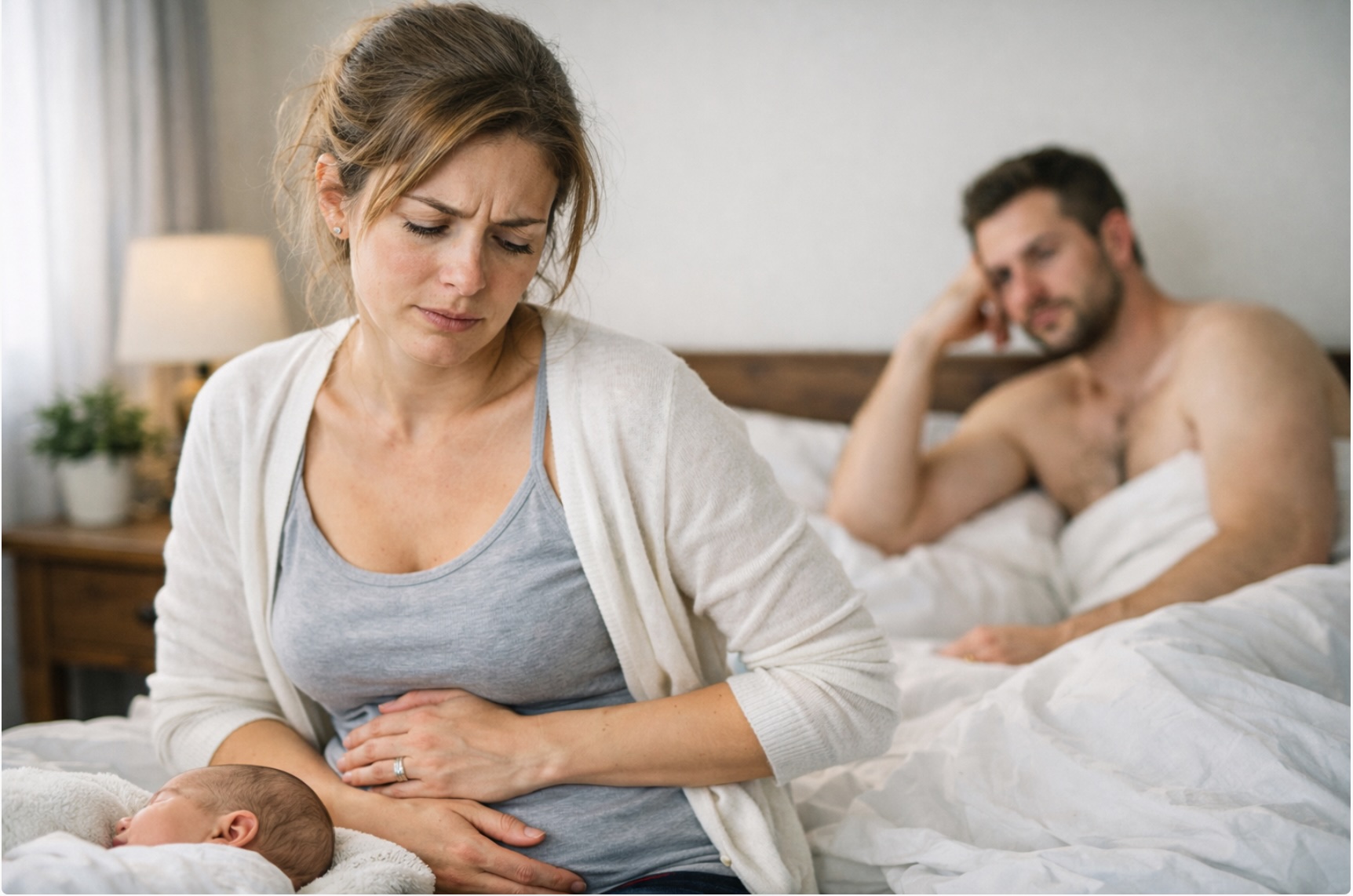
When a Mother Should Be Worried About Painful Sex After Childbirth
How to Tell Normal Healing from a Problem That Needs Medical Attention
Painful sex after childbirth is extremely common—but not all pain is normal, and not all pain should be ignored. One of the hardest parts for new mothers is knowing when to wait and when to seek help, especially when reassurance like “this happens to everyone” is so common.
Here’s the truth:
👉 Pain that improves steadily over time is usually part of healing.
Pain that persists, worsens, or feels mechanically restrictive is not.
This article explains:
- What normal postpartum discomfort looks like
- When painful sex becomes a red flag
- Entry pain vs deep pain and why it matters
- Specific symptoms that suggest something went wrong during healing
- When to seek a second opinion or specialist care
First: What Is Considered Normal After Childbirth?
In the early postpartum period, discomfort with sex can happen for several reasons:
- Healing vaginal or perineal tissue
- Temporary dryness (especially with breastfeeding)
- Pelvic floor weakness or fatigue
- Reduced lubrication or arousal early on
Normal postpartum pain usually:
- Improves month by month
- Feels sore or tender—not sharp or tearing
- Responds to time, lubrication, and gentle attempts
- Is noticeably better by 3–4 months postpartum
Short-term discomfort ≠ a problem.
When Painful Sex After Childbirth Becomes Concerning
A mother should start to be worried and seek evaluation when any of the following are true.
🚩 RED FLAG #1: Pain Lasts Longer Than 3–6 Months
If painful intercourse:
- Persists beyond 3–6 months postpartum
- Shows little or no improvement
- Feels the same—or worse—over time
- Feels like its due to obstruction or a barrier during penetration
👉 This suggests the issue is not hormonal or healing-related, but structural or functional.
🚩 RED FLAG #2: Pain Is Immediate at Penetration (Entry Pain)
Immediate pain at insertion is one of the strongest warning signs.
This often feels like:
- Burning or tearing
- Sharp pain right at the vaginal opening
- “It won’t go in”
- Pain even with full arousal and lubrication
This pattern strongly suggests:
- Over-tightened perineal repair
- Scar tissue at the vaginal opening
- Narrowing of the vaginal entrance (introital stenosis)
👉 Entry pain is not caused by anxiety or lack of desire—it is mechanical.
🚩 RED FLAG #3: Pain Was Not Present Before Childbirth
If sex was comfortable before pregnancy and childbirth—but painful afterward—this is a major clue.
Especially concerning if:
- You had perineal stitches, episiotomy, or tearing
- Pain began after the 6–8 week “clearance” visit
- You were told everything healed normally
👉 New pain after childbirth almost always has a specific cause.
🚩 RED FLAG #4: Bleeding After Sex Months Postpartum
Light spotting early postpartum can be normal.
Bleeding during or after intercourse months later is not.
Bleeding after intercourse may indicate:
- Fragile scar tissue
- Poor tissue healing
- Excess tension on repaired tissue
This should always be evaluated.
🚩 RED FLAG #5: Pelvic Exams or Tampons Are Painful
If you notice:
- Pelvic exams cause sharp pain
- Tampons are uncomfortable or difficult to insert
- Even gentle pressure causes burning
This suggests:
- Scar-related restriction
- Pelvic floor muscle guarding
- Nerve irritation
Normal healing should not make exams intolerable long-term.
🚩 RED FLAG #6: “Everything Looks Fine” — But Sex Still Hurts
This is one of the most common and frustrating experiences for mothers.
Visual exams often check:
- That tissue is closed
- That there’s no infection
But appearance ≠ function.
A vaginal opening can look healed yet be:
- Too tight
- Inelastic
- Scar-restricted
- Painful when stretched
Persistent pain despite reassurance is a reason to seek another opinion.
🚩 RED FLAG #7: Pain Triggers Fear or Muscle Clenching
When pain is persistent , the body learns to protect itself.
Signs include:
- Involuntary clenching during penetration
- Anxiety about intimacy due to pain
- Pain worsening with repeated attempts
While muscle tension can be treated, it often starts because of an underlying physical problem that needs to be addressed first.
Entry Pain vs Deep Pain: Why This Distinction Matters
Entry Pain (More Concerning Postpartum)
Most commonly linked to:
- Over-tightened perineal repair
- Scar tissue at the vaginal opening
- Narrowed introitus
This pain is:
- Immediate
- Sharp, burning, or tearing
- Mechanical
Deep Pain (Different Causes)
More often linked to:
- Pelvic floor dysfunction
- Support changes or uterine and vaginal prolapse
- Deeper scarring
Both deserve evaluation—but entry pain after childbirth is especially important to investigate early.
When Conservative Treatment Is Reasonable
Non-surgical treatment may be appropriate if:
- Pain is improving slowly
- Muscle spasm is mild
- Narrowing is minimal
This can include:
- Pelvic floor physical therapy
- Vaginal estrogen (when appropriate)
- Scar massage
- Guided dilator therapy
When Conservative Treatment Is Not Enough
If:
- Penetration is mechanically limited
- The vaginal opening feels physically too small
- Scar tissue does not stretch
- Pain does not improve after months of therapy
👉 Structural correction may be needed.
When to Seek a Specialist Opinion
A mother should seek further evaluation if:
- Pain persists beyond 6 months
- Pain is immediate at penetration
- Bleeding occurs after sex
- Pelvic exams are painful
- Sex was pain-free before childbirth
- She feels dismissed or unheard
Why Some Mothers Seek Advanced Pelvic Evaluation
Miklos & Moore
Some women seek evaluation from specialists such as Dr. John Miklos and Dr. Robert Moore because they focus on post-childbirth pelvic and vaginal function, especially in women with:
- Painful sex after delivery
- Perineal repairs that healed poorly
- Persistent entry pain
- Scar-related narrowing
They commonly evaluate women who were told:
- “This is normal after having a baby”
- “It will get better eventually”
- “Everything looks healed”
- “Your exam is normal”
Bottom Line for Mothers
💡 Trust the timeline. Trust the pattern. Trust your body.
Painful sex after childbirth becomes concerning when it:
- Lasts too long
- Starts immediately at penetration
- Does not improve
- Was not present before delivery
You do not have to accept painful intimacy as the cost of motherhood.
Early evaluation leads to better outcomes, fewer years of suffering, and a clearer path forward.