
Vaginal Mesh Complications & Insurance Coverage
Women experiencing vaginal mesh exposure, mesh erosion, mesh extrusion, pelvic or vaginal pain, painful intercourse, bleeding, recurrent infections or urinary problems after previous mesh or bladder sling surgery may benefit from a specialized evaluation. Drs. John Miklos and Robert Moore have extensive experience evaluating complex pelvic floor conditions, including complications following previous mesh, sling, prolapse and incontinence procedures.
Treatment is individualized and may include conservative care, mesh revision, partial mesh removal or more extensive mesh removal and reconstructive surgery when medically appropriate.
Because vaginal mesh complications can represent a medical condition rather than a cosmetic concern, medically necessary evaluation and treatment may be covered by insurance, including certain UMR, UnitedHealthcare, Blue Cross Blue Shield, Anthem and other commercial insurance plans.
Please call our office to schedule a consultation.
Vaginal Mesh Problems & Insurance Coverage – Mesh Exposure, Erosion, Extrusion & Pain
Women experiencing complications from previous vaginal mesh or bladder sling surgery may be dealing with exposed mesh, mesh erosion, mesh extrusion, pelvic or vaginal pain, painful intercourse, bleeding, urinary problems or other symptoms that require medical evaluation and, in some cases, corrective surgery.
An important concern for many patients is whether health insurance may help cover the cost of treating a vaginal mesh complication.
When a documented mesh complication is causing pain, exposure, erosion, bleeding, infection, urinary problems or other medically significant symptoms, evaluation and treatment may be considered medically necessary and may qualify for health insurance benefits.
Dr. John Miklos and Dr. Robert Moore evaluate and treat women with complications following previous pelvic organ prolapse, vaginal mesh and urinary incontinence sling procedures. They also provide second opinions for women who continue to experience problems following previous attempts at mesh revision or removal.
If you have been told that your mesh is exposed, eroded or extruding, or you are experiencing persistent symptoms following previous mesh surgery, a detailed evaluation can help determine the cause of the problem and what treatment options may be appropriate.
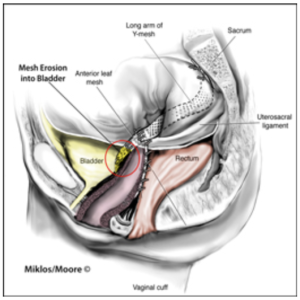
Vaginal mesh erosion into the bladder following previous pelvic reconstructive surgery.
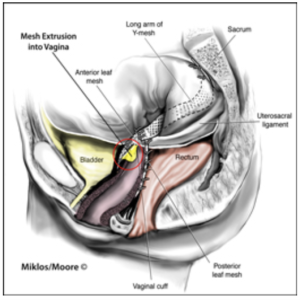
Vaginal mesh extrusion into the vagina following previous pelvic reconstructive surgery.
Insurance Coverage for Vaginal Mesh Complications
One of the first questions many patients ask is:
“Will my insurance cover vaginal mesh removal or revision surgery?”
It may.
Unlike procedures performed solely for cosmetic reasons, treatment of a documented vaginal mesh complication may be considered medically necessary when a patient is experiencing a diagnosed complication or significant symptoms.
Miklos & Moore works with patients who have insurance coverage through major health plans, including:
- UnitedHealthcare
- UMR
- Blue Cross Blue Shield (BCBS)
- Anthem Blue Cross Blue Shield
- Other commercial and employer-sponsored health insurance plans
Coverage varies according to the patient’s individual policy and benefits. Having insurance through one of these companies does not automatically mean that a consultation, diagnostic test, mesh revision or mesh removal procedure will be covered or that a particular service will be considered in-network.
However, patients should not automatically assume that treatment for a vaginal mesh complication must be paid entirely out of pocket.
When there is a documented medical complication, insurance benefits may be available for medically necessary evaluation and treatment.
Conditions and symptoms that may support medical necessity can include:
- Exposed vaginal mesh
- Mesh erosion
- Mesh extrusion or protrusion
- Persistent vaginal or pelvic pain
- Painful intercourse
- Vaginal bleeding
- Abnormal vaginal discharge
- Infection
- Recurrent urinary tract infections
- Difficulty urinating
- Bladder or urethral involvement
- Complications following previous mesh removal or revision
- Other medically significant mesh-related problems
Depending on the diagnosis and recommended treatment, insurance benefits may potentially apply to specialist evaluation, diagnostic testing, mesh revision, partial mesh removal, more extensive mesh excision and related reconstructive surgery when medically necessary.
UnitedHealthcare and UMR Coverage for Vaginal Mesh Complications
Patients with UnitedHealthcare or UMR who are experiencing vaginal mesh complications are encouraged to contact Miklos & Moore before assuming that treatment will be self-pay.
UnitedHealthcare and UMR-administered employer plans can have different benefits, networks, deductibles and authorization requirements.
Blue Cross Blue Shield and Anthem Coverage for Vaginal Mesh Complications
Patients with Blue Cross Blue Shield (BCBS) or Anthem Blue Cross Blue Shield may also have benefits for medically necessary evaluation and treatment of vaginal mesh complications.
Because Blue Cross Blue Shield plans can vary by state, employer and individual policy, benefits should be reviewed based on the patient’s specific insurance plan.
Let Our Patient Coordinators Evaluate Your Insurance Coverage
If you have health insurance and are experiencing a vaginal mesh complication, please call our office before assuming that your treatment will need to be paid entirely out of pocket.
One of our experienced patient coordinators will review your insurance information and evaluate your individual benefits to help determine whether your insurance plan may cover the evaluation and medically necessary treatment of your vaginal mesh complication.
Our patient coordinators can help determine whether your plan provides applicable benefits, whether Miklos & Moore is considered in-network or out-of-network under your particular plan, whether prior authorization may be required, and what deductible, coinsurance or other patient responsibility may apply.
This may include medically necessary treatment for conditions such as exposed vaginal mesh, mesh erosion, mesh extrusion, pelvic or vaginal pain, painful intercourse, bleeding, urinary problems, infection or complications following a previous mesh revision or removal.
Please call Miklos & Moore and speak with one of our patient coordinators. We will review your UMR, UnitedHealthcare, Blue Cross Blue Shield, Anthem or other insurance coverage and help you understand whether your plan is expected to provide benefits for your medically necessary vaginal mesh treatment and what costs, if any, may be your responsibility.
Insurance benefits and authorization can often be investigated in advance; however, verification of benefits is not a guarantee that an insurance company will ultimately authorize a particular procedure or pay a submitted claim.
What Are Vaginal Mesh Complications?
Surgical mesh has been used in different types of pelvic floor surgery, including procedures for pelvic organ prolapse and stress urinary incontinence.
It is important to distinguish between different mesh procedures. Mesh used in a midurethral sling for stress urinary incontinence is not the same procedure as transvaginal mesh previously used for pelvic organ prolapse.
Mesh can also be used abdominally or robotically during procedures such as sacrocolpopexy.
Complications can vary according to the original procedure, type and location of the mesh, previous surgeries, surrounding tissue and the individual patient.
Possible mesh-related complications include:
- Vaginal mesh exposure
- Mesh erosion
- Mesh extrusion or protrusion
- Pelvic or vaginal pain
- Pain during intercourse
- Partner discomfort during intercourse
- Vaginal bleeding or spotting
- Abnormal vaginal discharge
- Recurrent urinary tract infections
- Infection
- Scar tissue
- Urinary symptoms
- Bladder or urethral involvement
- Recurrent pelvic organ prolapse
- Complications related to previous attempts at mesh revision or removal
Some complications may be relatively localized. Others can be considerably more complex.
What Is Exposed Vaginal Mesh?
Mesh exposure generally describes a situation in which implanted mesh becomes visible or palpable through the vaginal tissue.
A woman may not realize she has exposed mesh until it is identified during a pelvic examination.
Other women may experience:
- Vaginal spotting or bleeding
- Vaginal discharge
- Vaginal irritation
- Pelvic or vaginal pain
- Pain during sexual intercourse
- A partner feeling something sharp or rough during intercourse
- Recurrent infections
The size and location of the exposure can vary considerably.
A small area of exposure does not necessarily require the same treatment as a larger or more complicated mesh problem. The patient’s symptoms, previous surgery, tissue quality and location of the mesh all need to be considered before deciding on treatment.
What Is Vaginal Mesh Erosion?
The terms mesh erosion and mesh exposure are frequently used interchangeably by patients, although physicians may use more specific terminology depending on the location of the complication.
Mesh erosion can describe mesh that has become exposed through or affected surrounding tissue.
The important question is not simply what terminology is being used. It is where the mesh is located, what structures are involved and whether it is responsible for the patient’s symptoms.
Depending on the circumstances, treatment can range from conservative management to surgical excision or removal of affected mesh.
What Is Mesh Extrusion?
Mesh extrusion generally refers to mesh protruding or extending through tissue where it was not intended to be exposed.
Patients sometimes describe the problem in very straightforward terms:
“My mesh is coming through my vagina.”
“I can feel something sharp.”
“My partner can feel the mesh during sex.”
“My doctor told me my sling or mesh is exposed.”
The terminology can be confusing, but determining exactly where the mesh is located and what effect it is having on surrounding structures is what matters clinically.
An experienced pelvic reconstructive evaluation can help determine whether the mesh is exposed, eroded, extruding, contracted, displaced or otherwise contributing to the patient’s symptoms.
Can Vaginal Mesh Cause Pelvic Pain?
Yes. Pain is a recognized complication associated with urogynecologic mesh.
Mesh-related pain can present in several ways, including:
- Vaginal pain
- Pelvic pain
- Groin pain
- Pain with sitting
- Pain with physical activity
- Pain during intercourse
- Deep pain during intercourse
- Localized tenderness
- Bladder or urinary discomfort
However, pelvic pain following mesh surgery is not always caused solely by the mesh.
Scar tissue, pelvic floor muscle dysfunction, nerve-related pain, recurrent prolapse, infection, previous surgery and other pelvic conditions can contribute to a woman’s symptoms.
For that reason, simply assuming that removing all of the mesh will automatically eliminate pain may not be appropriate.
The goal is to identify the likely source or combination of sources of the patient’s symptoms before recommending treatment.
Painful Intercourse After Vaginal Mesh Surgery
Painful intercourse, also called dyspareunia, can occur following pelvic surgery involving mesh.
Pain may result from:
- Exposed mesh
- Scar tissue
- Vaginal tenderness
- Mesh contraction
- Changes in vaginal tissue
- Pelvic floor muscle dysfunction
- Other complications from previous surgery
In some cases, the patient’s partner may also experience discomfort if exposed mesh can be felt during intercourse.
Women should not assume that persistent painful intercourse after mesh surgery is something they simply have to live with.
A detailed pelvic examination can help identify potential causes and determine whether treatment may be appropriate.
Bleeding or Vaginal Discharge After Mesh Surgery
Persistent vaginal bleeding, spotting or abnormal discharge following previous mesh surgery deserves evaluation.
These symptoms can potentially occur with vaginal mesh exposure or erosion.
A woman who underwent pelvic floor surgery years earlier may not immediately associate new vaginal bleeding or discharge with her previous operation.
Providing the physician with information about all previous prolapse, incontinence, sling and mesh procedures can therefore be very helpful during the evaluation.
Recurrent Urinary Tract Infections After Mesh Surgery
Repeated urinary tract infections can have many causes.
However, in a woman with a history of mesh or sling surgery, persistent or recurrent infections may warrant additional evaluation.
Depending on the symptoms and surgical history, additional testing may be appropriate to determine whether mesh exposure, urinary tract involvement, incomplete bladder emptying or another condition could be contributing.
How Are Vaginal Mesh Complications Diagnosed?
Evaluation begins with a detailed medical and surgical history.
Drs. Miklos and Moore will want to understand:
- What original surgery was performed
- Why the surgery was performed
- When the procedure was performed
- Whether mesh or a sling was used
- When symptoms began
- Whether additional pelvic surgeries have occurred
- Whether previous attempts have been made to remove or revise the mesh
- Current pain symptoms
- Urinary symptoms
- Sexual symptoms
- Prolapse symptoms
A careful pelvic examination is particularly important.
Depending on the patient’s symptoms and previous procedure, additional diagnostic evaluation may sometimes be recommended.
When available, patients should consider providing previous operative reports and relevant medical records.
Knowing the type and location of the original mesh can be extremely useful when planning revision surgery.
Do All Vaginal Mesh Complications Require Mesh Removal?
No.
The presence of mesh alone does not mean it should automatically be removed.
Women who have mesh and are doing well without symptoms generally do not require surgery simply because mesh is present.
Treatment should focus on the patient’s specific complication and symptoms.
Some relatively small vaginal mesh exposures may be managed conservatively in selected patients.
Other complications may require surgical treatment.
The decision can depend on:
- Location of the mesh
- Amount of mesh exposed
- Severity of symptoms
- Presence and location of pain
- Infection
- Urinary tract involvement
- Sexual symptoms
- Previous attempts at mesh removal
- Type of original surgery
- Patient’s treatment goals
Partial vs. Complete Vaginal Mesh Removal
One of the most important decisions in mesh revision surgery is determining how much mesh actually needs to be removed.
More is not automatically better.
For some patients, removing the problematic exposed portion may be appropriate.
In other situations, more extensive mesh excision may be necessary.
Mesh can become incorporated into surrounding tissue, and removing it can be technically challenging.
The objective is not simply to remove material. The objective is to address the patient’s complication while minimizing additional injury and preserving or restoring pelvic function whenever possible.
This is one reason experience with complex pelvic reconstructive and revision surgery can be important.
Can Mesh Affect the Bladder or Urethra?
Mesh or sling complications can occasionally involve structures such as the bladder or urethra.
These cases may require additional evaluation and a different surgical approach than a straightforward vaginal mesh exposure.
If urinary symptoms, recurrent infections, pain or other findings raise concern for urinary tract involvement, additional diagnostic testing may be recommended.
Treatment should be tailored to the location and extent of the problem.
What If I’ve Already Had Mesh Removal and Still Have Pain?
Some of the most challenging cases involve women who have already undergone one or more attempts at mesh revision or removal.
Persistent symptoms do not necessarily mean another surgery is automatically required.
The first step is determining why symptoms remain.
Potential causes can include:
- Residual mesh
- Scar tissue
- Pelvic floor muscle dysfunction
- Recurrent pelvic organ prolapse
- Urinary problems
- Nerve-related pain
- Sexual pain
- Changes resulting from previous surgery
- Multiple overlapping pelvic conditions
Drs. Miklos and Moore evaluate revision and second-opinion cases to determine whether additional surgical treatment is likely to provide meaningful benefit.
Vaginal Mesh Complications After Prolapse Surgery
Mesh has historically been used through different surgical approaches for pelvic organ prolapse repair.
In 2019, the FDA ordered manufacturers to stop selling surgical mesh products intended for transvaginal repair of pelvic organ prolapse in the United States.
That does not mean every use of surgical mesh in urogynecology was banned.
Mesh continues to have recognized uses in other procedures, including abdominal or robotic sacrocolpopexy, and mesh midurethral slings continue to be used for stress urinary incontinence.
Women who previously received transvaginal prolapse mesh may still develop symptoms years later.
New pelvic pain, bleeding, discharge, painful intercourse or urinary symptoms should be evaluated.
Mesh Sling Complications After Incontinence Surgery
Midurethral mesh slings have been widely used to treat stress urinary incontinence.
Although many women have successful outcomes, complications can occur.
Potential problems include:
- Vaginal mesh exposure
- Mesh erosion
- Mesh extrusion
- Pelvic or vaginal pain
- Painful intercourse
- Urinary difficulties
- Recurrent urinary infections
- Bladder or urethral complications
- Persistent or recurrent urinary incontinence
Treatment depends on the specific complication and should not be based solely on the fact that a sling was previously used.
Vaginal Mesh Revision and Second Opinions
A woman may benefit from obtaining a second opinion if she has been told she needs mesh removal, continues to experience symptoms following previous treatment or is uncertain about the treatment being recommended.
A second opinion may be particularly valuable when:
- Symptoms continue despite previous treatment
- Previous mesh removal did not resolve the problem
- Multiple pelvic surgeries have already been performed
- Complete mesh removal has been recommended
- The patient is uncertain whether surgery is necessary
- Multiple pelvic floor problems are present
- The patient wants to understand alternative treatment options
The goal of a second opinion is not automatically to recommend another operation.
It is to determine what is causing the symptoms and what treatment approach makes the most sense for that individual patient.
Traveling to Miklos & Moore for a Vaginal Mesh Complication
Complex vaginal mesh complications can lead women to seek specialized evaluation outside their immediate area, particularly after previous treatment has failed to resolve their symptoms.
Drs. Miklos and Moore evaluate patients from Georgia, throughout the Southeast, across the United States and internationally for complex pelvic floor and reconstructive conditions.
Patients traveling for an evaluation should bring or arrange to have previous operative reports, diagnostic studies and other relevant medical records available whenever possible.
Why Experience Matters in Vaginal Mesh Revision Surgery
Mesh revision and removal can be considerably different from performing the patient’s original prolapse or incontinence surgery.
Previous operations can alter normal anatomy. Scar tissue can make tissue planes more difficult to identify, and mesh may become incorporated into surrounding structures.
Dr. John Miklos and Dr. Robert Moore specialize in urogynecology, female pelvic medicine and reconstructive pelvic surgery and have extensive experience evaluating complex and previously operated pelvic floor patients.
Their approach begins by identifying the patient’s specific problem rather than assuming that every woman with mesh requires the same operation.
Frequently Asked Questions About Vaginal Mesh Complications
What does exposed vaginal mesh feel like?
Some women have no symptoms. Others may experience vaginal discomfort, spotting, discharge, pain during intercourse or a rough or sharp area in the vagina. A partner may sometimes feel exposed mesh during intercourse.
Are mesh exposure and mesh erosion the same thing?
Patients sometimes use the terms interchangeably. More precise terminology may be used to describe exactly where the mesh is exposed or has affected surrounding tissue. Determining the location and extent of the complication is more important than terminology alone.
Can mesh erosion happen years after surgery?
Yes. Mesh complications can sometimes become apparent well after the original operation. New pelvic pain, bleeding, discharge, painful intercourse or urinary symptoms in a woman with previous mesh surgery should be evaluated.
Does exposed mesh always have to be removed?
No. Treatment depends on the size and location of the exposure, symptoms, previous procedures and other individual factors. Some patients may be candidates for conservative treatment, while others require surgery.
Can vaginal mesh cause pain during sex?
Yes. Mesh exposure, scar tissue and other pelvic complications can contribute to painful intercourse.
Can mesh cause recurrent urinary tract infections?
Recurrent UTIs have many possible causes, but persistent infections following mesh or sling surgery may warrant evaluation for mesh exposure, urinary tract involvement or other problems.
Can all vaginal mesh be removed?
The appropriate extent of removal depends on the type and location of the mesh and the patient’s symptoms. Complete removal is not always necessary or appropriate.
Will removing vaginal mesh eliminate my pain?
There is no guarantee that mesh removal will eliminate pelvic pain. Pain can have multiple causes, which is why careful evaluation before surgery is important.
Does insurance cover vaginal mesh removal?
Health insurance may provide benefits for evaluation and medically necessary treatment of documented vaginal mesh complications. Coverage depends on the patient’s specific insurance plan, diagnosis, network benefits, prior authorization requirements and treatment being recommended.
Does UMR cover vaginal mesh removal?
UMR administers many employer-sponsored health plans, and benefits vary by individual plan. Patients with UMR should call Miklos & Moore so a patient coordinator can review their insurance information and help determine the applicable benefits and coverage requirements.
Does UnitedHealthcare cover vaginal mesh complications?
UnitedHealthcare plans vary. Patients should contact Miklos & Moore so one of our patient coordinators can evaluate the patient’s individual insurance benefits and help determine whether medically necessary mesh treatment is expected to be covered.
Does Blue Cross Blue Shield cover mesh removal?
BCBS plans vary considerably by state and policy. One of our patient coordinators can review the patient’s specific BCBS plan and help determine what benefits may be available for medically necessary mesh evaluation or treatment.
Do Drs. Miklos and Moore provide second opinions for vaginal mesh complications?
Yes. Miklos & Moore evaluate women with complex pelvic floor problems, including patients experiencing symptoms following previous mesh, sling, prolapse or incontinence surgery.
Schedule an Evaluation for Vaginal Mesh Complications
If you are experiencing exposed vaginal mesh, mesh erosion, mesh extrusion, pelvic or vaginal pain, painful intercourse, bleeding, discharge, recurrent urinary infections or other symptoms following previous mesh surgery, you do not have to assume that nothing can be done.
The first step is determining exactly what is causing your symptoms.
Dr. John Miklos and Dr. Robert Moore provide evaluations and second opinions for women with complex vaginal mesh and pelvic floor complications.
Treatment may range from observation or conservative management to targeted mesh revision, partial mesh removal or more extensive reconstructive surgery depending on the individual situation.
Insurance may help cover medically necessary evaluation and treatment for vaginal mesh complications. If you have UMR, UnitedHealthcare, Blue Cross Blue Shield, Anthem or another commercial insurance plan, please call Miklos & Moore and speak with one of our patient coordinators. We will review your individual insurance benefits and help determine whether your plan is expected to provide coverage for medically necessary vaginal mesh treatment and what costs, if any, may be your responsibility.
Contact Miklos & Moore to schedule an evaluation for vaginal mesh complications and have one of our patient coordinators evaluate your insurance benefits.