
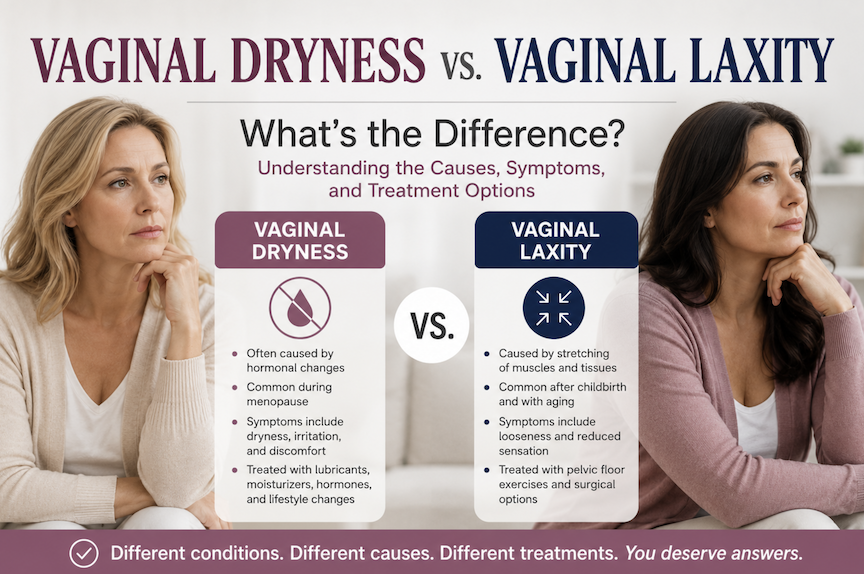
Vaginal Dryness vs. Vaginal Laxity: What’s the Difference?
Understanding Two Common Conditions That Are Often Confused
Many women notice changes in their vaginal health after childbirth, during menopause, or as they get older.
Some experience discomfort during intercourse.
Others notice reduced sensation.
Some describe a feeling of vaginal looseness.
Others struggle with burning, irritation, or dryness.
Because these symptoms often occur around the same time, many women assume they are all caused by the same problem.
In reality, vaginal dryness and vaginal laxity are two very different conditions.
Although they can occur together, they affect different tissues, cause different symptoms, and often require different treatments.
Understanding the difference is one of the most important steps toward finding the treatment that’s right for you.
At Miklos & Moore, Dr. John Miklos and Dr. Robert Moore frequently evaluate women who believe they have only one problem, only to discover that several conditions are contributing to their symptoms. As fellowship-trained urogynecologists specializing in Female Pelvic Medicine and Reconstructive Surgery (FPMRS), they perform a comprehensive pelvic floor evaluation to determine whether symptoms are related to hormonal changes, vaginal laxity, pelvic organ prolapse, childbirth injuries, or a combination of factors. This individualized approach helps ensure that treatment addresses the underlying cause rather than simply masking symptoms.
Why Women Often Confuse These Conditions
Vaginal dryness and vaginal laxity frequently develop during similar stages of life.
For example, many women begin noticing symptoms:
- After childbirth
- During perimenopause
- After menopause
- As part of the natural aging process
Because these changes often occur together, it’s easy to assume they have the same cause.
However, they involve different parts of the body.
Vaginal dryness is primarily related to changes in the vaginal lining and natural lubrication.
Vaginal laxity involves the muscles, connective tissues, and support structures of the pelvic floor.
Treating one condition does not necessarily correct the other.
What Is Vaginal Dryness?
Vaginal dryness occurs when the vaginal tissues produce less natural lubrication.
The most common cause is declining estrogen levels during menopause, although other factors may contribute.
Women with vaginal dryness often describe:
- Burning
- Irritation
- Itching
- Pain during intercourse
- A feeling of friction
- Increased sensitivity
- Recurrent urinary tract infections
- General discomfort throughout the day
Many women notice that symptoms become more pronounced during intimacy because the tissues no longer produce the lubrication they once did.
What Causes Vaginal Dryness?
The most common causes include:
Menopause
As estrogen levels decline, the vaginal tissues naturally become thinner, drier, and less elastic.
Breastfeeding
Temporary hormonal changes following childbirth can reduce estrogen levels and contribute to vaginal dryness.
Certain Medications
Some medications may reduce natural lubrication as a side effect.
Cancer Treatments
Chemotherapy and certain hormone-blocking therapies may also affect vaginal tissue health.
Natural Aging
Even women who have not yet reached menopause may notice gradual changes in lubrication as they age.
What Is Vaginal Laxity?
Vaginal laxity is a completely different condition.
Rather than involving lubrication, vaginal laxity affects the muscles and connective tissues that support the vagina.
It most commonly develops following:
- Vaginal childbirth
- Pelvic floor injury
- Aging
- Menopause
- Connective tissue weakening
Women with vaginal laxity frequently describe:
- A loose feeling
- Less tightness during intercourse
- Reduced sensation
- A wider vaginal opening
- Vaginal air during exercise or intimacy
- Reduced pelvic support
Unlike vaginal dryness, vaginal laxity is primarily a structural condition.
What Causes Vaginal Laxity?
Several factors may contribute.
Childbirth
By far the most common cause.
Pregnancy and vaginal delivery stretch the muscles, ligaments, and connective tissues supporting the pelvic floor.
Aging
Natural collagen loss gradually affects the strength and elasticity of supportive tissues.
Menopause
Although menopause itself does not usually cause the dramatic stretching associated with childbirth, hormonal changes may reduce tissue elasticity and make existing pelvic floor weakness more noticeable.
Pelvic Floor Injury
Muscle injuries, connective tissue damage, and injury to the perineal body may all contribute to vaginal laxity.
Comparing the Symptoms
Although these conditions may occur together, their symptoms are often quite different.
| Vaginal Dryness | Vaginal Laxity |
| Burning | Loose feeling |
| Irritation | Reduced tightness |
| Itching | Less sensation |
| Pain from friction | Wider vaginal opening |
| Reduced lubrication | Vaginal air during exercise or intercourse |
| Thin tissues | Pelvic floor weakness |
Recognizing these differences helps women understand why one treatment may work well for one condition but not for the other.
Why Proper Diagnosis Is Essential
One of the biggest mistakes women make is assuming that every vaginal symptom is caused by menopause.
While menopause certainly affects vaginal health, many women also have childbirth-related injuries, pelvic organ prolapse, pelvic floor muscle weakness, or vaginal laxity that require a different treatment approach.
This is why a comprehensive pelvic floor evaluation is so important.
Rather than focusing on a single symptom, Dr. John Miklos and Dr. Robert Moore evaluate the entire pelvic floor to identify every factor contributing to a woman’s concerns.
Only after understanding the complete picture can the most appropriate treatment plan be developed.
Can You Have Both Vaginal Dryness and Vaginal Laxity?
Yes—and many women do.
This is one of the reasons women often become frustrated when they search online for answers.
A woman may begin using lubricants because she believes vaginal dryness is causing all of her symptoms.
Another woman may think she needs vaginal rejuvenation surgery when her primary concern is actually hormone-related tissue changes.
In reality, both conditions commonly occur together, particularly after menopause.
For example, a woman may experience:
- Vaginal dryness from declining estrogen
- Vaginal laxity from childbirth decades earlier
- Mild pelvic floor weakness
- Early pelvic organ prolapse
Because several conditions may exist simultaneously, successful treatment often requires addressing more than one problem.
How Are These Conditions Diagnosed?
The first step is understanding what is actually causing your symptoms.
During your consultation, your physician will ask questions such as:
- When did your symptoms begin?
- Did they start after childbirth or menopause?
- Is intercourse painful or simply different?
- Do you experience burning or irritation?
- Do you notice vaginal looseness?
- Have you developed bladder leakage?
- Do you feel pelvic pressure or a vaginal bulge?
A comprehensive pelvic examination may evaluate:
- Vaginal tissue health
- Natural lubrication
- Vaginal elasticity
- Pelvic floor muscle strength
- The perineal body
- Pelvic organ support
- Signs of pelvic organ prolapse
- Childbirth-related injuries
- Previous scar tissue
This detailed assessment helps determine whether your symptoms are hormonal, structural, or caused by a combination of both.
Treatment for Vaginal Dryness
When symptoms are primarily related to reduced estrogen and thinning of the vaginal tissues, treatment may focus on improving tissue health and comfort.
Depending on your medical history and individual needs, options may include:
- Vaginal moisturizers
- Personal lubricants
- Local vaginal estrogen therapy (when appropriate)
- Other prescription therapies recommended by your physician
- Lifestyle modifications
The goal is to improve lubrication, tissue quality, and comfort during daily activities and intimacy.
Because every woman is different, treatment should always be individualized after discussing the potential benefits and risks with your healthcare provider.
Treatment for Vaginal Laxity
Treatment for vaginal laxity depends on the severity of the structural changes and their impact on your quality of life.
Some women benefit from conservative treatment, including:
- Pelvic floor physical therapy
- Pelvic floor muscle exercises
- Lifestyle modifications
When significant structural changes are present, surgical treatment may be considered.
Depending on the findings of your examination, treatment may include:
- Perineoplasty
- Vaginoplasty
- Pelvic organ prolapse repair
- Combination reconstructive procedures
The goal is not simply to tighten tissue, but to restore normal anatomy, improve support, and address the underlying cause of your symptoms.
Why the Correct Diagnosis Matters
Treating vaginal dryness alone will not repair stretched muscles or weakened pelvic support.
Likewise, surgery for vaginal laxity will not correct symptoms caused primarily by hormonal changes affecting the vaginal tissues.
Choosing the wrong treatment may leave women wondering why their symptoms persist despite receiving care.
This is why an accurate diagnosis is the foundation of successful treatment.
Understanding whether your symptoms are caused by hormonal changes, structural changes, or both allows your physician to recommend the most effective treatment plan.
Why Women Choose Dr. John Miklos & Dr. Robert Moore
Many women arrive believing they have a single problem.
After a comprehensive evaluation, they often discover that their symptoms involve several different conditions requiring a coordinated treatment plan.
Dr. John Miklos and Dr. Robert Moore are fellowship-trained urogynecologists specializing in Female Pelvic Medicine and Reconstructive Surgery (FPMRS). Their practice focuses exclusively on diagnosing and treating pelvic floor disorders, childbirth-related injuries, vaginal laxity, pelvic organ prolapse, urinary incontinence, and cosmetic vaginal concerns.
Rather than treating symptoms in isolation, they evaluate the entire pelvic floor to determine how hormones, childbirth, aging, connective tissue support, and pelvic anatomy all contribute to a woman’s concerns.
Their expertise includes:
- Vaginal laxity
- Vaginal rejuvenation
- Perineoplasty
- Vaginoplasty
- Pelvic organ prolapse
- Pelvic reconstructive surgery
- Childbirth-related pelvic floor injuries
- Revision surgery
Every patient receives an individualized treatment plan based on her anatomy, symptoms, medical history, and personal goals.
Women travel from Atlanta, throughout Georgia, across the United States, and internationally because they are seeking surgeons with specialized expertise in both reconstructive pelvic surgery and cosmetic gynecology who take the time to understand the complete picture—not just one symptom.
Why Many Women Delay Seeking Help
Unfortunately, many women assume these symptoms are simply something they have to live with.
Some feel embarrassed to discuss intimacy.
Others believe vaginal changes are an unavoidable part of childbirth or menopause.
The truth is that many of these concerns can be evaluated, explained, and, in many cases, treated.
Whether your symptoms are caused by vaginal dryness, vaginal laxity, pelvic organ prolapse, or a combination of conditions, seeking an evaluation is the first step toward understanding your options and making informed decisions about your care.