
When Vaginal Depth Causes Pain or Difficulty With Intercourse
Some women experience pain or difficulty with deep penetration, particularly after hysterectomy, prolapse repair, or other pelvic surgery. A partner may also notice a change in vaginal depth that was not present before.
These symptoms can have several causes, including postsurgical vaginal shortening, scar tissue, pelvic floor dysfunction, menopause-related tissue changes, or congenital anatomy. Determining the underlying cause is important because treatment can range from pelvic floor therapy or vaginal dilators to specialized reconstructive surgery.
Dr. John Miklos and Dr. Robert Moore have extensive experience evaluating complex vaginal problems, including women with surgically shortened vaginas following previous pelvic or vaginal surgery.
For women experiencing new pain with deep penetration or a noticeable loss of vaginal depth, a specialized evaluation can help identify the cause and appropriate treatment options.
Why Does My Vagina Feel Too Shallow or Not Deep Enough?
Some women describe their vagina as feeling too shallow, too short, or not deep enough, particularly during sexual intercourse. A partner may feel as though he is “hitting the end” of the vagina, deep penetration may cause pain, or intercourse that was previously comfortable may suddenly become difficult.
These symptoms can be frustrating, particularly when a woman has been told that her examination is normal or that nothing can be done.
A vagina that feels too shallow does not always mean that the vaginal canal is anatomically too short. However, in some women, true vaginal shortening can occur, especially after hysterectomy, pelvic reconstructive surgery, prolapse surgery, radiation therapy, or multiple previous vaginal surgeries.
Determining why the vagina feels too shallow is the first step toward finding the appropriate treatment.
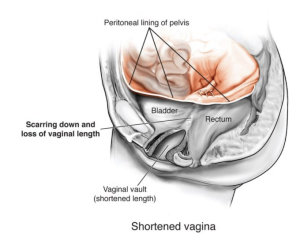
Illustration showing vaginal vault scarring and loss of vaginal length that can contribute to a shortened or shallow vaginal canal.
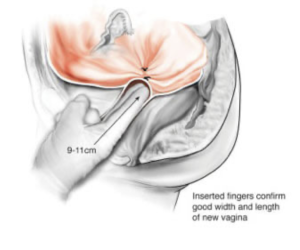
Illustration demonstrating vaginal depth following reconstructive vaginal lengthening, with approximately 9–11 cm of vaginal length.
Is My Vagina Actually Too Short?
There is considerable natural variation in vaginal anatomy, and vaginal length alone does not determine sexual function.
The vagina is also a flexible structure. Its dimensions can change with sexual arousal, hormonal status, pelvic floor muscle activity, previous childbirth, aging, menopause, and surgery.
For this reason, a woman who feels that her vagina is not deep enough does not necessarily have an abnormally short vagina.
The more important questions are:
- Has intercourse always felt this way, or is this a new problem?
- Did the symptoms begin after hysterectomy or another pelvic surgery?
- Is there pain specifically with deep penetration?
- Does a partner describe feeling as though he is hitting the end of the vagina?
- Has intercourse become more difficult than it was previously?
- Is there vaginal scarring or narrowing?
- Has the woman undergone previous prolapse, mesh, cancer, or vaginal reconstructive surgery?
These details can help distinguish an anatomical problem involving vaginal length from other causes of painful or difficult intercourse.
Why Does My Partner Feel Like He Is Hitting the End of My Vagina?
This is a surprisingly important description.
Women with a shortened vagina may report pain with deep thrusting, while their partners may describe hitting an obstruction or reaching the end of the vaginal canal much sooner than expected.
When this begins after pelvic surgery, vaginal shortening should be considered as one possible explanation.
However, pain with deep penetration can have other causes. Pelvic floor muscle dysfunction, scar tissue, tenderness at the vaginal apex, endometriosis, pelvic adhesions, prolapse, hormonal changes, and other gynecologic conditions can sometimes produce similar symptoms.
A careful pelvic examination is therefore important before assuming that vaginal length is the problem.
Can a Hysterectomy Make the Vagina Shorter?
Yes. Vaginal shortening can occur following hysterectomy in some patients.
During a hysterectomy in which the cervix is removed, the upper portion of the vagina is closed to create what is commonly called the vaginal cuff or vaginal apex.
Most women heal without developing a significant problem with vaginal length. However, vaginal shortening can occur in certain circumstances, particularly when surgery involves extensive tissue removal, scarring, repeated operations, prolapse repair, radiation, or complications from previous pelvic surgery.
A woman may notice that intercourse feels different following surgery, particularly if she develops pain with deep penetration that did not exist before the operation.
Other Surgeries That May Contribute to Vaginal Shortening
Vaginal shortening is not limited to hysterectomy.
It can potentially occur following procedures involving the vaginal canal or vaginal apex, including:
- Vaginal prolapse repair
- Anterior vaginal repair
- Posterior vaginal repair
- Enterocele repair
- Vaginal vault suspension
- Sacrospinous ligament suspension
- Bladder suspension procedures
- Vaginal mesh surgery
- Cancer surgery
- Multiple previous vaginal operations
Radiation treatment involving the pelvis can also result in significant vaginal scarring and narrowing.
The risk and severity vary considerably from patient to patient.
Can Scar Tissue Make the Vagina Feel Shallow?
Yes.
Scar tissue can affect both the length and flexibility of the vagina.
Following surgery, radiation, trauma, or significant inflammation, scar tissue may form within the vaginal canal or near the vaginal apex. In some women, this can produce narrowing, tight bands of tissue, loss of elasticity, pain, or an apparent reduction in vaginal depth.
This is one reason simply measuring vaginal length does not always tell the entire story.
A vagina may technically have adequate length but still be painful or functionally restricted because of scarring or pelvic floor dysfunction.
Can You Be Born With a Short Vagina?
Yes. Congenital differences in vaginal development can result in a shortened or absent vaginal canal.
One of the best-known conditions is Mayer-Rokitansky-Küster-Hauser syndrome (MRKH), in which the vagina and uterus do not develop normally before birth.
The situation is very different from a woman who previously had a normal-length, functional vagina that became shortened following surgery.
Distinguishing between a congenital short vagina and an acquired or surgically shortened vagina is important because treatment recommendations may differ.
Does Menopause Make the Vagina Shorter?
Menopause can produce changes that make the vagina feel tighter, less flexible, or less comfortable, although this is not necessarily the same as severe anatomical shortening caused by surgery.
Declining estrogen levels can contribute to vaginal dryness, thinning of vaginal tissue, decreased elasticity, irritation, and discomfort with intercourse.
For some women, these changes can create the sensation that penetration is more difficult or that the vagina is smaller.
This is another reason an accurate diagnosis matters. Treating menopausal vaginal changes is very different from surgically reconstructing a genuinely shortened vaginal canal.
Can Pelvic Floor Muscles Make the Vagina Feel Too Short?
They can contribute to the sensation.
Pelvic floor muscles surround and support the vaginal canal. If these muscles are excessively tight, painful, or poorly coordinated, penetration may become uncomfortable and a woman may perceive the vagina as being smaller or shallower than it actually is.
Pelvic floor dysfunction can also coexist with a structural problem.
For appropriate patients, pelvic floor physical therapy may therefore be considered before surgery or as part of a broader treatment plan.
How Is a Short or Shallow Vagina Evaluated?
Evaluation should begin with a detailed medical and surgical history.
For women whose symptoms developed after surgery, knowing exactly which procedures were performed can be particularly important.
A pelvic examination can then assess:
- Vaginal depth and length
- Location of the vaginal apex
- Areas of tenderness
- Vaginal scarring
- Narrowing or stenosis
- Pelvic floor muscle tenderness
- Vaginal prolapse
- Previous surgical repairs
- Vaginal tissue quality
The objective is not simply to obtain a measurement. It is to determine what is causing the patient’s symptoms.
Can Vaginal Dilators Help a Vagina That Is Not Deep Enough?
Vaginal dilators can be helpful for certain patients.
They may be considered when narrowing, muscle tightness, postoperative healing, radiation changes, or other conditions contribute to difficulty with penetration.
Pelvic floor physical therapy and vaginal massage may also be appropriate in selected cases.
However, a severely shortened vagina caused by removal, fixation, or extensive scarring of vaginal tissue may not respond sufficiently to dilation alone.
This is where determining the underlying anatomy becomes particularly important.
Can a Short Vagina Be Surgically Lengthened?
In selected patients, vaginal lengthening surgery is possible.
Dr. John Miklos and Dr. Robert Moore have used the laparoscopic Davydov technique to restore vaginal length in women with surgically shortened vaginas as well as to create a vaginal canal in women with vaginal agenesis.
The Davydov technique uses the patient’s own pelvic peritoneum—the natural tissue lining the abdominal and pelvic cavity—to create or extend the vaginal canal.
For women with acquired vaginal shortening, the objective is not cosmetic enlargement. The goal is to restore sufficient functional vaginal depth while addressing pain and allowing comfortable sexual intercourse when possible.
Miklos & Moore’s Experience With Surgically Shortened Vaginas
Dr. Miklos and Dr. Moore have extensive experience in complex vaginal and pelvic reconstructive surgery, including patients who have undergone multiple previous operations.
Their experience with vaginal lengthening is particularly relevant because women with surgically shortened vaginas are relatively uncommon and may have difficulty finding a surgeon familiar with reconstructive options.
Drs. Miklos and Moore have also published a medical case report describing the use of the laparoscopic Davydov procedure to restore vaginal length in a woman who developed severe vaginal shortening following multiple previous vaginal surgeries.
In another documented Miklos & Moore patient experience, a woman suffering from deep pain with intercourse following hysterectomy was found to have a vaginal length of approximately 5 cm. Following vaginal lengthening surgery, her vaginal length measured approximately 9.5 cm, and she reported a substantial reduction in pain.
These cases demonstrate an important point: a surgically shortened vagina is a real anatomical complication, and reconstructive options may exist even when a patient has previously been told that nothing can be done.
When Should You Seek a Second Opinion?
A second opinion may be particularly valuable when:
- Intercourse became painful after hysterectomy or pelvic surgery
- Your vagina feels noticeably shorter than it did before surgery
- Your partner feels that he is hitting the end of the vagina
- Deep penetration causes significant pain
- You have been told that vaginal shortening cannot be corrected
- Dilators or pelvic floor therapy have not resolved the problem
- You have undergone several previous vaginal surgeries
- You have significant vaginal scarring
- A previous vaginal reconstruction or lengthening procedure failed
Complex vaginal reconstruction is a highly specialized area of pelvic surgery. Experience becomes especially important when normal anatomy has been altered by previous operations, scar tissue, mesh, radiation, or failed reconstruction.
A Shallow-Feeling Vagina Does Not Always Require Surgery
Perhaps the most important point is that feeling as though the vagina is too shallow does not automatically mean vaginal lengthening surgery is necessary.
Some women have normal vaginal anatomy but experience symptoms from pelvic floor dysfunction, menopause-related tissue changes, scar sensitivity, or another source of pelvic pain.
Others have genuine anatomical shortening that may require a completely different approach.
The treatment should match the cause.
For women experiencing a vagina that feels too short or not deep enough—particularly when symptoms developed after hysterectomy, prolapse repair, or previous vaginal surgery—a specialized evaluation can help determine whether the problem involves vaginal length, scar tissue, pelvic floor dysfunction, or another condition.
Consultation for a Short or Shallow Vagina
Dr. John Miklos and Dr. Robert Moore specialize in Female Pelvic Medicine and Reconstructive Surgery and have extensive experience evaluating complex vaginal problems, including surgically shortened and scarred vaginal canals.
Women travel to Miklos & Moore Urogynecology for evaluation of difficult or previously treated vaginal conditions, including patients seeking second opinions after previous pelvic or vaginal surgery.
If your vagina feels too shallow, too short, or not deep enough, or intercourse has become painful because your partner seems to be hitting the end of the vaginal canal, a comprehensive evaluation can help determine the cause and whether nonsurgical treatment or vaginal reconstruction should be considered.
Request a confidential consultation with Dr. Miklos or Dr. Moore to discuss your symptoms and available treatment options.
Frequently Asked Questions
Why does my vagina feel too shallow?
A vagina can feel shallow because of actual vaginal shortening, scar tissue, pelvic floor muscle tightness, menopause-related changes, previous surgery, or other pelvic conditions. An examination is necessary to determine the cause.
How do I know if my vagina is too short?
Symptoms alone cannot determine vaginal length. A pelvic examination can measure the vaginal canal and evaluate the vaginal apex, scar tissue, pelvic floor muscles, and other potential causes of painful penetration.
Why does my partner hit the end of my vagina?
A partner may normally contact the upper vagina during deep penetration. However, if this suddenly begins after hysterectomy or another pelvic surgery and causes pain, vaginal shortening or tenderness at the vaginal apex may need to be evaluated.
Can hysterectomy cause a shallow vagina?
Vaginal shortening can occur after hysterectomy in some women, particularly when combined with extensive pelvic surgery, prolapse repair, scarring, radiation, or multiple previous operations.
Can a short vagina cause painful sex?
Yes. Significant vaginal shortening can cause pain with deep penetration and, in severe cases, make intercourse difficult or impossible.
Can vaginal dilators make the vagina deeper?
Dilators may help certain types of vaginal narrowing, tightness, postoperative scarring, or pelvic floor dysfunction. They may not adequately correct severe anatomical shortening in every patient.
Is there surgery to make the vagina deeper?
Yes. Vaginal lengthening or neovagina procedures can be considered for appropriately selected patients with significant vaginal shortening. The appropriate procedure depends on the patient’s anatomy, previous surgeries, scarring, and underlying cause.
Can a vagina be lengthened after hysterectomy?
In selected patients with significant postsurgical vaginal shortening, vaginal length may be surgically restored. Drs. Miklos and Moore have used the laparoscopic Davydov technique for patients with surgically shortened vaginas.
Should I get a second opinion for a shortened vagina?
A second opinion can be particularly valuable when symptoms are severe, previous treatments have failed, multiple surgeries have altered the anatomy, or you have been told that no treatment options are available.