
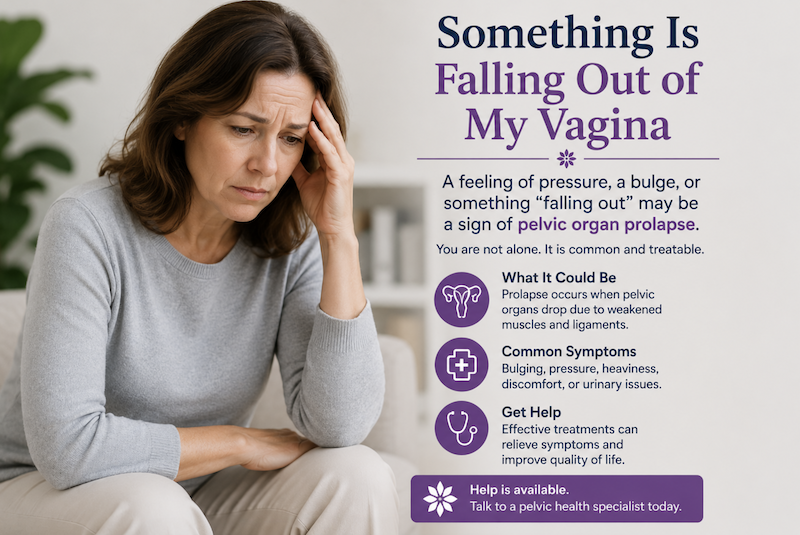
Why Does It Feel Like Something Is Falling Out of My Vagina? Causes, Symptoms, and What to Do
If you’ve ever had the unsettling sensation that something is “falling out” of your vagina, you’re not alone—and you’re not imagining it.
This is one of the most common early symptoms women search for online, yet it’s often misunderstood, dismissed, or misdiagnosed.
Patients rarely use medical terms like “pelvic organ prolapse.” Instead, they describe what they feel:
- “It feels like something is dropping”
- “There’s pressure down there”
- “I feel a bulge”
- “Something doesn’t feel right when I stand”
These descriptions are often the body’s way of signaling a structural pelvic floor issue—most commonly pelvic organ prolapse.
The key is understanding what’s actually happening, how to evaluate it, and what your options are.
What Does This Sensation Really Mean?
The feeling that something is falling out is typically caused by loss of support in the pelvic floor.
The pelvic floor is a complex system of:
- Muscles
- Ligaments
- Connective tissue known as fascia
These structures act like a hammock, holding your pelvic organs in place:
- Bladder
- Uterus
- Rectum
- Urethra
- Vaginal walls
When this support weakens or stretches, organs can begin to shift downward under gravity, creating:
- Pressure
- Fullness
- A bulging sensation
- The feeling of “something coming down”
The Most Common Cause: Pelvic Organ Prolapse
Pelvic organ prolapse is the leading cause of this sensation.
It occurs when one or more pelvic organs descend into the vaginal canal due to weakened support structures.
Types of Prolapse
- Cystocele (Bladder prolapse):
Pressure, urinary leakage, frequent urination - Rectocele:
Difficulty with bowel movements, a bulge in the vaginal floor - Uterine prolapse:
Central heaviness, noticeable descent - Urethrocele
- Heaviness under the urethral opening coming from the ceiling of the vagina
- Vaginal vault prolapse:
Occurs after hysterectomy
What Prolapse Actually Feels Like (Real Patient Descriptions)
Patients often describe:
- “A tampon falling out” feeling
- “A ball or bulge down there”
- “Heaviness by the end of the day”
- “Relief when I lie down”
That last point is critical.
Standing vs Lying Down: The Most Important Clue
One of the strongest indicators of prolapse is how symptoms change with position:
- Worse when standing, walking, or lifting
- Better or gone when lying down
Why?
Gravity pulls organs downward when support is weakened.
Other Causes That Can Mimic This Feeling
While prolapse is most common, other conditions may create similar sensations:
- Vaginal Laxity
- Feeling of looseness
- No true bulge
- Often after childbirth
- Pelvic Floor Weakness
- General pressure
- Early-stage support issues
- Postpartum Changes
- Temporary swelling or tissue laxity
- May resolve—or progress
- Vaginal Cysts or Masses (Less Common)
- Usually firm
- Localized
At-Home Self-Assessment: Do You Likely Have Prolapse?
While only a specialist can diagnose prolapse, this quick self-check is helpful:
✔️ Ask Yourself:
- Do I feel pressure or heaviness in my pelvis?
- Do symptoms worsen throughout the day?
- Do I feel or see a bulge?
- Do symptoms improve when I lie down?
- Do tampons feel like they won’t stay in?
- Do I have discomfort or pain during intercourse?
- Does my tampon stay in place during menses
- Lower back pain as the day progresses
- Can I feel my cervix on self-examination
Your Score:
- 0–1 symptoms → unlikely prolapse
- 2–3 symptoms → possible early prolapse
- 4+ symptoms → likely prolapse
Anatomy: What’s Actually Happening Inside
As support structures weaken:
- The bladder may fall into the vaginal canal due to a broken support system in the vaginal ceiling
- The uterus may descend downward
- The rectum may bulge upward into the vaginal canal due to a broken support system in vaginal floor
This creates the sensation patients describe.
A Critical (Often Ignored) Symptom: Pain During Sex
Many women don’t connect this feeling with pain during intercourse—but they’re often related.
Collision Dyspareunia
This refers to deep pain during deep penetration, caused by:
- Altered vaginal length or angle
- Organs shifting usually the uterus into the path of penetration
- Loss of structural support of the uterus
This is frequently misdiagnosed or ignored—but it’s a key clue.
What Many Women Are Told (And Why It’s Incomplete)
Patients are often told:
- “It’s normal after kids”
- “It’s just aging”
- “Do Kegels”
While these statements may contain some truth, they often miss the bigger picture.
Prolapse is not just a “muscle issue”—it’s a structural support problem.
Do Kegels Fix This Feeling?
Kegels can:
- Strengthen muscles
- Improve mild symptoms
But they do NOT reposition organs once prolapse becomes moderate or severe. Vaginal prolapse are essentially vaginal hernias, just like an umbilical hernia muscle exercises will never fix the broken support system
This is one of the biggest misconceptions.
When Should You See a Specialist?
You should seek evaluation if:
- The sensation is persistent
- You feel a visible or palpable bulge
- You have pain during intercourse
- You have urinary or bowel symptoms
- Your quality of life is affected
Why Expertise Matters (More Than Most People Realize)
Not all prolapse evaluations are the same.
Accurate diagnosis requires:
- Identifying all compartments involved
- Understanding functional symptoms
- Evaluating prior surgeries
Specialists like Miklos and Moore Urogynecology focus on:
- Complex and multi-compartment prolapse
- Failed prior repairs
- Sexual function preservation
- Advanced surgical techniques
This level of expertise can significantly impact outcomes.
Treatment Options: What Are Your Choices?
Non-Surgical Options
- Pelvic floor therapy
- Pessary devices
- Do nothing a live with the condition
Surgical Options
- Native tissue repair
- Hysteropexy (uterus-preserving)
- Reconstructive surgery
Treatment is highly individualized.
Is This Dangerous?
Most prolapse is not life-threatening, but it can:
- Progress over time
- Affect bladder and bowel function
- Impact sexual health
- Reduce quality of life
Final Takeaway
If it feels like something is falling out of your vagina, your body is sending a signal.
- It is not something to ignore
It is not “just aging”
And it is often treatable with the right care
Next Step: Get Clarity
The most important step is understanding exactly what’s happening.
A proper evaluation can:
- Confirm or rule out prolapse
- Identify the type and severity
- Provide clear treatment options