
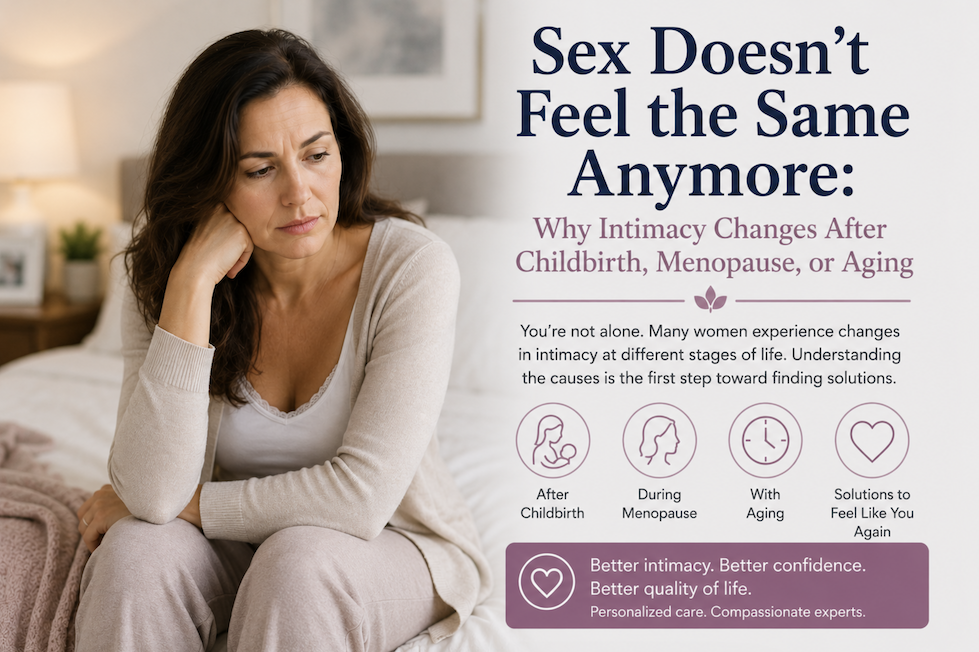
Sex Doesn’t Feel the Same Anymore: Why Intimacy Changes After Childbirth, Menopause, or Aging
“I don’t know how to explain it… sex just doesn’t feel the same anymore.”
For many women, this is one of the hardest conversations they’ll ever have.
Some are afraid to mention it because they think it’s simply part of getting older.
Others worry their partner will think they’re no longer interested in intimacy.
Many blame themselves.
The truth is that changes during sex are incredibly common, especially after childbirth and during menopause. Yet because these conversations can feel embarrassing, countless women live with symptoms for years without realizing that there may be an explanation—and, in many cases, a solution.
If intimacy doesn’t feel the way it once did, your body may be trying to tell you something important. The challenge is that many different pelvic conditions can create similar symptoms, which is why an accurate diagnosis is so valuable.
What Do Women Mean When They Say “It Doesn’t Feel the Same”?
Every woman experiences this differently.
Some describe:
“I don’t feel as much.”
Others say:
“Everything feels looser.”
Some explain:
“It hurts now.”
Others notice:
“I just don’t enjoy it anymore.”
Still others say:
“I feel pressure during sex.”
These are all legitimate concerns.
However, none of them automatically point to a single diagnosis.
Childbirth Can Change Intimacy
One of the most common reasons women notice changes during sex is vaginal childbirth.
Delivery can affect:
- Pelvic floor muscles
- Connective tissues
- The vaginal opening
- Perineal tissues
- Scar tissue formation
- Pelvic support
Some women recover completely.
Others notice lasting changes that affect intimacy long after their baby is born.
That doesn’t mean something went wrong.
It means your body experienced one of the most physically demanding events it will ever undergo.
Vaginal Laxity May Be One Explanation
When tissues stretch beyond their ability to fully recover, some women experience vaginal laxity.
Women often describe this as:
- Feeling less friction
- Feeling wider
- Feeling less muscle support
- Reduced sensation
- Less confidence during intimacy
Not every woman with vaginal laxity requires surgery.
Some improve with pelvic floor rehabilitation, while others benefit from reconstructive procedures designed to restore anatomy and support.
Pain During Sex Isn’t Normal Just Because You’ve Had Children
Many women assume painful intercourse is simply part of motherhood or aging.
It isn’t.
Pain may result from:
- Scar tissue
- Vaginal dryness
- Hormonal changes
- Pelvic floor muscle tension
- Childbirth injuries
- Pelvic organ prolapse
- Endometriosis
- Other gynecologic conditions
Treating pain begins by understanding why it occurs.
Simply avoiding intimacy doesn’t solve the underlying problem.
Menopause Can Affect More Than Hormones
Hormonal changes influence nearly every tissue in the pelvis.
Reduced estrogen may contribute to:
- Vaginal dryness
- Less elasticity
- Tissue thinning
- Increased sensitivity
- Burning
- Discomfort during intercourse
Many women assume surgery is the answer when hormonal treatment may actually provide significant improvement.
Others assume hormones are responsible when structural changes are the real issue.
Again, diagnosis comes first.
Sometimes It’s Not the Vagina
This surprises many patients.
The discomfort or changes you’re experiencing during intimacy may actually originate from:
- Pelvic floor muscles
- Bladder support
- Connective tissue
- Nerves
- Previous childbirth injuries
Several different conditions can produce nearly identical symptoms.
That’s why treatment should never be based solely on an internet search.
Emotional Changes Matter Too
Sexual health isn’t purely physical.
If you’ve been experiencing:
- Urinary leakage
- Pelvic pressure
- Changes in appearance
- Childbirth injuries
- Reduced confidence
those concerns can naturally affect intimacy as well.
Many women avoid sex not because of pain, but because they no longer feel comfortable in their own bodies.
Addressing the physical problem often helps restore confidence, but emotional support and open communication are equally important parts of the healing process.
There Isn’t One Treatment for Every Woman
This is perhaps the most important message.
Women often search online hoping to find the treatment.
In reality, several different options may help depending on the diagnosis.
Treatment could include:
- Pelvic floor physical therapy
- Vaginal estrogen
- Moisturizers and lubricants
- Lifestyle modifications
- Vaginal rejuvenation
- Perineoplasty
- Vaginoplasty
- Pelvic reconstructive surgery
- Treatment for prolapse
- Treatment for urinary incontinence
The right treatment depends entirely on the underlying cause.
Why an Accurate Diagnosis Changes Everything
Many women come to their consultation believing they already know what’s wrong. They may request vaginal tightening because intimacy feels different, or they may assume menopause is the only explanation. However, the same symptom can result from several different pelvic conditions.
This is why Dr. John Miklos and Dr. Robert Moore begin every evaluation by listening to the patient’s experience before discussing treatment options. As internationally recognized, award-winning urogynecologists, they have spent decades helping women with childbirth-related pelvic floor injuries, vaginal laxity, pelvic organ prolapse, urinary incontinence, and cosmetic gynecologic concerns. Their contributions to the specialty include numerous peer-reviewed scientific publications and educational presentations that have helped advance the understanding of female pelvic reconstructive surgery.
Rather than focusing on one procedure, they focus on understanding why intimacy has changed. Once the diagnosis is clear, they can recommend a personalized treatment plan that addresses the underlying problem rather than simply treating the symptom.
You Deserve Answers
One of the most common things women tell us is:
“I wish I had asked about this years ago.”
Many spend years believing that changes during intimacy are simply something they must accept.
They aren’t.
Whether your symptoms are caused by childbirth, menopause, pelvic floor weakness, prolapse, hormonal changes, or another condition, understanding the reason is the first step toward finding a solution.
Frequently Asked Questions
Is it normal for sex to feel different after childbirth?
Yes. Many women notice changes, although persistent symptoms deserve evaluation.
Can menopause change sexual sensation?
Yes. Hormonal changes can affect lubrication, elasticity, and tissue health.
Does feeling loose always require surgery?
No. Some women improve with pelvic floor therapy or other conservative treatments.
Why does sex hurt now when it didn’t before?
Pain may result from scar tissue, hormonal changes, muscle dysfunction, prolapse, or several other conditions.
Can prolapse affect intimacy?
Yes. Some women experience pressure, bulging, or discomfort during intercourse because of pelvic organ prolapse.
How do I know what’s causing my symptoms?
A comprehensive pelvic floor evaluation is the most effective way to identify the underlying cause and determine the most appropriate treatment.
Conclusion
If sex doesn’t feel the same anymore, don’t dismiss your concerns or assume they’re simply part of aging or motherhood. Many women experience changes in intimacy, but those changes can have many different causes.
The most important step isn’t deciding on a treatment—it’s finding the reason behind your symptoms. Once you understand what’s causing the changes, you and your physician can develop a treatment plan designed to help restore comfort, confidence, and quality of life.