
Second Opinion After Failed Prolapse Surgery
When pelvic organ prolapse returns after surgery, another operation should not automatically mean repeating the same procedure. A second opinion can help determine why the previous prolapse repair failed, whether the same or a different area has prolapsed, and which treatment may provide a more durable repair. Dr. John Miklos and Dr. Robert Moore are fellowship-trained urogynecologists and high-volume pelvic reconstructive surgeons near Atlanta, Georgia, with decades of experience treating recurrent prolapse, failed repairs, post-hysterectomy prolapse, and complex revision cases. Women travel to Miklos & Moore from across the United States and around the world seeking their experience after one or even multiple unsuccessful prolapse surgeries and to understand what can be done differently before undergoing another operation.
Second Opinion After Failed Prolapse Surgery: What Are Your Options?
Pelvic organ prolapse surgery is intended to restore support to the vagina and pelvic organs, but prolapse can sometimes persist or return after an operation. For a woman who has already undergone surgery, discovering another vaginal bulge, pressure, difficulty emptying the bladder or bowel, or other recurrent symptoms can be extremely frustrating.
If your prolapse surgery did not work as expected, the next step should not automatically be another operation.
Before undergoing additional surgery, obtaining a second opinion after failed prolapse surgery can help determine why the original repair failed, what type of prolapse is present now, and which treatment options may provide the best opportunity for a durable repair.
Dr. John Miklos and Dr. Robert Moore are fellowship-trained urogynecologists and high-volume pelvic reconstructive surgeons near Atlanta, Georgia. Their decades of experience include complex prolapse surgery, recurrent pelvic organ prolapse, revision surgery, and treatment of women who have undergone previous unsuccessful repairs.
Women travel to Miklos & Moore from throughout the United States and around the world seeking second opinions after failed or recurrent prolapse surgery.
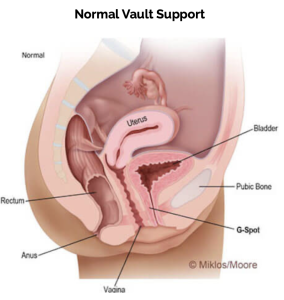
Medical illustration showing normal vaginal and pelvic organ support. After prolapse surgery, maintaining adequate support at the top of the vagina is an important part of pelvic reconstruction.
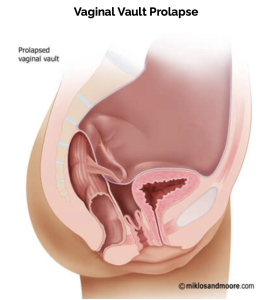
Medical illustration showing vaginal vault prolapse, which can occur when support at the top of the vagina is lost, including in women who have undergone previous hysterectomy or prolapse surgery.
Why Does Pelvic Organ Prolapse Surgery Sometimes Fail?
Recurrent prolapse does not necessarily mean that the original surgeon performed the operation incorrectly.
Pelvic organ prolapse is a disorder of the supporting tissues of the pelvis. Those tissues can continue to weaken over time, and different areas of the pelvic floor may fail independently.
A woman can also have several types of prolapse simultaneously.
Possible reasons prolapse may persist or return include:
- Failure of the original repair
- Progressive weakening of pelvic support
- Recurrent apical prolapse
- An untreated support defect
- Development of prolapse in another vaginal compartment
- Significant childbirth-related tissue damage
- Previous hysterectomy
- Multiple prior pelvic surgeries
- Connective tissue weakness
- Complex multi-compartment prolapse
Understanding why the prolapse returned is one of the most important parts of planning revision surgery.
Is It the Same Prolapse or a Different Prolapse?
This is a critical question.
A woman may assume that the same prolapse has returned because she again feels vaginal pressure or a bulge.
That is not always the case.
For example, a previous bladder prolapse repair may remain intact while the top of the vagina subsequently loses support.
A woman who previously underwent rectocele surgery may later develop apical or anterior prolapse.
In other cases, the original prolapse truly has recurred.
Before another operation is recommended, an experienced urogynecologist should determine exactly which areas of pelvic support have failed.
Second Opinion Before Repeat Prolapse Surgery
Revision prolapse surgery can be more complicated than the original procedure.
The surgeon is no longer operating on untouched anatomy.
Previous surgery may have created scar tissue, changed normal anatomical planes, removed tissue, altered pelvic support, or introduced mesh or graft material.
This means that simply repeating the original operation may not always be the best solution.
A second opinion provides an opportunity to reconsider the entire pelvic floor rather than automatically repeating what was done previously.
My Prolapse Came Back After Surgery — What Should I Do?
The first step is determining what has actually recurred.
Symptoms alone cannot always identify the specific support defect.
A comprehensive evaluation may determine:
Where the prolapse is located.
How advanced it is.
Whether multiple compartments are involved.
Whether the original repair remains intact.
Whether the top of the vagina or uterus lacks adequate support.
Whether previous mesh or graft material is present.
Whether urinary or bowel symptoms are related to the prolapse.
Only after understanding the anatomy should another surgical plan be developed.
Failed Bladder Prolapse Surgery
Women who have undergone cystocele repair may later notice another anterior vaginal bulge.
However, what appears to be recurrent bladder prolapse can sometimes be influenced by inadequate support higher in the vagina.
This is why revision planning should evaluate the entire vaginal support system rather than focusing exclusively on the visible bulge.
Repeatedly repairing one compartment without recognizing another support problem may fail to address the underlying anatomy.
Failed Rectocele Surgery
A woman who continues to experience posterior vaginal bulging or difficulty with bowel movements after rectocele surgery may seek another opinion to determine whether the rectocele persists, has recurred, or whether another condition is contributing to her symptoms.
Revision posterior vaginal surgery requires careful evaluation because previous surgery may have created scar tissue or altered the tissue available for reconstruction.
Recurrent Prolapse After Hysterectomy
Some women develop prolapse after hysterectomy or after prolapse surgery that included hysterectomy.
One important possibility is vaginal vault prolapse, in which the top of the vagina loses support and descends.
Removing the uterus does not eliminate the need for long-term apical support.
When recurrent prolapse develops after hysterectomy, the surgeon must evaluate the entire vaginal support system and determine which reconstructive approach is appropriate.
Recurrent Prolapse After Mesh Surgery
Previous mesh surgery can make revision considerably more complex.
The patient may have recurrent prolapse, a mesh complication, or both.
Mesh may also have become incorporated into surrounding tissues.
Before another operation, the surgeon should understand:
What type of mesh was used.
Where it was placed.
Whether it remains intact.
Whether mesh is contributing to symptoms.
Whether prolapse has developed around or despite the previous reconstruction.
Whether mesh revision or removal is actually necessary.
Operative reports from previous procedures can be particularly valuable.
What If I’ve Had Two or Three Failed Prolapse Surgeries?
The importance of obtaining an experienced second opinion generally increases as the surgical history becomes more complicated.
Each additional operation can alter anatomy and potentially create more scar tissue.
A woman who has undergone multiple unsuccessful repairs should not simply assume that another repeat of the same operation is the only choice.
Instead, the entire surgical history should be reconstructed.
An experienced revision surgeon will want to know:
What prolapse existed originally.
Which operations were performed.
Whether hysterectomy was performed.
Whether mesh was used.
Which symptoms improved.
Which symptoms remained.
What subsequently recurred.
This information can help determine why previous treatments may not have produced a durable result.
Can Failed Prolapse Surgery Be Fixed?
Many women with recurrent prolapse have additional treatment options.
However, there is no single revision operation appropriate for every failed repair.
The available options depend on the current anatomy, previous procedures, age, health, symptoms, sexual activity, treatment goals, and other individual factors.
The objective should not simply be to “fix it again.”
The objective is to understand why the previous repair failed and choose the reconstruction most appropriate for the anatomy that exists now.
Why High Surgical Volume Matters in Revision Prolapse Surgery
Revision surgery requires experience not only with prolapse but with prolapse that has already been surgically altered.
High-volume pelvic reconstructive surgeons routinely encounter a wider range of:
Recurrent prolapse patterns.
Previous surgical techniques.
Scarred anatomy.
Failed repairs.
Mesh procedures.
Multiple-compartment defects.
Post-hysterectomy prolapse.
Complex combinations of pelvic floor problems.
No surgeon can guarantee that prolapse will never recur.
However, extensive experience can be particularly valuable when determining how to approach a difficult revision.
Dr. Miklos and Dr. Moore: Revision Prolapse Surgeons in Georgia
Dr. John Miklos and Dr. Robert Moore are fellowship-trained urogynecologists who have dedicated decades of their careers to female pelvic reconstructive surgery.
Their experience includes thousands of prolapse and incontinence procedures as well as difficult revision and recurrent prolapse cases.
They evaluate women whose previous prolapse surgery was performed through vaginal, laparoscopic, robotic, or other surgical approaches.
The objective of the second opinion is not to criticize the previous surgeon.
It is to determine what the pelvic anatomy looks like today and what should happen next.
Getting the Previous Operative Report Is Important
One of the most useful documents for a recurrent prolapse consultation is the operative report from the original surgery.
Patients often know that they had “bladder surgery,” “prolapse repair,” or “mesh surgery” but may not know exactly which procedures were performed.
The operative report can tell the revision surgeon:
Which structures were repaired.
Which suspension technique was used.
Whether hysterectomy was performed.
Whether mesh or graft material was implanted.
Where the mesh was placed.
Which vaginal compartments were addressed.
This information can significantly improve the understanding of a complicated surgical history.
What Should You Bring to a Failed Prolapse Surgery Second Opinion?
When available, bring:
- Previous operative reports
- Pathology reports
- Information about implanted mesh
- Previous urogynecology records
- Imaging or diagnostic studies
- Urodynamic testing
- A list of previous pelvic operations
- Dates of previous procedures
- A timeline of when symptoms returned
- Information about the surgery currently being recommended
Even if some records cannot be obtained, an evaluation can still be performed.
Questions to Ask Before Another Prolapse Operation
Before agreeing to revision surgery, ask:
Why did my prolapse come back?
Is this the same prolapse or a different support defect?
Which areas of my pelvic floor are currently failing?
Why would this operation be different from my previous surgery?
Are you repeating the same repair?
Are other surgical approaches available?
Is previous mesh affecting my options?
Do I need a hysterectomy if I still have my uterus?
How much revision prolapse surgery do you perform?
How often do you treat patients who have already had failed repairs?
These questions help shift the conversation from simply having another operation to understanding the strategy behind it.
Women Travel to Miklos & Moore After Failed Prolapse Surgery
Women with recurrent prolapse frequently search beyond their local area for another opinion because their cases are no longer straightforward first-time repairs.
Patients travel to Miklos & Moore near Atlanta from throughout Georgia, across the United States, and internationally for evaluation of recurrent prolapse and complex revision surgery.
This is particularly common among women who have undergone multiple previous operations, received conflicting recommendations, experienced recurrence after mesh surgery, or have been told that their case is unusually complicated.
For these patients, surgical experience may become more important than geographic convenience.
A Failed Prolapse Surgery Does Not Automatically Mean Another Surgery
One of the most important reasons to obtain a second opinion is to determine whether another operation is actually necessary.
The presence of anatomical prolapse alone does not determine treatment.
Symptoms, severity, quality of life, medical history, and patient goals all matter.
Some women may decide to pursue nonsurgical management.
Others may benefit from revision surgery.
A second opinion should help clarify those options rather than simply lead to another procedure.
Get a Second Opinion After Failed Prolapse Surgery
If your prolapse has returned after surgery, another operation should begin with a new evaluation—not simply a repetition of the original treatment.
Dr. Miklos and Dr. Moore provide second opinions for women with recurrent pelvic organ prolapse, previous failed repairs, post-hysterectomy prolapse, mesh-related cases, and complex multi-compartment prolapse.
As fellowship-trained urogynecologists and high-volume pelvic reconstructive surgeons near Atlanta, Georgia, their extensive revision experience allows them to evaluate what was previously performed, what has failed, and what options may now be available.
For women facing a second, third, or even more complicated prolapse operation, the most important question may not be:
“Can you fix my prolapse?”
It may be:
“Why did my previous surgery fail, and what would you do differently this time?”
Frequently Asked Questions
Why did my prolapse come back after surgery?
Prolapse can recur because of continued tissue weakness, failure of a previous repair, inadequate support in another area, or development of prolapse in a different vaginal compartment. An examination is necessary to determine the cause in an individual patient.
Can recurrent prolapse be repaired again?
Many women with recurrent prolapse have additional treatment options. The appropriate approach depends on the current anatomy, previous operations, symptoms, and overall health.
Should I get a second opinion before repeat prolapse surgery?
A second opinion can be particularly valuable before revision surgery because previous procedures may have altered the anatomy and there may be several possible approaches to reconstruction.
What kind of surgeon should treat failed prolapse surgery?
Consider a urogynecologist with substantial experience in pelvic reconstructive surgery and recurrent or revision prolapse cases.
What if I’ve already had several failed prolapse operations?
Multiple previous surgeries can make treatment more complex. Obtaining previous operative reports and consulting a surgeon experienced with revision pelvic reconstruction can help determine what options remain.
Do Miklos and Moore treat recurrent prolapse after previous surgery?
Yes. Their Atlanta-area practice evaluates women with recurrent prolapse and previous failed pelvic reconstructive procedures, including patients traveling from other states and internationally.