
PERINEOPLASTY RECOVERY: RESTORING COMFORT, SUPPORT & CONFIDENCE
Recovery after perineoplasty is about more than healing the skin—it also involves restoring the muscles and supportive tissues of the perineum. Because this area plays an important role in sitting, walking, bowel movements, and sexual activity, precise surgical technique and careful postoperative care are essential for a successful outcome. Drs. Miklos and Moore have extensive experience performing advanced perineal reconstruction and cosmetic vaginal surgery, using meticulous techniques designed to restore anatomy while preserving normal function. Every patient receives individualized recovery instructions and close follow-up to monitor healing and answer questions throughout the recovery process. As swelling subsides and the repaired tissues strengthen, most women experience improved comfort, enhanced support, and renewed confidence in their daily activities and intimate relationships.
Perineoplasty Recovery: Healing, Sitting Comfort & What to Expect After Surgery
Perineoplasty is one of the most rewarding procedures in cosmetic and reconstructive gynecology because it restores and strengthens the perineum—the area of tissue located between the vaginal opening and the anus. Many women seek perineoplasty after childbirth has stretched or torn the perineum, while others undergo the procedure to improve discomfort, restore anatomy, or enhance the appearance of the vaginal opening.
Although the operation itself is relatively straightforward, recovery is different from almost every other cosmetic vaginal procedure.
Unlike labiaplasty, where patients primarily focus on swelling of the labia, or clitoropexy, where sensitivity is often the biggest concern, perineoplasty recovery revolves around protecting the perineal repair while allowing the tissues to heal without excessive tension. Everyday activities such as sitting, standing, walking, and even having a bowel movement place pressure on the exact area that has been reconstructed.
That reality understandably makes many women anxious before surgery.
Questions such as:
- Will sitting hurt?
- How painful are bowel movements?
- When can I exercise again?
- How long before intercourse is comfortable?
- Will the scar remain noticeable?
are among the most common concerns discussed during consultation.
Fortunately, most women discover that recovery is easier than expected. While soreness and swelling are common during the first several weeks, severe pain is uncommon, and most patients notice steady improvement every week. Understanding what is normal—and what deserves medical attention—can make recovery significantly less stressful.
At Miklos & Moore, Dr. John Miklos and Dr. Robert Moore have performed thousands of reconstructive and cosmetic vaginal procedures, including complex perineal repairs following childbirth injuries and previous surgeries. Their extensive experience in female pelvic reconstruction allows them to restore both function and appearance while providing detailed postoperative care throughout the healing process.
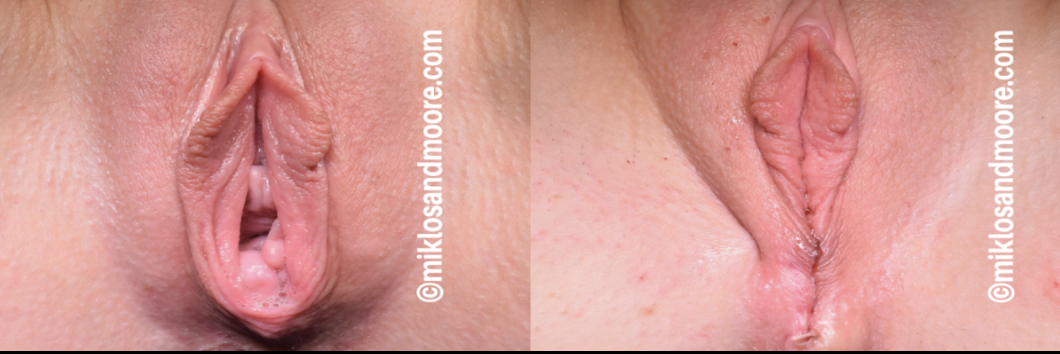
Perineoplasty before and after photographs demonstrating restoration of the perineum and improved vaginal opening following childbirth-related stretching. Individual results vary.
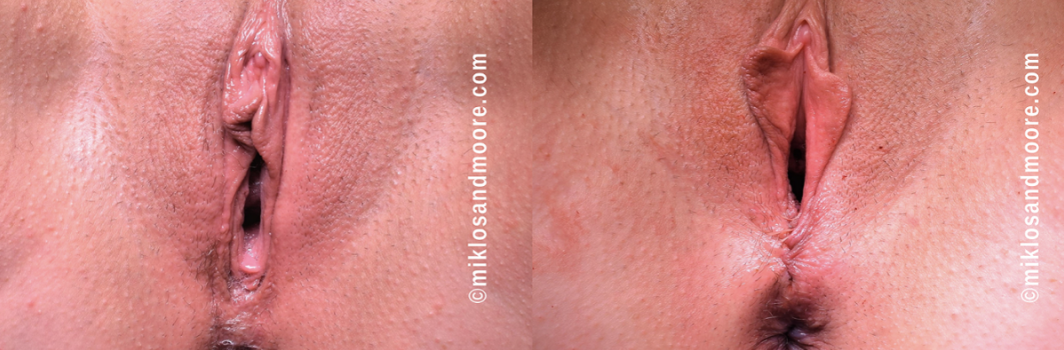
Before and after perineoplasty surgery illustrating reconstruction of the perineum to improve support, symmetry, and the appearance of the vaginal opening. Results vary by patient.
Understanding the Perineum and Why It Matters
The perineum is a relatively small area of the body, yet it plays an important role in everyday function.
It provides support for the tissues surrounding the vaginal opening, contributes to the integrity of the pelvic floor, and stretches during childbirth. Because it is involved in sitting, walking, bowel movements, and sexual activity, even small changes in this area can have a meaningful impact on comfort and quality of life.
Pregnancy and vaginal delivery are the most common reasons women experience stretching or injury to the perineum. Some women develop tears during childbirth that heal with noticeable scar tissue, while others experience widening of the vaginal opening or discomfort that persists long after delivery.
Perineoplasty is designed to repair and reshape these tissues by removing scar tissue when appropriate, restoring normal anatomy, and carefully reconstructing the muscles and soft tissues of the perineum.
Unlike procedures that remove only skin, perineoplasty often includes repairing deeper supportive tissues. For that reason, recovery is not just about the skin incision healing. The deeper muscles and connective tissues also require time to regain strength.
How Healing Takes Place
Immediately after surgery, your body begins repairing the reconstructed tissues.
Blood flow increases to the surgical site, bringing oxygen and specialized healing cells that begin rebuilding the incision. During this phase, swelling, tenderness, and firmness are completely normal.
Over the following weeks, collagen is deposited throughout the repair.
Collagen acts as the body’s natural scaffolding, strengthening the tissues while the incision heals.
This process explains why the perineum often feels firmer than expected during the early stages of recovery.
Many women worry that firmness means something is wrong.
In reality, it usually means the body is healing exactly as it should.
As collagen remodels over the following months, the tissues gradually soften and become increasingly flexible.
The final result develops slowly—not overnight.
The First 48 Hours After Surgery
The first two days are usually focused on controlling swelling, protecting the repair, and allowing the body to rest.
Most patients describe the discomfort as soreness or pressure rather than severe pain.
Common symptoms include:
- Mild swelling around the vaginal opening
- Tenderness while sitting
- Bruising
- A feeling of tightness
- Small amounts of spotting
Because the incision is located in an area that supports body weight while sitting, many women find it more comfortable to shift positions frequently rather than remaining seated for long periods.
Walking around the house for several minutes every few hours is encouraged to maintain healthy circulation, but strenuous activity should be avoided.
Many patients are understandably nervous about their first bowel movement after surgery.
This concern is normal.
Fortunately, the fear is often worse than the experience itself, especially when patients stay hydrated, follow their postoperative instructions, and avoid constipation.
The First Week: Protecting the Perineal Repair
The first week is when healing is most active.
During this period, your body’s priority is strengthening the repair while reducing inflammation.
Swelling usually reaches its highest point during the first several days before gradually beginning to improve.
Many women notice that the perineum feels:
- Tight
- Swollen
- Firm
- Sensitive while sitting
- More noticeable during walking than expected
These sensations are part of normal healing.
One of the biggest mistakes patients make during the first week is trying to resume normal activity simply because they are feeling better.
Although discomfort often improves quickly, the deeper tissues still require protection.
The first week is not the time to resume exercise, lift heavy objects, or spend prolonged periods sitting without breaks.
Giving the repair time to stabilize during these early days provides the best opportunity for long-term healing and a durable surgical result.
The First Two Weeks: Recovery Day by Day
Most women find that the first two weeks after perineoplasty are much easier than they expected. While the surgical area is naturally tender, recovery is usually defined by gradual improvement rather than significant pain.
One of the most important things to remember is that the perineum is involved in nearly every movement you make. Sitting, standing, walking, coughing, laughing, and using the restroom all place varying amounts of pressure on the tissues. Because of this, it’s completely normal to be more aware of the surgical site than you would be after many other procedures.
Fortunately, awareness does not mean something is wrong—it simply reflects where the surgery was performed.
Days 1–3: Protecting the Repair
The first several days are focused on allowing the repaired tissues to begin healing without unnecessary stress.
During this time, most patients notice:
- Mild to moderate swelling
- Tightness near the vaginal opening
- Tenderness while sitting
- Bruising around the incision
- Light spotting
Many women expect severe pain after surgery but instead describe the sensation as pressure or soreness, similar to the feeling after a vaginal delivery or significant muscle strain.
The repaired muscles beneath the skin have been carefully brought back together, and they naturally feel tight during the early stages of healing.
This tightness should not be mistaken for a complication.
In fact, many patients are reassured when they learn it is an expected part of the reconstruction.
Your First Bowel Movement
For many women, this is the part of recovery they worry about most.
Almost every patient asks:
“Is my first bowel movement going to hurt?”
Fortunately, the experience is usually much less uncomfortable than patients anticipate.
The greatest challenge is often anxiety rather than pain itself.
Your surgeon may recommend stool softeners, increased fluid intake, and a diet rich in fiber during the first several days. These measures help reduce straining, which protects the repair while making bowel movements more comfortable.
Patients should never force a bowel movement or strain excessively.
If constipation develops, contacting your surgeon for additional recommendations is preferable to continued straining.
Many women are pleasantly surprised to discover that bowel movements become progressively easier after the first several days.
Keeping the Area Clean
Good hygiene supports healthy healing, but the incision should always be treated gently.
After using the restroom, many surgeons recommend gently rinsing the area with warm water instead of relying entirely on toilet paper during the first several days.
This helps remove urine or stool without excessive wiping, which can irritate healing tissues.
Patients should avoid:
- Vigorous rubbing
- Harsh soaps
- Fragranced feminine products
- Douching
- Powders or creams unless specifically recommended
Keeping the area clean, dry, and protected is generally all that is required.
Week Two: Everyday Life Becomes Easier
By the second week, most women notice substantial improvement.
Swelling begins decreasing.
Walking becomes more comfortable.
Tenderness improves.
Many patients feel comfortable returning to office work and routine household activities.
However, this stage can be deceptive.
Although you may feel much better, the deeper muscles repaired during surgery are still healing.
Patients sometimes become overly confident because discomfort has improved and attempt activities that place unnecessary strain on the repair.
Healing continues long after pain disappears.
Sitting Comfort Improves Gradually
Unlike labiaplasty, where swelling is often the primary concern, perineoplasty patients usually judge recovery by one simple question:
“Can I sit comfortably?”
The answer changes week by week.
Initially, sitting on hard chairs may feel uncomfortable because body weight is placed directly over the healing tissues.
Many women naturally shift their weight to one side or sit on softer cushions during the first several days.
As swelling decreases and the repaired muscles relax, sitting gradually becomes much easier.
By several weeks after surgery, most patients no longer think about sitting at all.
The Five Most Common Questions During Recovery
Every perineoplasty patient heals differently, but Dr. Miklos and Dr. Moore hear many of the same questions during postoperative visits.
Understanding these concerns before surgery often helps reduce anxiety afterward.
“Everything Feels Much Tighter Than Before.”
This is perhaps the most common observation after perineoplasty.
The procedure restores support to tissues that may have been stretched for years.
Immediately after surgery, swelling and newly repaired muscles naturally create a feeling of tightness.
Patients sometimes worry the repair is “too tight.”
In reality, much of this sensation gradually decreases as swelling resolves and the tissues become more flexible.
The final result should never be judged during the first several weeks.
“I’m Afraid I’m Going to Tear Something.”
Many women become extremely cautious during recovery.
Simple activities like standing up, coughing, laughing, or climbing stairs may create concern that the repair could come apart.
Fortunately, normal daily movement is unlikely to damage the surgical repair.
The deeper tissues are closed with strong sutures designed to support healing.
The greater concern is repeated heavy lifting, vigorous exercise, or excessive straining before healing is complete.
Following your surgeon’s activity restrictions provides the best protection while your body rebuilds its natural strength.
“I Still Feel the Stitches.”
Absorbable sutures remain in place for several weeks while healing occurs.
Patients may notice:
- Small knots
- Firm areas beneath the skin
- Occasional suture ends
These findings are completely normal.
As healing progresses, the sutures gradually dissolve and become much less noticeable.
Patients should never attempt to remove visible stitches themselves.
“The Scar Feels Firm.”
Firmness along the incision is another common concern.
This firmness is usually caused by collagen production beneath the surface.
During healing, collagen temporarily creates a dense framework that strengthens the repair.
Over the following months, this tissue gradually softens as scar remodeling continues.
Most women notice that the scar becomes increasingly comfortable and difficult to detect over time.
“Recovery Is Better Than I Expected.”
Interestingly, this is one of the comments surgeons hear most often.
Many women spend weeks worrying about sitting, walking, and using the restroom.
After surgery, they often realize the recovery was significantly easier than anticipated.
While every patient is different, understanding the normal stages of healing before surgery often makes the experience much less intimidating.
Returning to Normal Activities After Perineoplasty
One of the most common questions after perineoplasty is, “When can I get back to my normal routine?” While many women feel significantly better within the first two weeks, complete healing takes longer than most people realize. The skin incision is only one part of the recovery. The muscles and connective tissues that were repaired beneath the surface continue strengthening for several weeks, and protecting that repair is one of the most important parts of achieving an excellent long-term result.
Rather than trying to recover as quickly as possible, the goal should be to recover completely. Giving your body the time it needs during the early weeks can help reduce complications and improve both comfort and long-term function.
Returning to Work
The amount of time needed away from work depends largely on the type of job you perform.
Women with desk jobs often return within one week, provided they are comfortable sitting for moderate periods and are able to change positions throughout the day.
Simple adjustments can make returning to work much easier, including:
- Standing every hour to stretch.
- Taking short walks during breaks.
- Sitting on a cushioned chair if needed.
- Wearing loose, comfortable clothing.
- Staying well hydrated throughout the day.
Women whose occupations involve heavy lifting, prolonged standing, climbing, or repetitive physical activity may require additional recovery time. Returning too soon can increase swelling and place unnecessary strain on the healing muscles of the perineum.
Exercise and Physical Activity
Exercise is an important part of a healthy lifestyle, but it should be resumed gradually after perineoplasty.
Walking is encouraged almost immediately because it improves circulation, reduces stiffness, and supports recovery without placing excessive stress on the repair.
More strenuous activities should wait until healing has progressed appropriately.
Activities that typically require the greatest patience include:
- Running
- Cycling
- Horseback riding
- Rowing
- Heavy weightlifting
- Squats and lunges
- HIIT workouts
- Contact sports
These exercises increase pressure on the pelvic floor and perineal muscles—the exact tissues that were reconstructed during surgery.
Many women feel physically capable of exercising before the repair has regained its full strength. This is why follow-up examinations are so important. Your surgeon can evaluate healing and determine when it is appropriate to increase activity safely.
When Can You Resume Sexual Activity?
For many women, one of the primary reasons for having perineoplasty is to improve comfort and restore normal anatomy during intimacy. Because of this, it is natural to wonder when sexual activity can safely resume.
The repaired tissues require adequate time to heal before they are subjected to stretching and pressure.
Returning to intercourse too early may:
- Increase discomfort.
- Irritate the incision.
- Delay healing.
- Increase swelling.
- Place unnecessary tension on the muscle repair.
Most surgeons recommend waiting until the tissues have healed completely and a follow-up examination confirms that recovery is progressing normally.
Even after receiving clearance, many couples choose to resume intimacy gradually.
It is common to feel some anxiety the first time after surgery, particularly for women whose previous childbirth injuries or scar tissue caused discomfort for years.
Fortunately, most patients report that confidence improves quickly once healing is complete. As tenderness resolves and the tissues soften, many women experience greater comfort than they did before surgery.
Long-Term Healing
One of the greatest misconceptions about perineoplasty is that recovery ends when the stitches dissolve.
In reality, healing continues for several months.
During this period:
- Scar tissue becomes softer.
- Swelling continues decreasing.
- The repaired muscles become stronger.
- The perineum becomes more flexible.
- The appearance of the scar continues improving.
Many women also notice improvements they were not expecting.
Simple daily activities such as walking, exercising, sitting comfortably, and sexual intercourse often become more comfortable as the reconstructed tissues mature.
The goal of perineoplasty is not simply to repair an incision—it is to restore support and improve function while creating a natural appearance.
That process takes time.
When Should You Contact Your Surgeon?
Although complications following perineoplasty are uncommon, patients should recognize symptoms that deserve prompt medical attention.
Contact your surgeon if you experience:
- Heavy bleeding.
- Fever greater than 101°F.
- Increasing redness around the incision.
- Thick drainage or foul odor.
- Rapidly increasing swelling.
- Severe pain that continues worsening.
- Difficulty urinating or having a bowel movement despite following postoperative instructions.
- Separation of the incision.
Most postoperative concerns ultimately prove to be part of normal healing, but early communication with your surgeon can provide reassurance and allow problems to be addressed before they become more significant.
Why Choosing an Experienced Surgeon Matters
Perineoplasty is far more than a cosmetic procedure. The surgery requires a detailed understanding of the muscles, connective tissues, and support structures that make up the perineum. Restoring these tissues while maintaining normal function requires precision and experience.
Dr. John Miklos and Dr. Robert Moore have dedicated their careers to female pelvic reconstructive surgery and cosmetic gynecology. Their experience extends beyond aesthetic procedures alone and includes the treatment of complex childbirth injuries, pelvic floor disorders, and revision surgeries. They have authored numerous peer-reviewed scientific publications, lecture internationally, and have helped train physicians in advanced reconstructive techniques.
This reconstructive background allows them to approach perineoplasty with a focus on both appearance and function. Careful tissue handling, meticulous muscle repair, and comprehensive postoperative care all contribute to a smoother recovery and durable long-term results.
Frequently Asked Questions
How long does perineoplasty recovery take?
Most women return to normal daily activities within one to two weeks. However, complete healing of the muscles and connective tissues continues for several months.
Is it normal to feel tight after surgery?
Yes. Tightness is one of the most common sensations after perineoplasty. It reflects both postoperative swelling and the restoration of support to tissues that may have been stretched or weakened before surgery.
When will sitting become comfortable?
Most patients notice steady improvement during the first few weeks. Sitting on soft surfaces and changing positions frequently often makes recovery more comfortable early on.
Will bowel movements damage the repair?
No. Normal bowel movements should not damage the repair. Following your surgeon’s recommendations regarding hydration, fiber, and stool softeners can help minimize straining during the early recovery period.
When can I exercise again?
Walking is encouraged early, while higher-impact activities such as running, cycling, and heavy lifting should wait until your surgeon confirms that healing is adequate.
When can I have sex after perineoplasty?
Most patients should wait until the tissues have healed completely and they have been examined during a postoperative visit before resuming sexual activity.
Will the scar remain visible?
The scar generally becomes softer and less noticeable over time. As healing progresses, many women find that it blends naturally into the surrounding tissue.
When will I see the final results?
While the repair is noticeable soon after swelling improves, final scar maturation and tissue remodeling typically continue for several months.
Schedule a Consultation with Miklos & Moore
Whether you are considering perineoplasty to repair childbirth-related changes, improve comfort, or restore the appearance of the perineum, understanding the recovery process is an important part of making an informed decision.
Dr. John Miklos and Dr. Robert Moore combine decades of experience in female pelvic reconstruction with advanced cosmetic gynecologic surgery to provide individualized treatment plans and comprehensive postoperative care. Their goal is not only to restore anatomy but also to help patients return confidently to the activities they enjoy with greater comfort and improved quality of life.