
MRKH Syndrome Second Opinion
An MRKH diagnosis can leave patients and families with important questions about anatomy, vaginal development, fertility, and whether treatment is necessary. Because MRKH syndrome can affect each patient differently, a second opinion can help confirm the diagnosis, review imaging, and determine the individual’s anatomy before making decisions about vaginal dilation or reconstructive surgery. Dr. John Miklos and Dr. Robert Moore have extensive experience in complex vaginal and pelvic reconstruction, including congenital vaginal conditions, vaginal agenesis, and revision surgery after unsuccessful treatment. Patients travel to Miklos & Moore from across the United States and around the world for MRKH second opinions to better understand their options and determine the most appropriate path forward.
MRKH Syndrome Second Opinion: Understanding Your Diagnosis and Treatment Options
Being diagnosed with MRKH syndrome can be overwhelming, particularly when the diagnosis comes unexpectedly during adolescence or young adulthood. Some patients are told they need surgery. Others are advised to begin vaginal dilation. Some receive very little explanation beyond being told that the uterus or vagina did not develop normally.
For patients and families, the immediate questions are often much bigger than the diagnosis itself:
Is the diagnosis definitely MRKH?
What anatomy do I actually have?
Do I need treatment now?
Do I need surgery?
What are my options for creating or lengthening a functional vagina?
Will I be able to have sex?
What does MRKH mean for fertility and my future?
A second opinion for MRKH syndrome can provide an opportunity to confirm the diagnosis, carefully evaluate the patient’s individual anatomy, review previous imaging and recommendations, and understand the available treatment options before making an irreversible decision.
Dr. John Miklos and Dr. Robert Moore have extensive experience in complex vaginal reconstruction and congenital vaginal conditions. Patients with MRKH and their families travel to Miklos & Moore from across the United States and internationally seeking another opinion regarding diagnosis, vaginal reconstruction, previous unsuccessful treatment, and available surgical and nonsurgical options.
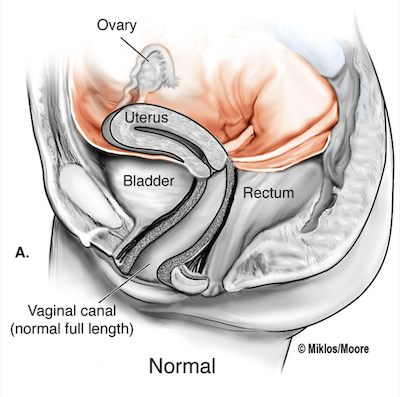
Medical illustration showing typical female pelvic anatomy, including the uterus, ovary, bladder, rectum, and normally developed vaginal canal.
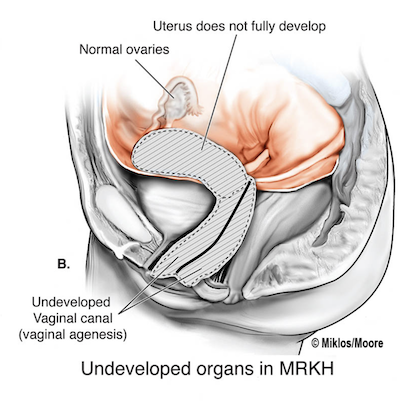
Medical illustration showing anatomical differences associated with MRKH syndrome, including an underdeveloped uterus and vaginal canal while the ovaries may be normally developed.
What Is MRKH Syndrome?
MRKH stands for Mayer-Rokitansky-Küster-Hauser syndrome.
MRKH is a congenital condition in which structures derived from the Müllerian ducts do not develop typically. Most patients have normal ovaries and typical external female genital development but have an absent or underdeveloped uterus and an absent or shortened upper vagina.
Because external development can appear typical, MRKH may not be discovered until adolescence.
One of the most common reasons for evaluation is primary amenorrhea—a young woman has developed breasts and other secondary sexual characteristics but has not started menstruating.
The anatomy can vary significantly from one patient to another, which is one reason an individualized evaluation is so important.
Why Get a Second Opinion After an MRKH Diagnosis?
MRKH is uncommon, and most physicians encounter relatively few patients with the condition.
A second opinion can be particularly valuable because treatment decisions may have lifelong implications.
Patients and families may seek another opinion when:
- MRKH has recently been diagnosed.
- The diagnosis remains uncertain.
- The patient does not fully understand her anatomy.
- Surgery has been recommended immediately.
- Vaginal dilation has been recommended but has not been successful.
- The patient wants to understand surgical and nonsurgical options.
- A previous vaginal reconstruction did not produce the desired result.
- The reconstructed vagina has become shortened or narrowed.
- Pain or difficulty with intercourse persists after treatment.
- Different physicians have recommended different procedures.
- The patient wants evaluation by surgeons experienced with vaginal reconstruction.
The purpose of another opinion is not necessarily to change the diagnosis or treatment plan.
Sometimes the greatest value is simply understanding the condition and available choices before deciding what to do.
Does MRKH Always Require Treatment?
No.
The presence of MRKH does not automatically mean that a patient needs immediate surgery or even immediate treatment.
Treatment decisions are highly personal and should take into account the patient’s age, anatomy, goals, emotional readiness, and whether she desires creation or lengthening of a vaginal canal.
There should generally be no pressure to undergo reconstruction simply because MRKH has been diagnosed.
For many patients, the first step is education.
Understanding the anatomy and options can make the condition considerably less frightening.
Do All MRKH Patients Have the Same Anatomy?
No, and this is extremely important.
The term MRKH describes a developmental condition, but there can be meaningful anatomical differences between patients.
Evaluation may consider:
- Vaginal length and development
- Presence of uterine remnants
- Ovarian anatomy
- Renal anatomy
- Skeletal abnormalities
- Previous imaging findings
- Previous procedures
- Previous attempts at vaginal dilation
Some patients have associated abnormalities involving the kidneys, skeleton, hearing, or other systems.
For that reason, MRKH should not be viewed solely as a vaginal condition.
A thorough evaluation helps establish the patient’s actual anatomy rather than assuming every MRKH case is identical.
Confirming the Diagnosis of MRKH
Before making treatment decisions, the diagnosis and anatomy should be clearly established.
Evaluation may include a medical history, physical examination when appropriate, and review of imaging such as ultrasound or MRI.
The objective is to determine:
- Whether the vagina is shortened or absent
- Whether a uterus or uterine remnants are present
- Whether the ovaries are present and functioning
- Whether associated renal abnormalities have been evaluated
- Whether other congenital conditions should be considered
For a patient who has already been diagnosed, previous imaging and medical records can be extremely helpful during a second-opinion consultation.
Do I Need MRKH Surgery?
Not necessarily.
This may be one of the most important reasons to obtain a second opinion.
A patient diagnosed with MRKH should understand that surgery is not automatically required to create a functional vaginal canal.
Nonsurgical vaginal dilation is an established treatment option and may be appropriate for many patients.
Surgery may be considered when dilation is unsuccessful, unsuitable, not desired after informed discussion, or when the patient’s anatomy or previous treatment history makes reconstruction appropriate.
The decision should be individualized.
Vaginal Dilation for MRKH
Vaginal dilation is commonly considered a first-line approach for creating or increasing vaginal length in appropriately selected and motivated patients.
Progressive dilation applies controlled pressure to gradually create or lengthen a vaginal canal.
Successful dilation requires:
- Patient motivation
- Appropriate instruction
- Consistency
- Realistic expectations
- Follow-up when necessary
It should be undertaken when the patient is personally ready rather than simply because she has reached a particular age.
For some patients, dilation works very well.
For others, it may be difficult, unsuccessful, or not the treatment they ultimately choose.
What If Vaginal Dilation Hasn’t Worked?
An unsuccessful attempt at dilation does not mean that there are no other options.
A second opinion can help determine why the patient has struggled.
Questions may include:
- Was the diagnosis and anatomy clearly established?
- Was the dilation technique appropriate?
- Was adequate instruction provided?
- Was discomfort preventing consistent use?
- How much vaginal length currently exists?
- Does the patient actually want to continue dilation?
- Would another approach be more appropriate?
The goal should not be to label the patient as having “failed” dilation.
The goal is to determine what treatment makes sense now.
MRKH Vaginal Reconstruction Surgery
When surgical reconstruction is considered, patients may encounter several different techniques.
This can become confusing very quickly.
Different surgeons may recommend different approaches based on their training, experience, and the patient’s anatomy.
Rather than focusing exclusively on the name of an operation, patients should understand:
- How the vagina will be created
- What tissue or material will be used
- Where the reconstructed vagina will be positioned
- Expected vaginal length
- Recovery
- Whether postoperative dilation is required
- Potential complications
- Long-term maintenance
- The surgeon’s experience with the technique
- What happens if the reconstruction narrows or shortens later
There is no substitute for understanding exactly what is being proposed before undergoing reconstruction.
What Is the Goal of MRKH Treatment?
For patients who desire treatment, the objective is generally to create or develop a vaginal canal that is functional and comfortable for the patient’s goals.
The goal is not simply to produce a particular measurement.
Long-term function matters.
That includes considering:
- Vaginal length
- Vaginal width
- Comfort
- Tissue quality
- Scarring
- Risk of narrowing
- Sexual function when relevant to the patient
- Long-term maintenance requirements
These factors become particularly important when comparing different reconstructive options.
MRKH Surgery Is Not the Same as Cosmetic Vaginal Surgery
This distinction is important.
MRKH vaginal reconstruction is performed because of congenital anatomy and functional needs. It is not simply a cosmetic procedure.
The surgeon must understand pelvic anatomy, vaginal reconstruction, tissue handling, and the potential challenges of creating a functional vaginal canal when normal anatomy is absent or underdeveloped.
This is one reason patients may choose to seek a second opinion from surgeons with substantial reconstructive vaginal experience.
What If My Previous MRKH Surgery Failed?
Patients who have already undergone vaginal reconstruction may seek another opinion because of:
- Vaginal narrowing
- Loss of vaginal length
- Scar tissue
- Pain
- Difficulty with penetration
- Inability to have intercourse
- Problems maintaining the reconstructed canal
- Complications from the original technique
- Dissatisfaction with function
- Need for additional reconstruction
Revision MRKH surgery can be substantially more complicated than first-time reconstruction because previous surgery may have altered tissue and created scar tissue.
Before another operation, it is important to understand what was originally performed and why the result is no longer functional.
Get the Original MRKH Operative Report
If previous surgery has already been performed, obtaining the operative report can be extremely valuable.
It can tell the second-opinion surgeon:
- Which reconstruction technique was used
- What tissue was used
- How the vaginal canal was created
- Whether graft material was used
- Whether complications occurred
- What postoperative instructions were given
- Whether other procedures were performed
If more than one reconstruction has been attempted, records from every procedure can help reconstruct the patient’s surgical history.
Questions to Ask Before MRKH Surgery
Patients and families should feel comfortable asking detailed questions.
Important questions include:
- Is my diagnosis definitely MRKH?
- What exactly does my anatomy look like?
- Do I need treatment right now?
- Can I try vaginal dilation?
- What if dilation doesn’t work?
- Why are you recommending surgery?
- Which reconstruction are you recommending?
- Why do you prefer that technique for me?
- How much experience do you have treating MRKH?
- How many vaginal reconstructions have you performed?
- Will I need dilation after surgery?
- What are the risks of narrowing or scarring?
- What happens if the reconstruction fails?
- What are my revision options?
- What should I expect long term?
There should be enough time to understand the answers before making a decision.
MRKH and Sexual Function
One of the most common concerns among patients diagnosed with MRKH is whether they will be able to have a satisfying sexual relationship.
For patients who desire vaginal intercourse, successful nonsurgical or surgical creation of adequate vaginal length can make intercourse possible.
However, sexual function involves much more than vaginal length.
Comfort, tissue flexibility, lubrication, pelvic floor function, emotional readiness, relationships, and individual preferences all matter.
A patient’s treatment should therefore focus on function and quality of life rather than anatomy alone.
MRKH and Fertility
MRKH typically affects development of the uterus and vagina, but the ovaries are commonly present and functional.
This means many patients produce eggs even though carrying a pregnancy may not be possible when a functional uterus is absent.
Depending on individual anatomy and applicable medical and legal circumstances, reproductive options may include assisted reproduction using the patient’s eggs with a gestational carrier. Uterus transplantation is also an emerging option available only in specialized programs for carefully selected patients.
Fertility counseling is a separate part of MRKH care and should be individualized.
MRKH Is More Than a Surgical Diagnosis
A new MRKH diagnosis can affect far more than anatomy.
Questions about menstruation, fertility, relationships, sexual function, and identity can arrive simultaneously.
For an adolescent or young adult, that can be a tremendous amount of information to process.
Good MRKH care should therefore allow the patient time to understand the diagnosis and make decisions at her own pace.
Treatment does not need to be rushed simply because a diagnosis has been made.
Why Experience Matters in MRKH Vaginal Reconstruction
MRKH is uncommon.
Complex vaginal reconstruction is also a highly specialized area of surgery.
A surgeon evaluating MRKH should understand not only first-time reconstruction but also the potential problems that can develop after treatment.
Experience becomes especially important in patients with:
- Unusual anatomy
- Previous unsuccessful dilation
- Previous vaginal reconstruction
- Significant scar tissue
- Vaginal narrowing or stenosis
- Loss of vaginal length
- Multiple previous operations
- Complex congenital abnormalities
These patients may require an individualized reconstructive strategy rather than a standardized operation.
Dr. Miklos and Dr. Moore: MRKH Second Opinions
Dr. John Miklos and Dr. Robert Moore have extensive experience in complex vaginal and pelvic reconstructive surgery.
Their practice evaluates patients seeking second opinions after an MRKH diagnosis as well as women who have undergone previous vaginal reconstruction and continue to experience functional problems.
A consultation may involve reviewing the diagnosis, examining existing anatomy when appropriate, reviewing previous imaging and operative reports, discussing dilation, evaluating surgical options, or developing a plan for revision reconstruction.
The purpose is not to push every patient toward surgery.
It is to help the patient understand:
What anatomy exists now.
What options are available.
What each option requires.
And which approach best fits her individual goals.
Patients Travel From Across the United States and Around the World for MRKH Second Opinions
Because MRKH is rare and relatively few surgeons have extensive experience with complex vaginal reconstruction, patients and families may look beyond their local area for another opinion.
Patients travel to Miklos & Moore from across the United States and internationally for evaluation of congenital vaginal conditions, MRKH, previous unsuccessful reconstruction, vaginal stenosis, and other complex vaginal reconstructive problems.
For patients facing a major reconstructive procedure—or trying to correct the result of a previous one—the experience of the surgeon providing the second opinion can be especially important.
When Should You Consider an MRKH Second Opinion?
A second opinion may be especially worthwhile if:
- You were recently diagnosed with MRKH.
- You are unsure whether the diagnosis is correct.
- You do not fully understand your anatomy.
- Surgery was recommended without discussing dilation.
- You have been told there is only one surgical option.
- Vaginal dilation has not been successful.
- Two specialists have recommended different treatments.
- You underwent MRKH reconstruction but have inadequate vaginal length.
- The reconstructed vagina has narrowed or scarred.
- Intercourse remains difficult or impossible after treatment.
- Another revision operation has been recommended.
- You want an opinion from surgeons experienced in complex vaginal reconstruction.
There is usually value in understanding all reasonable options before making an irreversible decision.
Getting a Second Opinion Doesn’t Mean Starting Over
Patients sometimes worry that seeing another specialist means repeating the entire diagnostic process.
Often, previous records can provide valuable information.
Bring copies of:
- Pelvic MRI or ultrasound reports
- Imaging studies when available
- Previous specialist evaluations
- Operative reports
- Pathology reports if applicable
- Information about previous dilation
- Records from previous vaginal reconstruction
- A list of questions and concerns
The second opinion can build upon what has already been learned while providing another interpretation of the diagnosis and options.
Get an MRKH Syndrome Second Opinion
An MRKH diagnosis can create questions that affect a patient’s health, sexuality, fertility, relationships, and future.
Those decisions deserve time and careful consideration.
If you have recently been diagnosed with MRKH, have received conflicting treatment recommendations, have been told you need vaginal reconstruction, or continue to experience problems after previous treatment, a second opinion can provide additional clarity before you decide what comes next.
Dr. John Miklos and Dr. Robert Moore provide second opinions for patients with MRKH syndrome, congenital vaginal abnormalities, unsuccessful vaginal reconstruction, vaginal stenosis, and complex revision cases.
For many patients, the most important outcome of an MRKH second opinion is not immediately choosing a procedure.
It is finally being able to answer:
What exactly is my anatomy, what are my options, and which choice is right for me?
Frequently Asked Questions
What does MRKH stand for?
MRKH stands for Mayer-Rokitansky-Küster-Hauser syndrome, a congenital condition involving atypical development of the uterus and upper vagina.
Do women with MRKH have ovaries?
Most patients with MRKH have functioning ovaries, although individual anatomy should be evaluated.
Does MRKH always require surgery?
No. Surgery is not automatically required. Vaginal dilation is an established nonsurgical option for many appropriately selected patients who desire creation or lengthening of a vaginal canal.
When should vaginal dilation begin?
The timing should be individualized and should take into account the patient’s goals, maturity, understanding of the process, and readiness to participate in treatment.
What if dilation for MRKH doesn’t work?
An evaluation can determine why dilation has been difficult and whether continued dilation, a different approach, or surgical reconstruction should be considered.
Can MRKH vaginal reconstruction fail?
Complications can occur after reconstruction, including narrowing, scarring, loss of vaginal length, discomfort, or functional difficulties. Revision options depend on the original procedure and current anatomy.
Can someone with MRKH have biological children?
Many patients with MRKH have functioning ovaries and may produce eggs. Reproductive options depend on individual anatomy and circumstances and should be discussed with a reproductive specialist.
Should I get a second opinion before MRKH surgery?
Because vaginal reconstruction is a significant and generally irreversible decision, obtaining another opinion can help patients understand nonsurgical and surgical options, expected outcomes, long-term requirements, and alternatives before proceeding.
Why seek an MRKH second opinion from Miklos and Moore?
Drs. Miklos and Moore have extensive experience in complex vaginal and pelvic reconstructive surgery, including congenital vaginal conditions and revision reconstruction. They evaluate patients from throughout the United States and internationally who want another opinion regarding MRKH treatment or previous unsuccessful surgery.