
LABIA MAJORA AUGMENTATION RECOVERY: WHY SURGICAL EXPERIENCE MATTERS
Recovering from labia majora augmentation involves more than simply allowing the treated area to heal. Whether performed using a patient’s own fat or dermal fillers, achieving soft, natural-looking, and symmetrical results depends on meticulous technique and careful postoperative care. Drs. Miklos and Moore have extensive experience performing cosmetic vaginal rejuvenation procedures and utilize advanced methods designed to optimize volume retention, minimize swelling, and preserve the natural contours of the labia majora. Their individualized recovery protocols, close follow-up, and decades of surgical expertise help patients heal comfortably while maximizing long-lasting, aesthetically pleasing results. Most women notice significant improvement during the first few weeks, with the final outcome continuing to refine as swelling subsides and the tissues fully stabilize.
Labia Majora Augmentation Recovery: Protecting Fat Transfer & Achieving Your Final Results
Recovery after labia majora augmentation is unlike recovery after tissue reduction procedures. Instead of healing after tissue removal, your body is adapting to newly transferred fat that must establish a healthy blood supply in order to survive.
The first several weeks are not simply about reducing swelling—they are about giving the transferred fat the best possible opportunity to become a permanent part of your body.
At Miklos & Moore, Dr. John Miklos and Dr. Robert Moore carefully perform fat grafting techniques designed to maximize long-term fat survival while creating fuller, softer, and more youthful labia majora. Following recovery instructions plays an important role in achieving the best possible outcome.
The First Month Is About Protecting Your Fat Graft
Many patients assume the surgery is finished once the fat has been injected.
In reality, the healing process has just begun.
During the first several weeks, tiny new blood vessels begin growing into the transferred fat cells. Until this process occurs, those cells are extremely dependent on a healthy healing environment.
For that reason, the first month is focused on protecting the graft—not simply recovering from surgery.
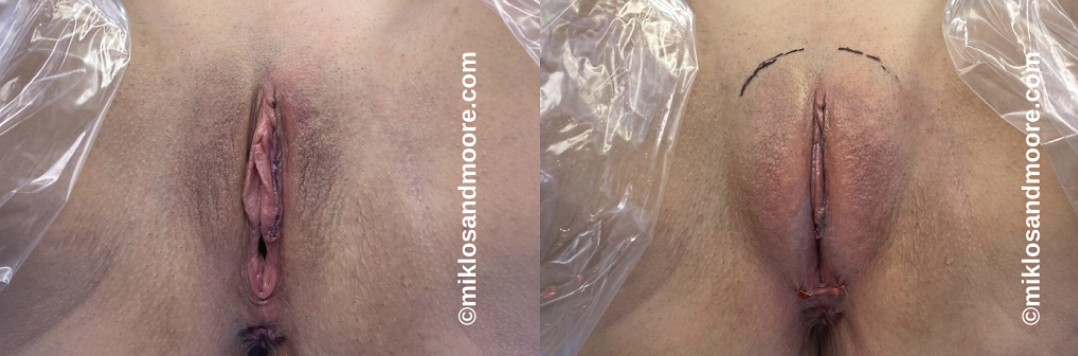
Before and after labia majora augmentation recovery photos demonstrating gradual healing, improved fullness, and natural-looking enhancement as swelling resolves.
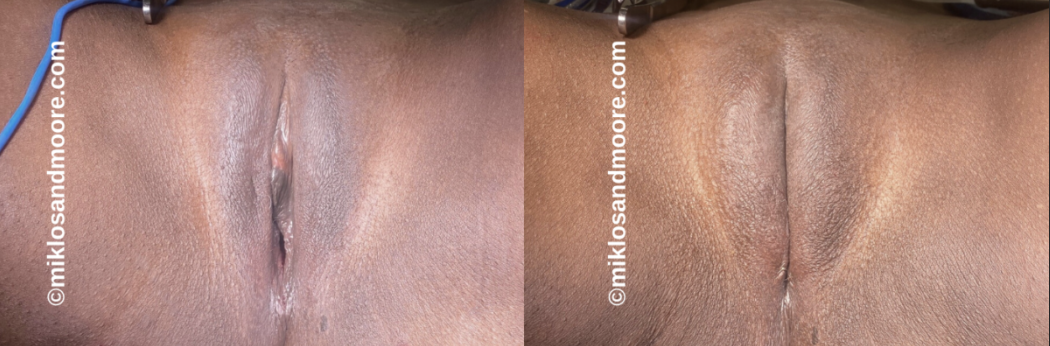
Healed before and after labia majora augmentation photos demonstrating natural-looking volume restoration and improved contour following full recovery.
Why Your Results Change Week by Week
One of the biggest surprises after fat transfer is that your appearance changes repeatedly.
During recovery you may notice:
- Significant swelling
- Extra fullness
- Gradual decrease in size
- Slight differences between each side
This is completely expected.
Initially, swelling makes the labia appear larger than the final result.
As swelling resolves, some of the injected fat is naturally absorbed while the remaining fat becomes permanent.
Some Fat Loss Is Expected
Unlike implants, fat transfer is a living tissue procedure.
Not every transferred fat cell survives.
Your body naturally absorbs a portion of the injected fat during healing.
For this reason, surgeons often account for expected absorption when planning treatment.
Patients should avoid judging their final results too early.
Avoid Pressure Whenever Possible
One of the most important recovery instructions involves minimizing unnecessary pressure.
Although normal daily movement is encouraged, excessive pressure placed directly on the treated area may interfere with early healing.
Patients are often advised to avoid:
- Long periods on hard chairs
- Tight shapewear
- Aggressive cycling
- Horseback riding
- Activities that repeatedly compress the vulva
These precautions help protect the newly transferred fat during its most vulnerable stage.
Why Sitting Feels Different
Many women describe a sensation of fullness rather than pain.
Common descriptions include:
- Soft pressure
- Mild tightness
- Awareness of increased volume
- Tenderness while sitting
These sensations gradually improve as swelling decreases and the transferred fat stabilizes.
The Donor Area Also Needs Time to Heal
If fat was harvested from another part of your body, recovery includes healing at two separate surgical sites.
Depending on the treatment area, patients may notice temporary soreness involving the:
- Abdomen
- Flanks
- Inner thighs
- Outer thighs
In many cases, discomfort from liposuction is greater than discomfort within the labia themselves.
Exercise Requires Patience
Walking is encouraged soon after surgery because it promotes healthy circulation.
More strenuous exercise should be delayed until both the donor site and fat graft have healed appropriately.
High-impact activities can increase swelling during the early recovery period.
Patients should gradually return to:
- Running
- Weight training
- Cycling
- Pilates
- Yoga
only after receiving clearance from their surgeon.
Don’t Worry if One Side Looks Fuller
Temporary asymmetry is extremely common.
This may result from:
- Different amounts of swelling
- Variable fat survival
- Natural anatomical differences
- Sleeping position
Most differences become less noticeable as healing progresses.
When Will I See My Final Volume?
Fat grafting requires patience.
Patients often experience three stages:
Stage One: Immediate fullness from swelling and newly placed fat.
Stage Two: Gradual decrease as swelling resolves and some fat is naturally absorbed.
Stage Three: Stable long-term volume after healing is complete.
Final results are generally evaluated several months after surgery.
Helping Your Fat Survive
Patients can support healing by:
- Avoiding nicotine
- Maintaining stable body weight
- Eating a nutritious diet
- Staying hydrated
- Following all postoperative instructions
- Avoiding unnecessary pressure on the treated area
Healthy circulation supports successful fat graft healing.
When Should You Contact Your Surgeon?
Although complications are uncommon, contact your surgeon if you develop:
- Rapidly increasing swelling
- Fever
- Severe redness
- Drainage from the incision
- Persistent worsening pain
- Large areas of firmness that continue enlarging
Prompt evaluation allows concerns to be addressed early.
Why Experience Matters
Fat grafting is as much an art as it is a surgical procedure. Achieving long-lasting volume depends on careful harvesting, gentle processing of the fat, precise placement, and meticulous postoperative management.
Dr. John Miklos and Dr. Robert Moore have extensive experience performing advanced cosmetic gynecologic procedures and have contributed to the field through peer-reviewed publications, international education, and decades of surgical innovation. Their refined techniques are designed to maximize fat survival while creating soft, natural-looking results.
Frequently Asked Questions
Will all of the injected fat survive?
No. Some fat absorption is expected and is a normal part of the healing process.
Why do I look bigger than expected?
Early swelling temporarily increases volume before the final result develops.
Is sitting dangerous after surgery?
Normal sitting is generally fine, but prolonged pressure on hard surfaces may be uncomfortable during the first few weeks.
Does gaining or losing weight affect my results?
Yes. Because transferred fat behaves like normal fat elsewhere in the body, significant weight changes can affect long-term volume.
When will I know my final results?
Most patients can better evaluate their results after several months, once swelling has resolved and the surviving fat has stabilized.