
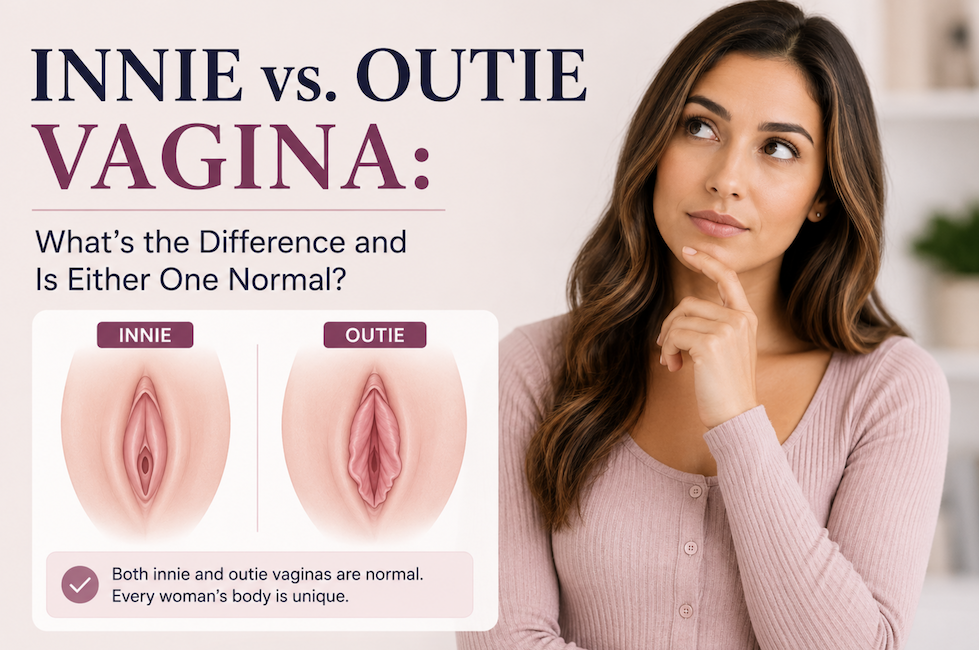
Innie vs. Outie Vagina: What’s the Difference and Is Either One Normal?
If You’ve Wondered Whether Your Anatomy Is “Normal,” You’re Far From Alone
One of the most common questions women search online is:
“Do I have an innie or an outie vagina?”
Many women first notice differences during puberty.
Others don’t think much about their anatomy until they become sexually active, have a baby, wear certain clothing, or compare themselves to images they see online.
Some worry because their inner lips seem to stick out.
Others wonder why one side looks different than the other.
Some even avoid intimacy because they believe something about their appearance isn’t normal.
The truth is that the phrase “innie vs. outie vagina” doesn’t actually describe the vagina itself.
Instead, women are usually talking about the appearance of the labia minora (the inner lips) and labia majora (the outer lips).
See Before and After Photos of Labiaplasty, Labia Minora Reduction and Labia Majora Reduction.
At the practice of Dr. John Miklos and Dr. Robert Moore in Alpharetta, Georgia, women from across the United States ask these same questions every day. Understanding the wide range of normal anatomy—and knowing when appearance or symptoms deserve evaluation—can help replace anxiety with accurate information.
What Is an “Innie” Vagina?
Although it isn’t a medical term, women generally use “innie” to describe external genital anatomy where the labia minora remain mostly inside the labia majora.
From the outside, the inner lips may be barely visible or not visible at all.
For many women, this is simply their natural anatomy.
It is neither healthier nor more attractive than any other variation.
What Is an “Outie” Vagina?
Again, “outie vagina” isn’t a medical diagnosis.
Most women use this phrase when the labia minora extend beyond the labia majora and are visible externally.
This is also completely normal.
In fact, research has shown tremendous variation in:
- Labia length
- Thickness
- Color
- Shape
- Symmetry
- Texture
Many women who believe their anatomy is “abnormal” actually fall well within the normal range of human variation.
Is One More Common Than the Other?
There is no universally accepted percentage because anatomy varies widely across populations and studies.
Many women have visible labia minora, while many others do not.
Some women have one side that extends farther than the other.
Others notice changes after childbirth, aging, weight fluctuations, or hormonal changes.
The important point is this:
There is no single “correct” appearance.
What About Uneven Labia?
One of the biggest concerns women have is asymmetry.
Questions like:
- “Why is one side bigger?”
- “Why is my left labia longer?”
- “Is it normal that they’re uneven?”
are extremely common.
Just like breasts, ears, feet, and hands, the labia are rarely perfectly symmetrical.
Mild to moderate asymmetry is considered normal.
When Does Labia Size Become a Problem?
For many women, prominent labia never cause any physical problems.
For others, symptoms may include:
- Discomfort in tight clothing
- Irritation while exercising
- Pain during cycling or horseback riding
- Pulling during intercourse
- Difficulty wearing swimsuits or leggings
- Hygiene concerns
- Recurrent irritation
When symptoms affect daily comfort or quality of life, an evaluation can help determine whether treatment may be appropriate.
Social Media Has Changed Expectations
Many women compare themselves to edited photographs, pornography, or filtered social media images.
Unfortunately, those images often represent only a narrow range of anatomy.
Real women have tremendous natural variation.
Understanding this can help reduce unnecessary anxiety about appearance.
When Do Women Consider Labiaplasty?
Some women seek labiaplasty for cosmetic reasons.
Others are primarily trying to relieve physical discomfort.
Common reasons women request an evaluation include:
- Chronic irritation
- Pain during exercise
- Discomfort during intercourse
- Difficulty wearing fitted clothing
- Labial twisting or pulling
- Long-standing self-consciousness
The decision is highly personal and should never be based on someone else’s idea of what is “normal.”
Why Women Choose Drs. John Miklos and Robert Moore
For decades, Dr. John Miklos and Dr. Robert Moore have specialized in cosmetic gynecology and female pelvic reconstructive surgery.
Women travel to their practice for evaluation of:
- Enlarged labia minora
- Labiaplasty
- Revision labiaplasty
- Clitoral hood reduction
- Vaginal rejuvenation
- Childbirth-related changes
- Functional discomfort during exercise or intimacy
- Cosmetic concerns about the vulva
Rather than focusing on appearance alone, they discuss each patient’s symptoms, goals, anatomy, and expectations to develop an individualized treatment plan. Their work has been recognized internationally, and they have authored numerous publications and educational materials on cosmetic gynecologic surgery.
Women Travel From Across the United States
Located in Alpharetta, Georgia, the practice welcomes women from Georgia, Florida, Alabama, Tennessee, North Carolina, South Carolina, as well as California, Texas, New York, Illinois, and many other states seeking specialized cosmetic gynecology care.
Every Woman’s Anatomy Is Unique
One of the most important things to remember is that there is no single “normal” vulva.
Some women naturally have an “innie.”
Others naturally have an “outie.”
Many fall somewhere in between.
The goal shouldn’t be to match an image you’ve seen online.
The goal is to understand your own anatomy, recognize what’s normal for you, and seek expert advice if you’re experiencing discomfort or have questions about your appearance.
Frequently Asked Questions
Is an outie vagina normal?
What most people call an “outie vagina” usually refers to labia minora that extend beyond the labia majora. This is a common and normal variation in anatomy.
Is an innie better than an outie?
No. Neither appearance is medically superior. Both represent normal anatomical variations.
Why are my inner lips sticking out?
Visible labia minora are usually a natural anatomical variation. They may also become more noticeable with puberty, childbirth, aging, or hormonal changes.
When should I consider labiaplasty?
Some women consider labiaplasty because of physical discomfort, irritation, or functional concerns. Others seek consultation because they are unhappy with the appearance of their labia. A consultation can help determine whether surgery is appropriate based on your individual symptoms and goals.