
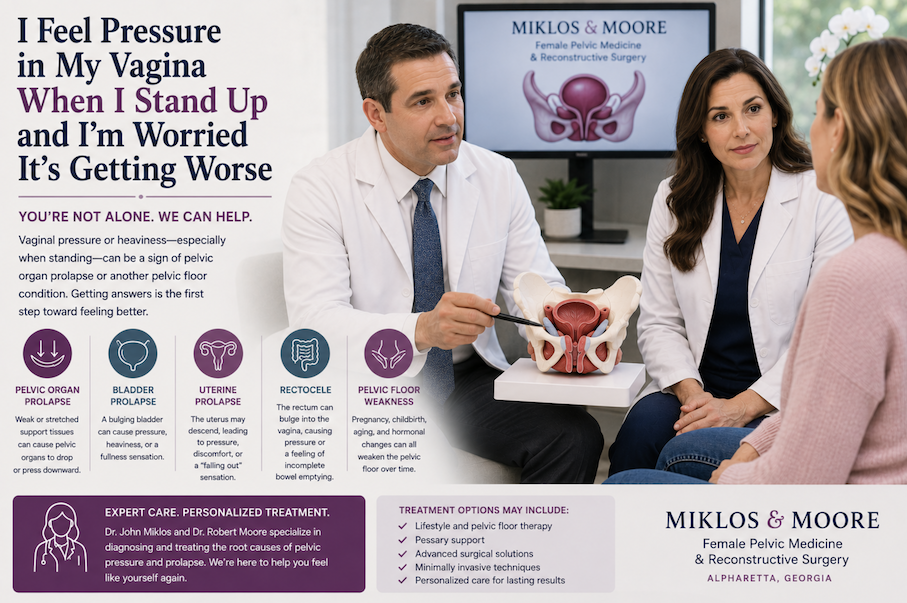
“I Feel Pressure in My Vagina When I Stand Up and I’m Worried It’s Getting Worse”
Why Pelvic Pressure Happens—and When It Could Be a Sign of Pelvic Organ Prolapse
It usually isn’t pain.
It’s pressure.
A heaviness.
A feeling that something is pushing downward.
Many women say they notice it the moment they stand up after sitting for a while.
Others feel it after walking through the grocery store, exercising, lifting their grandchildren, or spending a long day on their feet.
At first, you ignore it.
Then it starts happening more often.
Eventually, you begin wondering:
“Why does my vagina feel heavy when I stand?”
“Is something dropping?”
“Why does it feel better when I lie down?”
“Am I making it worse by walking?”
“Do I have pelvic organ prolapse?”
If you’ve searched any of those questions, you’re certainly not alone.
At the practice of Dr. John Miklos and Dr. Robert Moore in Alpharetta, Georgia, women from Georgia, Florida, Alabama, Tennessee, North Carolina, South Carolina, as well as California, Texas, New York, Illinois, and across the country often seek answers after developing pelvic pressure that becomes worse throughout the day.
What Does Pelvic Pressure Feel Like?
Every woman describes it differently.
Some say:
- “It feels like something is pulling downward.”
- “There’s a heavy feeling in my vagina.”
- “It feels like I’m carrying a weight.”
- “I feel pressure every time I stand.”
- “It feels like something is going to fall out.”
- “I feel better when I lie down.”
- “The pressure gets worse by evening.”
Those descriptions are extremely common among women with pelvic floor disorders, but they can also occur with several other conditions.
Why Does It Feel Worse When You Stand?
When you’re standing, gravity naturally places more pressure on the muscles and connective tissues that support your pelvic organs.
If those support structures have weakened—whether because of childbirth, aging, menopause, chronic straining, or previous surgery—you may notice symptoms become more obvious while upright.
Many women report that symptoms improve after:
- Lying down
- Sleeping overnight
- Resting
- Avoiding heavy lifting
That pattern can provide an important clue during your evaluation.
What Conditions Can Cause Vaginal Pressure?
Pelvic pressure isn’t a diagnosis.
It may be associated with:
- Pelvic organ prolapse
- Bladder prolapse (cystocele)
- Rectocele
- Uterine prolapse
- Vaginal vault prolapse after hysterectomy
- Pelvic floor muscle dysfunction
- Chronic constipation with straining
- Less commonly, other pelvic or gynecologic conditions
Because several conditions can produce similar symptoms, an examination is important to determine the underlying cause.
Childbirth and Menopause Often Change the Pelvic Floor
Pregnancy and vaginal delivery can stretch the muscles and connective tissues that support the bladder, uterus, vagina, and rectum.
Menopause may also contribute to changes in tissue strength and elasticity because of hormonal changes.
These changes don’t affect every woman the same way, but they help explain why pelvic pressure often appears months or years after childbirth—or later in life.
The Symptom Is Physical—But the Worry Is Emotional
Many women say the hardest part isn’t the pressure itself.
It’s wondering what it means.
They think:
“Am I damaging something every time I walk?”
“Should I stop exercising?”
“Will this eventually require surgery?”
“Can this suddenly become an emergency?”
Those questions are understandable.
Fortunately, most pelvic organ prolapse symptoms are not emergencies, and a careful evaluation can usually determine what’s causing the pressure and what treatment options may help.
Why Women Choose Drs. John Miklos and Robert Moore
For more than twenty years, Dr. John Miklos and Dr. Robert Moore have devoted their practice to Female Pelvic Medicine and Reconstructive Surgery and cosmetic gynecology.
They evaluate women experiencing:
- Pelvic pressure
- Pelvic organ prolapse
- Bladder prolapse
- Rectocele
- Uterine prolapse
- Vaginal vault prolapse
- Urinary incontinence
- Vaginal laxity
- Childbirth-related pelvic floor injuries
- Complex revision pelvic surgery
Because their practice focuses specifically on female pelvic floor disorders, they evaluate not only the anatomy but also how symptoms affect each woman’s comfort, daily activities, exercise, intimacy, and overall quality of life.
Women Travel From Across the United States
Located in Alpharetta, Georgia, Drs. Miklos and Moore care for women from Georgia, Florida, Alabama, Tennessee, North Carolina, South Carolina, as well as California, Texas, New York, Illinois, Arizona, Virginia, Colorado, Pennsylvania, Ohio, and many other states.
Many patients travel specifically because of the physicians’ experience caring for women with both primary and recurrent pelvic floor disorders.
You Don’t Have to Keep Wondering Why It Feels Heavy
Pelvic pressure is one of the most common reasons women seek a pelvic floor evaluation.
While it can certainly be caused by pelvic organ prolapse, there are several possible explanations, and each requires a different treatment approach.
The first step isn’t assuming the worst.
It’s understanding what’s happening.
Once you know the cause, you and your physician can discuss treatment options that fit your symptoms, your lifestyle, and your goals.
Frequently Asked Questions
Why does my vagina feel heavy when I stand?
A heavy feeling when standing can occur with pelvic organ prolapse, bladder prolapse, pelvic floor muscle dysfunction, or other pelvic conditions. A medical evaluation can help identify the cause.
Why does the pressure improve when I lie down?
Lying down reduces the effect of gravity on the pelvic organs, which is why many women notice temporary symptom relief while resting.
Does pelvic pressure always mean I have prolapse?
No. Although prolapse is a common cause, pelvic pressure can also result from other pelvic floor disorders or gynecologic conditions.
Should I stop exercising if I feel pressure?
Not necessarily. The safest approach depends on the cause of your symptoms. A pelvic floor specialist can recommend activities that are appropriate for your condition.