
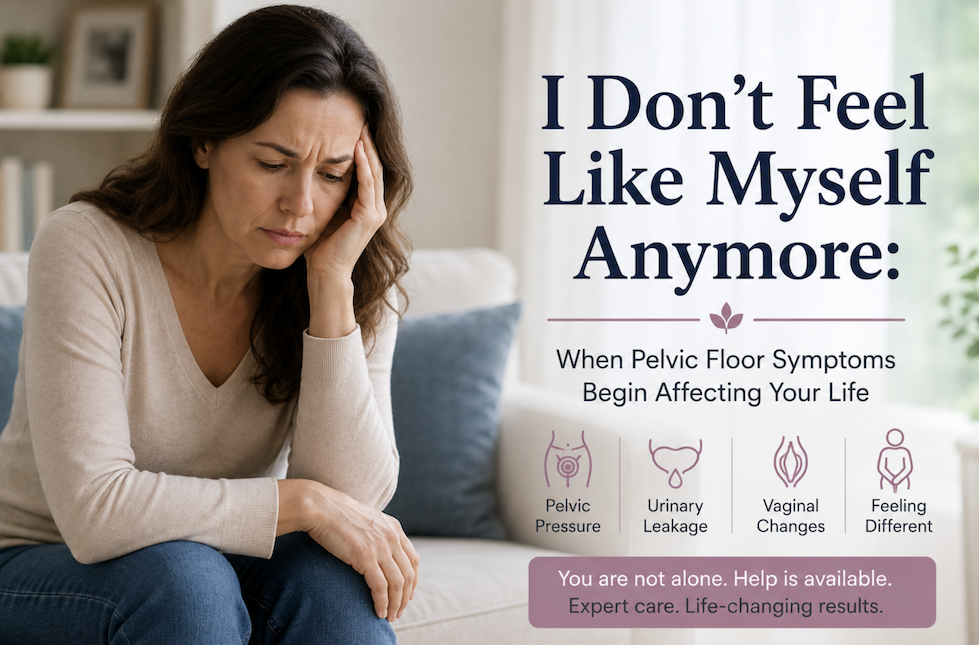
I Don’t Feel Like Myself Anymore: When Pelvic Floor Symptoms Begin Affecting Your Life
“I can’t really explain it…I just don’t feel like myself anymore.”
This may be one of the most honest things a woman can say.
Maybe you’ve noticed little changes over the past few months.
Or maybe everything changed after having a baby.
Perhaps it happened gradually during menopause.
At first, the symptoms seemed small.
A little urine leakage when you laughed.
A feeling of pressure after standing.
Sex didn’t feel the same.
You stopped wearing certain clothes.
You avoided long walks.
You quietly started planning your day around the nearest restroom.
None of those changes happened overnight.
But one day you realized something bigger had changed.
You.
Not just your body.
Your confidence.
Your routine.
Your relationships.
Your quality of life.
If that’s where you are today, know this:
You’re not being dramatic.
You’re not imagining your symptoms.
And you are certainly not alone.
Sometimes It’s Not One Big Problem
One of the biggest misconceptions about pelvic floor disorders is that they appear suddenly.
More often, they develop gradually.
One symptom becomes two.
Two become four.
You adapt.
Then adapt again.
Many women tell us:
“I didn’t realize how much my life had changed until I stopped doing the things I loved.”
Small Changes Can Add Up
Maybe you’ve started:
- Wearing pads every day.
- Avoiding exercise.
- Skipping pickleball or tennis.
- Crossing your legs every time you sneeze.
- Declining invitations because bathrooms aren’t nearby.
- Avoiding intimacy.
- Lifting less than you used to.
- Feeling anxious during long car rides.
Each decision may seem small.
Together, they can dramatically affect how you experience everyday life.
Your Symptoms May Be Connected
Women often assume each symptom is unrelated.
For example:
“The bladder leakage is probably age.”
“The pressure is probably childbirth.”
“The pain during sex must be menopause.”
In reality, those symptoms may all be connected.
Conditions such as:
- Pelvic organ prolapse
- Stress urinary incontinence
- Overactive bladder
- Pelvic floor muscle dysfunction
- Vaginal laxity
- Hormonal changes
can occur together.
Understanding how they interact is often the key to developing an effective treatment plan.
You Don’t Need to Know What’s Wrong
One of the biggest concerns we hear is:
“I don’t even know what to ask for.”
That’s okay.
You don’t need to know whether you have a cystocele, rectocele, stress urinary incontinence, vaginal atrophy, or pelvic floor dysfunction.
Your job isn’t to diagnose yourself.
Your job is simply to explain what’s changed.
That’s enough.
Childbirth and Menopause Are Common Turning Points
For many women, symptoms begin:
After pregnancy.
After childbirth.
During menopause.
Or gradually as the years pass.
That doesn’t mean every woman develops pelvic floor disorders.
But these life events can affect:
- Muscles
- Ligaments
- Connective tissues
- Hormones
- Bladder support
- Vaginal tissues
The result is that women with very different diagnoses often begin with exactly the same thought:
“Something just isn’t right anymore.”
What Happens During Your Evaluation?
One of the first things we ask isn’t about surgery.
It isn’t even about your bladder.
Instead, we ask a simple question:
“How have your symptoms changed your life?”
That answer often tells us more than any imaging study.
Have you stopped exercising?
Do you avoid intimacy?
Are you worried about leaking urine?
Do you constantly think about where the nearest restroom is?
Have you stopped traveling?
Those everyday experiences help us understand the true impact of your symptoms.
Next comes a comprehensive pelvic floor evaluation.
Rather than focusing on one complaint in isolation, we evaluate how your symptoms fit together. We examine bladder support, pelvic floor muscles, vaginal tissues, pelvic organ support, prior childbirth injuries, previous surgeries, and hormonal changes. Just as importantly, we listen carefully to your goals. Some women want to return to running. Others want to travel without worrying about bladder leakage. Others simply want to feel comfortable again.
That patient-centered philosophy has guided Dr. John Miklos and Dr. Robert Moore throughout their careers. They understand that women don’t come to the office asking for a specific operation—they come because something about their lives has changed. By combining decades of experience with careful listening, thoughtful evaluation, peer-reviewed research, and advanced expertise in Female Pelvic Medicine and Reconstructive Surgery, they work to identify not just the diagnosis, but the treatment plan that best fits each woman’s lifestyle and priorities.
Treatment Should Fit Your Life
There isn’t one treatment for every woman.
Depending on your diagnosis, treatment may include:
- Pelvic floor physical therapy
- Lifestyle modifications
- Hormonal therapy
- Bladder treatments
- Pessary fitting
- Vaginal rejuvenation
- Pelvic reconstructive surgery
- Urinary incontinence procedures
- Combination treatment for multiple pelvic floor disorders
The goal isn’t simply correcting anatomy.
The goal is helping you return to the life you want to live.
You Deserve to Feel Like Yourself Again
Many women wait years before asking for help.
Not because they don’t have symptoms.
Because they assume those symptoms are simply part of getting older.
Or part of having children.
Or something they should “just live with.”
You don’t have to settle for that.
Whether your symptoms are mild or severe, understanding what’s happening is the first step toward feeling more like yourself again.
Frequently Asked Questions
Is it normal to feel different after childbirth or menopause?
Many women notice changes during these life stages, but persistent symptoms deserve evaluation because many are treatable.
What if I don’t know what’s causing my symptoms?
You don’t need to know. Describing your symptoms is enough to begin the diagnostic process.
Could several symptoms be related?
Yes. Many pelvic floor conditions affect multiple parts of the pelvis at the same time.
Does every woman need surgery?
No. Many women improve with conservative treatment depending on their diagnosis.
What if I’ve been living with this for years?
It’s never too late to seek an evaluation. Many women are surprised to learn that treatment options are still available.
How do I know where to start?
Start by describing how your body feels and how your symptoms have affected your life. From there, a comprehensive evaluation can help identify the underlying cause.
Conclusion
If you’ve been telling yourself, “I just don’t feel like myself anymore,” don’t ignore that feeling. Pelvic floor disorders often affect much more than the bladder or vagina—they can change confidence, relationships, physical activity, and everyday routines.
The encouraging news is that you don’t have to figure everything out on your own. By understanding what has changed and why, you can work with a specialist to create a personalized treatment plan that helps you move forward—not just with fewer symptoms, but with the confidence to enjoy your life again.