
Hormone-Related Clitoral Enlargement: Evaluation and Treatment Options
Testosterone and other androgen-based hormone treatments can cause the clitoris to become larger or more prominent in some women. For some, this change causes no problems, while others may experience protrusion, increased sensitivity, irritation from clothing, physical discomfort, or concerns about appearance.
Dr. John Miklos and Dr. Robert Moore evaluate women with clitoral enlargement associated with testosterone or hormone therapy, as well as concerns involving clitoral protrusion, clitoral hood anatomy, and previous genital surgery. A careful evaluation can determine whether the change involves the clitoris itself, surrounding hood tissue, or a combination of factors and whether treatment may be appropriate.
Request a consultation with Miklos & Moore to discuss clitoral enlargement, hormone-related changes, and available treatment options.
Understanding Clitoral Enlargement Associated With Testosterone and Hormone Therapy
Women taking testosterone or other hormone treatments may notice changes in their genital anatomy that they did not expect. One of these changes can be an enlarged clitoris, sometimes referred to medically as clitoromegaly.
For some women, the change is relatively minor and causes no concern. For others, the clitoris may become noticeably larger or more prominent, protrude beyond the surrounding clitoral hood or labial tissue, become unusually sensitive, rub against clothing, or create a cosmetic change that makes the woman uncomfortable or self-conscious.
Because testosterone can influence clitoral tissue, women who use testosterone therapy may wonder whether their treatment is responsible for the change, whether the enlargement is permanent, and whether anything can be done about it.
At Miklos & Moore Urogynecology, Dr. John Miklos and Dr. Robert Moore evaluate women with concerns involving clitoral enlargement, protrusion, clitoral hood anatomy, genital changes associated with hormone therapy, and other complex cosmetic and functional concerns involving the female genitalia.
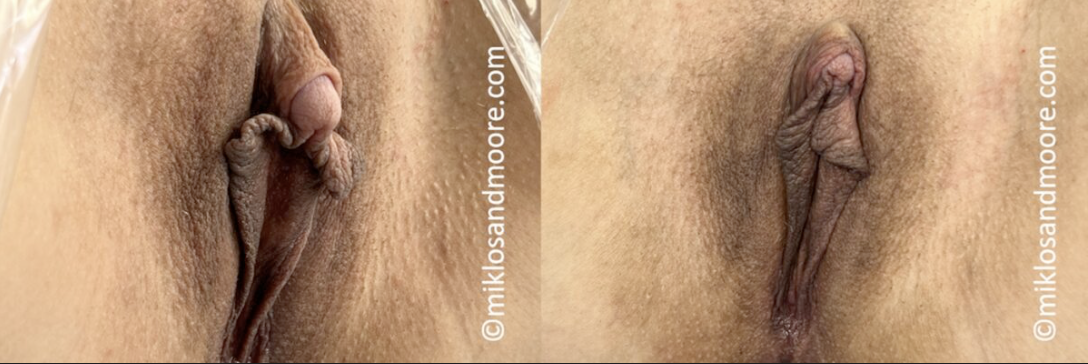
Before and after results showing surgical treatment of a significantly enlarged and protruding clitoris.
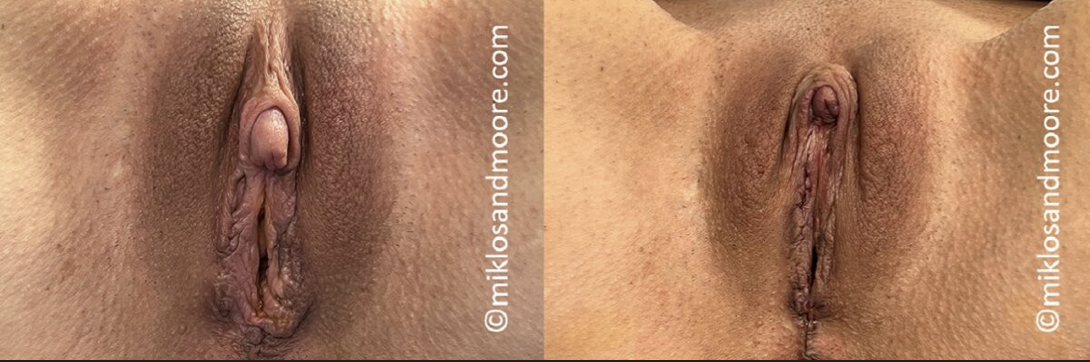
Before and after photographs demonstrating correction of a prominent, enlarged clitoris and improvement in surrounding anatomy.
Can Testosterone Cause an Enlarged Clitoris?
Yes. Testosterone and other androgens can stimulate androgen-sensitive tissue, including clitoral tissue.
The clitoris contains erectile tissue and responds to hormones. Increased androgen exposure can cause the clitoral body and glans to increase in size in some individuals.
The degree of enlargement can vary substantially.
Some women experience little or no noticeable change, while others may develop a more prominent clitoris over time.
Factors that may influence these changes include:
- Testosterone dosage
- Duration of treatment
- Individual sensitivity to androgens
- Baseline anatomy
- Blood testosterone levels
- Other medications or hormones
- Underlying endocrine conditions
- Previous hormone exposure
Not every woman using testosterone will develop significant clitoral enlargement.
Why Are Women Prescribed Testosterone?
Testosterone may be prescribed to selected women for specific medical reasons, including certain sexual health concerns, although approved indications and prescribing practices vary by country and individual clinical circumstances.
Women may also encounter testosterone through compounded hormone preparations, pellets, creams, injections, or other hormone regimens.
The important issue is that genital changes can occur when the body’s tissues are exposed to increased androgen levels.
A woman noticing unexpected clitoral enlargement while taking hormones should discuss the change with the clinician managing her hormone therapy.
She should not discontinue prescribed hormone treatment solely because of information found online without first discussing the situation with her healthcare provider.
What Does Testosterone-Related Clitoral Enlargement Look Like?
The appearance varies considerably between women.
Some notice that the clitoral glans has simply become easier to see. Others notice that the clitoris extends farther beyond the clitoral hood than it did previously.
Possible changes include:
- Increased clitoral length
- Increased clitoral width
- Greater prominence beneath the clitoral hood
- Clitoral protrusion
- Increased visibility when standing
- Changes in the relationship between the clitoris and labia
- Increased sensitivity
- More noticeable erectile changes during arousal
The distinction between the clitoris itself and the clitoral hood is important.
A woman may believe her clitoris has enlarged when the primary concern actually involves excess, asymmetric, or prominent clitoral hood tissue. Conversely, genuine enlargement of the clitoral body or glans requires a different evaluation.
An experienced examination can help distinguish between these conditions.
Can an Enlarged Clitoris Protrude?
Yes.
As clitoral tissue becomes larger, the clitoris may become more visible or extend beyond the surrounding clitoral hood.
Some women describe this as having a:
- Protruding clitoris
- Large clitoris
- Long clitoris
- Exposed clitoris
- Clitoris that sticks out
- Clitoris that has become larger after testosterone
These descriptions may refer to different anatomical situations, which is why evaluation is important before discussing treatment.
Is Clitoral Enlargement Dangerous?
Clitoral size varies naturally, and having a larger clitoris does not automatically indicate that something is medically wrong.
However, new or unexplained clitoral enlargement deserves medical evaluation, particularly when the woman is not intentionally receiving androgen therapy or when the change occurs rapidly.
Increased androgen levels can have several possible causes, and the appropriate evaluation depends on the patient’s age, medications, symptoms, medical history, and timing of the change.
Women may also notice other signs of increased androgen activity, such as changes in body or facial hair, acne, scalp hair changes, or voice changes.
The objective is to understand why the clitoris has changed before deciding whether anything should be done about its appearance.
Physical Problems From a Protruding or Enlarged Clitoris
Many women with clitoral enlargement have no physical problems whatsoever.
For others, increased prominence can cause practical concerns.
A protruding clitoris may have increased contact with:
- Tight pants
- Underwear
- Exercise clothing
- Bicycle seats
- Horseback riding equipment
- Certain sitting positions
- Sexual activity
Constant friction may produce irritation or uncomfortable hypersensitivity in some women.
Others may experience discomfort because previously protected clitoral tissue is now more exposed.
These symptoms should be evaluated individually rather than assuming that clitoral size alone is the problem.
Changes in Clitoral Sensitivity
Testosterone-related clitoral growth may also be accompanied by changes in sensation.
Some women report increased sensitivity, while others primarily notice an anatomical change without a major difference in sensation.
Clitoral sensation is extremely important when considering any surgical procedure involving this area.
The clitoris has a complex nerve and vascular supply. Any surgical treatment involving the clitoris or surrounding tissues must therefore prioritize preservation of sensation, blood supply, and sexual function.
This is one reason women considering surgery in this area should seek a surgeon with specific experience operating on clitoral and surrounding genital anatomy.
The Emotional Impact of Unexpected Clitoral Enlargement
An unexpected change in intimate anatomy can be emotionally difficult.
Some women become self-conscious because their genital appearance no longer looks the way it did previously. Others may feel embarrassed with a partner or worry that the change will continue.
These concerns should not be dismissed.
At the same time, there is a wide range of normal female genital anatomy, and a larger or more visible clitoris does not automatically require treatment.
The appropriate question is whether the change is causing a problem for the individual woman.
If she is comfortable with the change and there is no underlying medical concern, treatment may not be necessary.
If she is experiencing physical discomfort or is personally distressed by the change, an evaluation can help determine what options exist.
Will the Clitoris Return to Its Previous Size if Testosterone Is Stopped?
This is one of the most common questions women ask.
There is no single answer.
The degree to which androgen-related clitoral enlargement changes after testosterone is reduced or discontinued can vary. Some hormone-related effects may diminish, while established structural enlargement may not completely return to the previous size.
Several factors may matter, including the amount of enlargement, duration and degree of androgen exposure, and individual tissue response.
Women should not change prescribed testosterone therapy without consulting the healthcare professional managing their hormones.
If the enlargement remains bothersome after the hormonal situation has been evaluated, a specialist can assess the anatomy and discuss whether any additional treatment is appropriate.
Could Something Other Than Testosterone Be Causing the Enlargement?
Yes.
This is particularly important when a woman develops clitoral enlargement without known testosterone or androgen exposure.
Possible causes of clitoral enlargement can include congenital anatomical variation and certain hormonal or endocrine conditions. Less commonly, localized anatomical abnormalities can also create the appearance of enlargement.
Because the causes differ, unexplained or rapidly developing enlargement should receive an appropriate medical evaluation.
A cosmetic procedure should not be the first step when the underlying cause has not been established.
Clitoris or Clitoral Hood: Knowing the Difference Matters
This distinction is extremely important.
The clitoris and clitoral hood are different anatomical structures.
Some women who believe they have an enlarged clitoris actually have prominent clitoral hood tissue. In others, both structures may contribute to the appearance.
Clitoral hood reduction is designed to modify excess or redundant hood tissue. It is not the same procedure as surgery intended to address actual clitoral enlargement.
Similarly, clitoropexy addresses clitoral position and support and is not interchangeable with clitoral hood reduction or clitoral reduction surgery.
Selecting the wrong procedure because the anatomy was misunderstood could produce an unsatisfactory result.
The diagnosis must come first.
Can an Enlarged Clitoris Be Surgically Reduced?
Surgical procedures addressing true clitoral enlargement exist, but they require careful patient selection and specialized surgical expertise.
The goal should never simply be to remove tissue because the clitoris appears large.
Preservation of nerves, blood supply, sensation, and sexual function must be central to surgical planning.
The appropriate approach depends upon:
- The actual size and anatomy of the clitoris
- Degree of protrusion
- Clitoral hood anatomy
- Cause of the enlargement
- Symptoms
- Hormonal status
- Previous surgery
- Patient goals
Some women may discover that the concern can be addressed through surrounding tissue rather than directly altering clitoral tissue. Others may not be appropriate surgical candidates at all.
Why Experience With Clitoral Surgery Matters
Surgery involving the clitoral region is not routine cosmetic surgery.
The anatomy contains important sensory nerves and blood vessels that must be respected.
Dr. John Miklos and Dr. Robert Moore have extensive experience in cosmetic gynecology, vaginal reconstruction, clitoral hood procedures, clitoropexy, revision genital surgery, and complex female pelvic anatomy.
Their background as urogynecologic and reconstructive surgeons allows them to evaluate both the cosmetic concern and the underlying anatomy before recommending treatment.
This is especially important when a woman has undergone previous surgery, has unusual anatomy, or is considering a procedure involving the clitoris itself.
What Happens During an Evaluation?
The consultation begins by understanding when the change occurred and why it is concerning to the patient.
Important information may include:
- When the enlargement was first noticed
- Whether the change occurred gradually or rapidly
- Current and previous testosterone use
- Other hormone treatments
- Medication history
- Changes in clitoral sensitivity
- Physical discomfort
- Sexual function
- Previous genital surgery
- Other symptoms suggesting increased androgen exposure
- The patient’s cosmetic concerns and goals
The examination can then determine whether the concern involves true clitoral enlargement, protrusion, clitoral hood tissue, clitoral position, or a combination of anatomical factors.
When appropriate, additional medical or hormonal evaluation may be recommended before any surgical treatment is considered.
Treatment Should Be Individualized
There is no single “normal” clitoral size that every woman should have.
Treatment should therefore never be based solely on a measurement or photograph.
The important considerations are the cause of the enlargement, the patient’s anatomy, whether she has physical symptoms, whether the appearance personally bothers her, and whether treatment can be performed without creating unnecessary risk.
For some women, reassurance and observation may be appropriate.
Others may need adjustment or evaluation of their hormone therapy by the prescribing clinician.
Selected patients with persistent anatomical concerns may wish to discuss surgical options.
Enlarged Clitoris After Testosterone: When to Seek an Expert Opinion
Consider seeking an evaluation if:
- Your clitoris has noticeably enlarged after starting testosterone
- The enlargement continues to progress
- Your clitoris has become uncomfortable or excessively exposed
- Clothing or exercise causes irritation
- You are concerned about a major change in appearance
- You are unsure whether the clitoris or clitoral hood is enlarged
- You are considering surgery
- Another physician has recommended clitoral surgery
- You developed enlargement without taking testosterone
- You have previously undergone clitoral or cosmetic gynecologic surgery
An expert evaluation can clarify the anatomy and help determine whether treatment is necessary or advisable.
Enlarged Clitoris Evaluation at Miklos & Moore
Women concerned about clitoral enlargement after testosterone or hormone therapy deserve an individualized evaluation rather than a one-size-fits-all solution.
Dr. John Miklos and Dr. Robert Moore evaluate women with complex cosmetic and functional concerns involving the clitoris, clitoral hood, labia, vagina, and surrounding pelvic anatomy.
The objective is first to determine what has changed, why it may have changed, and exactly which anatomical structure is responsible for the concern.
Only then should treatment options be considered.
Request a consultation with Miklos & Moore to discuss clitoral enlargement, protrusion, changes associated with testosterone or hormone therapy, and available treatment options.
Frequently Asked Questions
Can testosterone make a woman’s clitoris bigger?
Yes. The clitoris is androgen-responsive tissue, and increased testosterone exposure can cause clitoral growth in some women.
Is clitoral growth from testosterone permanent?
The degree of persistence varies. Established structural enlargement may not completely reverse after testosterone is reduced or discontinued. Women taking prescribed testosterone should discuss any medication changes with their prescribing clinician.
Why does my clitoris stick out more after starting testosterone?
Growth of clitoral tissue can make the glans or clitoral body more prominent and less completely covered by surrounding tissue. An examination can determine whether the change involves the clitoris itself, the clitoral hood, or both.
Is having a large clitoris abnormal?
Not necessarily. Clitoral anatomy varies considerably among women. New or unexplained enlargement, however, may warrant medical evaluation to determine the cause.
Can an enlarged clitoris cause discomfort?
It can in some women. Increased exposure may result in rubbing, irritation, or hypersensitivity from clothing, exercise, or other activities.
Can clitoral enlargement be treated surgically?
Surgical options exist for selected patients, but procedures involving true clitoral tissue require specialized expertise because preservation of sensation, nerves, and blood supply is essential.
Is clitoral hood reduction the same as reducing an enlarged clitoris?
No. Clitoral hood reduction modifies surrounding hood tissue. It does not reduce the clitoris itself. Determining which structure is causing the concern is essential before selecting a procedure.
Should I stop testosterone if my clitoris becomes enlarged?
Do not stop or change prescribed hormone therapy solely because of online information. Discuss the change with the clinician who prescribed or manages your testosterone treatment.