
Can Hormones Change the Size of the Clitoris
Testosterone and other androgen hormones can influence the size and prominence of the clitoris. Some women may notice clitoral growth after testosterone therapy or other forms of increased androgen exposure, while others experience little or no visible change.
When clitoral enlargement or protrusion persists and becomes a functional or cosmetic concern, treatment options may be available. Clitoropexy is a specialized procedure designed to reduce excessive clitoral projection and create a more natural appearance while prioritizing sensation and sexual function.
How Hormones Affect Clitoral Size
Women taking testosterone or experiencing hormonal changes sometimes notice differences in their genital anatomy and ask an important question: Does testosterone make the clitoris grow?
The answer is yes, testosterone can affect clitoral size.
The clitoris is responsive to androgen hormones, particularly testosterone and dihydrotestosterone (DHT). When androgen exposure becomes sufficiently elevated, especially over an extended period of time, clitoral tissue may increase in size.</p>
However, taking testosterone does not automatically mean that a woman will develop a significantly enlarged clitoris. The response varies considerably and can depend on testosterone dosage, blood hormone levels, duration of treatment, age, baseline anatomy, individual sensitivity to androgens, and other hormonal factors.
When a woman notices that her clitoris has become larger or more prominent, it is also important to determine exactly what has changed. There is a significant anatomical difference between an enlarged or protruding clitoris and excess clitoral hood tissue.
At Miklos & Moore, identifying the cause of the change and the anatomy involved is an important first step before considering treatment.
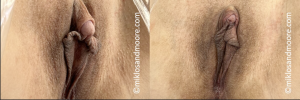
Before and after clitoropexy showing surgical correction of an enlarged and protruding clitoris associated with testosterone exposure.
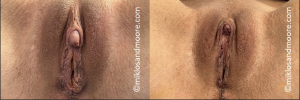
Real patient clitoropexy results showing reduced prominence of a clitoris enlarged following testosterone exposure.
Why Can Testosterone Make the Clitoris Grow?
Although testosterone is often considered a male hormone, women naturally produce testosterone as well.
The female body contains androgen receptors, and clitoral tissue is particularly responsive to androgen hormones. Testosterone and DHT can influence the development and characteristics of this tissue.
When androgen levels become substantially elevated, the clitoris may respond by becoming larger, longer, or more prominent.
Significant persistent enlargement of the clitoris is commonly referred to medically as clitoromegaly.
It is important to distinguish this from the normal temporary enlargement that occurs during sexual arousal. The clitoris contains erectile tissue and naturally becomes larger as blood flow increases during arousal.
Clitoromegaly refers to a more persistent anatomical enlargement rather than this temporary physiologic response.
Does Taking Testosterone Always Make the Clitoris Bigger?
No.
Women respond differently to testosterone.
Some women taking medically prescribed testosterone may notice little or no visible change in the clitoris. Others may notice changes in sensitivity, fullness, prominence, or size.
The amount of androgen exposure is particularly important.
Testosterone therapy that is carefully prescribed and monitored to maintain appropriate female hormone levels is very different from exposure to substantially elevated testosterone concentrations.
Greater androgen exposure may increase the likelihood of androgen-related physical changes.
Factors that can influence clitoral growth include:
- Testosterone dosage
- Blood testosterone levels
- Duration of testosterone exposure
- Individual androgen sensitivity
- Age
- Baseline clitoral anatomy
- Other medications or hormones
- Underlying endocrine conditions
Women receiving prescribed testosterone should have their therapy appropriately monitored by the healthcare professional managing their hormones.
What Hormones Affect the Size of the Clitoris?
Androgens are the hormones most directly associated with clitoral growth.
These include testosterone and DHT.
However, the overall appearance and health of the clitoral and vulvar region can also be influenced by other hormones.
Estrogen plays an important role in maintaining the health, elasticity, blood flow, moisture, and quality of vulvar and vaginal tissues.
As estrogen levels decline during menopause, these tissues may become thinner or change in appearance. These changes can sometimes make the clitoral region look or feel different even when the clitoris itself has not undergone significant androgen-related growth.
For this reason, evaluating a change in clitoral appearance should involve more than simply measuring testosterone.
What Is Clitoromegaly?
Clitoromegaly means an abnormally enlarged clitoris.
There is considerable natural variation in female genital anatomy, so having a relatively prominent clitoris does not automatically indicate a medical problem.
The more important issue is whether the clitoris has changed significantly or progressively enlarged.
A woman who has always had a prominent clitoris may simply have normal anatomical variation.
A woman whose clitoris has recently become noticeably larger, particularly when accompanied by other hormonal changes, may benefit from an evaluation to determine the cause.
What Else Can Cause an Enlarged Clitoris?
Testosterone medication is not the only possible cause of clitoral enlargement.
Other potential causes can include excessive androgen production, certain ovarian or adrenal conditions, congenital hormonal conditions, exposure to anabolic-androgenic steroids, and other medications or hormonal products.
Signs of excessive androgen activity may occur along with clitoral enlargement and can include:
- Increased facial or body hair
- Acne
- Menstrual changes
- Changes in scalp hair
- Increased muscle development
- Deepening of the voice
- Other signs of masculinization
New or progressive clitoral enlargement should therefore not automatically be considered a cosmetic issue.
Determining why the change occurred is important before considering treatment.
Can PCOS Cause an Enlarged Clitoris?
Polycystic ovary syndrome, commonly known as PCOS, can be associated with elevated androgen levels.
However, significant clitoral enlargement is not typical for most women with PCOS.
If a woman develops substantial or progressive clitoral growth, particularly when other androgen-related symptoms are present, additional evaluation may be appropriate rather than simply assuming PCOS is responsible.
The degree and speed of the change can be clinically important.
Can Anabolic Steroids Make the Clitoris Larger?
Yes.
Anabolic-androgenic steroids can produce substantial androgen exposure in women and may cause physical changes associated with increased androgen activity.
One potential change is clitoral enlargement.
The degree of enlargement varies depending on the substance, dosage, duration of use, and individual response.
Women being evaluated for unexplained clitoral enlargement should tell their physician about testosterone, anabolic steroids, hormone pellets, supplements, or other hormonal products they are taking or have previously taken.
What Is the Difference Between an Enlarged Clitoris and a Large Clitoral Hood?
This is an extremely important distinction.
The clitoris and clitoral hood are different anatomical structures.
The clitoris contains erectile tissue and an extensive network of nerves. Only a portion of the entire clitoral structure is externally visible.
The clitoral hood, also called the prepuce, is the fold of tissue that surrounds and protects the external portion of the clitoris.
Women naturally have considerable variation in the amount and distribution of clitoral hood tissue.
A woman may therefore have:
- An elongated or protruding clitoris
- An enlarged clitoris
- Excess clitoral hood tissue
- Asymmetrical clitoral hood tissue
- A combination of clitoral prominence and excess hood tissue
This distinction becomes especially important when considering surgery because clitoropexy and clitoral hood reduction are not the same operation.
Can Testosterone Change the Appearance of the Clitoral Hood?
Testosterone primarily affects androgen-responsive tissue, but enlargement or increased prominence of the clitoris can change the overall appearance of the surrounding anatomy.
For example, a clitoris that projects farther outward may make the relationship between the clitoris and clitoral hood look different.
Conversely, a woman may believe that her clitoris has enlarged when the primary issue is actually the amount or distribution of clitoral hood tissue.
An examination can help determine which structure is responsible for the change in appearance.
Will the Clitoris Shrink After Stopping Testosterone?
There is no single answer that applies to every woman.
Some hormone-related changes may become less noticeable when excessive androgen exposure is reduced. However, established clitoral tissue growth may not completely return to its previous size.
The amount of change depends on factors such as:
- Degree of enlargement
- Testosterone dosage
- Duration of exposure
- Underlying hormonal condition
- Individual tissue response
Women taking medically prescribed testosterone should not discontinue their medication solely because they notice a change without first discussing the issue with the healthcare professional managing their hormone therapy.
When Should Clitoral Enlargement Be Evaluated?
Consider an evaluation when the clitoris:
- Has noticeably increased in size
- Continues to become larger
- Has become significantly more prominent
- Causes irritation from clothing
- Creates discomfort during exercise
- Becomes excessively exposed or sensitive
- Changes after beginning testosterone therapy
- Changes after using anabolic steroids or other hormones
- Is accompanied by other signs of excessive androgen activity
The evaluation should determine whether the concern involves the clitoris itself, the clitoral hood, surrounding vulvar tissue, or a combination of these structures.
Can an Enlarged or Protruding Clitoris Cause Problems?
Not every enlarged or prominent clitoris requires treatment.
Some women have naturally prominent anatomy and experience no physical or aesthetic concerns.
For others, an enlarged or protruding clitoris may cause irritation, rubbing against clothing, discomfort with exercise, excessive exposure or sensitivity, or dissatisfaction with its appearance.
Treatment should therefore be based on the individual woman’s symptoms, anatomy, and personal concerns, not simply the size or appearance of the clitoris.
What Procedure Can Reduce an Enlarged or Protruding Clitoris?
When the clitoris remains significantly elongated or protruding after the underlying cause has been appropriately evaluated, clitoropexy may be an option.
Clitoropexy is a specialized cosmetic gynecologic procedure designed to address an elongated or excessively protruding clitoris.
It is important to understand that clitoropexy is not simply cutting away or removing the clitoris.
Instead, the procedure is designed to reposition the protruding clitoral tissue so that less of the clitoris projects externally. This can create a smaller and less prominent external appearance while preserving the clitoral structures that are important for sensation and sexual function.
How Does Clitoropexy Make the Clitoris Appear Smaller?
Sometimes what a patient describes as an excessively large clitoris is actually a clitoris that is elongated and projects too far outward.
Clitoropexy can reposition this tissue into a more anatomically appropriate position.
By reducing excessive external projection, the visible portion of the clitoris can appear shorter, smaller, and less prominent.
The surgical objective should be to improve the position and appearance of the clitoris while placing significant emphasis on preserving:
- Clitoral sensation
- Important nerve structures
- Blood supply
- Sexual function
- Natural anatomy
This is why clitoropexy is a highly specialized procedure and should not be confused with simply excising clitoral tissue.
Can Clitoropexy Help After Testosterone-Related Clitoral Growth?
Potentially.
If testosterone or another source of excessive androgen exposure contributed to clitoral enlargement, the hormonal cause should first be evaluated.
This is important because continued excessive androgen exposure may continue to influence androgen-sensitive tissue.
Once the hormonal situation has been appropriately addressed, a woman who continues to have significant clitoral elongation, protrusion, discomfort, or aesthetic concerns may be considered for clitoropexy.
The decision is individualized.
Surgery should not be viewed as a substitute for identifying and treating an underlying hormonal disorder.
Clitoropexy vs. Clitoral Hood Reduction
Women researching clitoral surgery frequently confuse these two procedures.
They address different anatomical problems.
Clitoropexy addresses an elongated or protruding clitoris by repositioning the clitoris and reducing excessive external projection.
Clitoral hood reduction addresses excess folds of tissue surrounding or covering the clitoris.
Reducing the clitoral hood alone does not correct an elongated or protruding clitoris.
In fact, removing excessive hood tissue without recognizing an underlying prominent clitoris could potentially leave the clitoris looking even more exposed.
Some women have both an elongated or prominent clitoris and excess clitoral hood tissue. In appropriately selected patients, more than one procedure may be considered to create a balanced result.
Why Experience Matters With Clitoropexy
The clitoris is one of the most neurologically sensitive structures in the female body.
Surgery involving this region requires an extensive understanding of clitoral anatomy, nerves, blood supply, supporting structures, and surrounding vulvar tissues.
Dr. John Miklos and Dr. Robert Moore are double board-certified in Obstetrics and Gynecology and Female Pelvic Medicine & Reconstructive Surgery and have extensive experience in female pelvic reconstructive and cosmetic vaginal surgery.
Their approach to a patient concerned about clitoral enlargement begins by determining exactly what is causing the problem.
Important questions include:
Is the clitoris actually enlarged?
Is it elongated or excessively protruding?
Could testosterone or another hormone be contributing to the change?
Is excess clitoral hood tissue creating the appearance of enlargement?
Does the patient have both clitoral and clitoral hood concerns?
Should an underlying hormonal condition be addressed before surgery?
Only after understanding the anatomy, symptoms, hormonal factors, and patient’s goals should surgical treatment be considered.
For women who ultimately choose clitoropexy, the goal is not simply to make the clitoris smaller. The objective is to achieve a more natural position and proportion while prioritizing preservation of sensation and sexual function.
Frequently Asked Questions About Testosterone and Clitoral Growth
Does testosterone make a woman’s clitoris bigger?
Yes. The clitoris is responsive to androgen hormones, and sufficiently elevated or prolonged testosterone exposure can cause clitoral tissue to grow. However, the degree of change varies considerably between women.
What hormone causes the clitoris to grow?
Androgens, particularly testosterone and DHT, are most directly associated with clitoral growth.
Does every woman who takes testosterone develop an enlarged clitoris?
No. The response depends on testosterone levels, dosage, duration of exposure, individual sensitivity, baseline anatomy, and other factors.
Can high testosterone naturally cause an enlarged clitoris?
Yes. Certain conditions associated with significant androgen excess can contribute to clitoral enlargement. New or progressive enlargement should be medically evaluated.
Can PCOS cause clitoral enlargement?
PCOS can cause elevated androgen levels, but significant clitoral enlargement is not typical for most women with PCOS. Noticeable progressive growth deserves further evaluation.
Will my clitoris return to its original size if I stop testosterone?
Not necessarily. Some changes may become less noticeable after androgen levels decrease, while established tissue enlargement may persist.
What surgery can make a protruding clitoris appear smaller?
Clitoropexy can be used in appropriately selected patients to reposition an elongated or protruding clitoris and decrease its external prominence.
Does clitoropexy remove part of the clitoris?
The objective of clitoropexy is not simply to remove the clitoris. It is a specialized procedure intended to reposition excessive clitoral projection while prioritizing preservation of important neurovascular structures and sexual function.
Is clitoropexy the same as clitoral hood reduction?
No. Clitoropexy addresses the position and projection of the clitoris itself, while clitoral hood reduction addresses excess surrounding hood tissue. Some patients may have concerns involving both structures.
When should I see a specialist about an enlarged clitoris?
New, progressive, uncomfortable, or unexplained clitoral enlargement should be evaluated, particularly when it develops after hormonal treatment or occurs with other signs of elevated androgen levels.
Understanding the Cause Comes First
A change in clitoral size does not automatically mean that surgery is necessary.
Testosterone and other androgens can influence clitoral tissue, but hormonal exposure is only one possible explanation for a prominent or enlarged clitoris. Some women have naturally elongated anatomy, while others actually have excess clitoral hood tissue rather than enlargement of the clitoris itself.
For this reason, the first step should be determining what changed, why it changed, and which anatomical structure is responsible.
When a woman continues to have significant clitoral elongation or protrusion after hormonal and medical causes have been appropriately evaluated, clitoropexy may provide a surgical option for reducing external prominence and improving clitoral position while prioritizing sensation and function.