
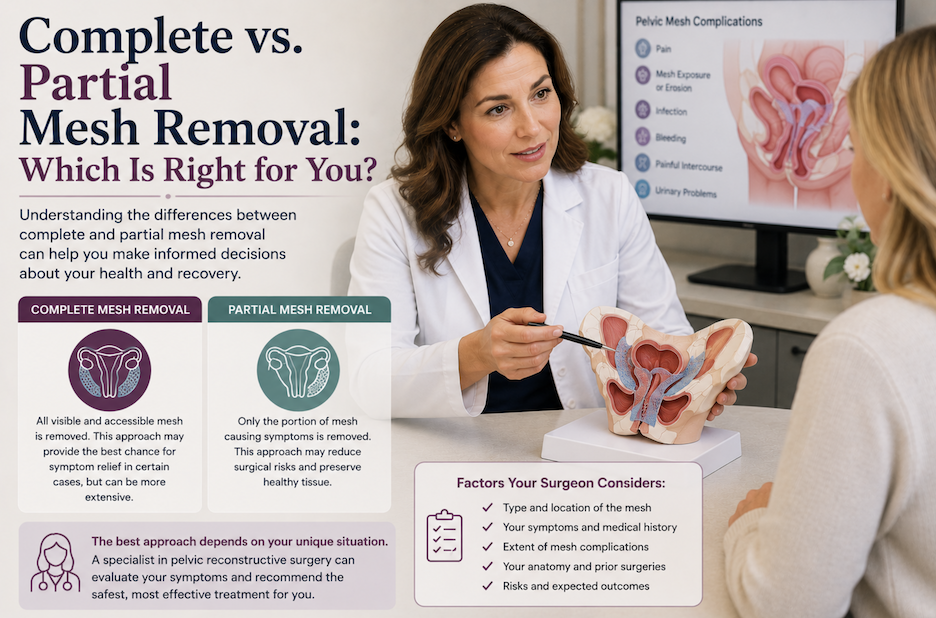
Complete vs. Partial Mesh Removal: Which Is Right for You?
Concerned About Pelvic Mesh? Understanding Your Surgical Options
If you’ve been told you may need pelvic mesh removal, one of the first questions you may ask is:
- Can all of the mesh be removed?
- Should only part of the mesh be removed?
- What’s the difference between complete and partial mesh removal?
- Which approach offers the best chance of relieving my symptoms?
The answer is different for every woman.
At Miklos & Moore, treatment begins with one goal: identifying the true source of your symptoms and determining the safest and most effective treatment for your individual situation. In some cases that may involve removing a small exposed portion of mesh. In others, a more extensive revision or complete mesh excision may be recommended.
Not Every Mesh Removal Is the Same
The term “mesh removal surgery” actually describes a wide range of procedures.
Depending on your condition, surgery may involve:
- Removal of an exposed portion of mesh
- Partial mesh excision
- Extensive mesh revision
- Complete mesh removal when medically appropriate and technically feasible
- Reconstruction of the surrounding pelvic tissues
The correct operation depends on your symptoms, anatomy, prior surgeries, and the location of the implanted mesh.
Why Complete Mesh Removal Can Be More Complex
Over time, surgical mesh becomes incorporated into the body’s tissues as part of the healing process. Scar tissue develops around the implant, and the mesh may lie close to the bladder, urethra, bowel, blood vessels, nerves, and pelvic support structures.
Because of this, complete mesh removal is often significantly more challenging than the original operation and requires meticulous surgical planning.
Is Complete Mesh Removal Always Necessary?
No.
The goal of surgery is not simply to remove as much mesh as possible—it is to improve symptoms while minimizing unnecessary risk.
Some women experience excellent results after removal of only the portion of mesh responsible for their symptoms. Others may benefit from a more extensive or complete excision.
The decision should be based on careful evaluation rather than a one-size-fits-all approach.
Why Experience Matters
Women seeking mesh revision surgery often have complex histories that may include:
- Previous prolapse surgery
- Bladder sling procedures
- Chronic pelvic pain
- Recurrent prolapse
- Urinary incontinence
- Multiple prior pelvic operations
These cases frequently require an individualized treatment plan that addresses more than the mesh itself.
A Comprehensive Approach to Mesh Revision
Drs. John Miklos and Robert Moore have devoted a substantial portion of their practice to caring for women with complex pelvic floor disorders, including patients seeking evaluation after prior mesh procedures. Their educational resources on mesh complications and revision surgery are among the most comprehensive available from a pelvic reconstructive surgery practice, reflecting their commitment to helping women understand their options before making treatment decisions.
When a patient is an appropriate candidate, they have experience performing extensive mesh revision procedures, including complete mesh excision when it is medically indicated and technically feasible. Just as importantly, they recognize that complete removal is not the right solution for every patient. Their recommendations are guided by anatomy, symptoms, surgical history, and the treatment most likely to improve long-term quality of life.
Choosing the Right Operation
Every woman deserves an individualized evaluation—not a predetermined operation.
Whether your treatment involves observation, conservative management, partial revision, or complete mesh removal, the goal is the same: to identify the true cause of your symptoms and recommend the approach that offers the greatest potential benefit while preserving pelvic function.
Frequently Asked Questions
Is complete mesh removal always possible?
Not always. The feasibility depends on the type of mesh, its location, surrounding scar tissue, and the relationship to nearby organs and nerves.
Is complete mesh removal always better than partial removal?
No. The best procedure is the one that addresses the source of your symptoms while balancing potential benefits and surgical risks.
Can Miklos & Moore perform complete mesh removal?
When medically appropriate and technically feasible, Drs. Miklos and Moore perform extensive mesh revision procedures, including complete mesh excision. The recommended approach is determined after a comprehensive evaluation of each patient’s individual case.