
CLITOROPEXY RECOVERY: WHY SURGICAL EXPERIENCE MATTERS
Recovering from clitoropexy involves more than allowing an incision to heal. Because the procedure is performed around one of the most delicate and highly innervated areas of the female anatomy, careful surgical technique plays an important role in postoperative comfort, healing, and the preservation of normal sensation. Drs. Miklos and Moore have performed thousands of cosmetic and reconstructive vaginal procedures and have developed techniques that emphasize meticulous tissue handling, precise anatomical restoration, and long-term function. Their individualized postoperative protocols, detailed follow-up care, and decades of experience help patients recover with confidence while achieving natural-looking, balanced results. Most women experience progressive improvement over the first several weeks, with continued refinement as swelling resolves and the tissues fully heal.
Clitoropexy Recovery: Healing, Swelling, Sensation & What to Expect After Surgery
For many women, deciding to undergo clitoropexy is the culmination of years of feeling self-conscious about the appearance of their genital anatomy. Whether performed alone or combined with a labiaplasty, clitoropexy is designed to create a more balanced relationship between the clitoris, clitoral hood, and surrounding labial tissues. While the cosmetic improvement is often immediately noticeable in the operating room, the recovery process requires patience, realistic expectations, and an understanding of how this delicate area heals.
Unlike procedures that simply remove excess skin, clitoropexy involves carefully repositioning and supporting tissue around one of the most sensitive anatomical structures in the female body. For that reason, many patients have questions that extend beyond swelling and bruising. They want to know whether sensation will change, how long tenderness lasts, when they can safely return to exercise, and whether intimacy will feel different after healing is complete.
These concerns are entirely normal.
The reassuring news is that most women recover more comfortably than expected. During the first several weeks, swelling, firmness, and temporary changes in sensation are common, but they gradually improve as healing progresses. Understanding these normal stages can prevent unnecessary anxiety and help patients focus on the steady improvements that occur throughout recovery.
At Miklos & Moore, Dr. John Miklos and Dr. Robert Moore have devoted decades to female pelvic reconstructive and cosmetic gynecologic surgery. Their experience extends well beyond cosmetic procedures alone. As internationally recognized urogynecologists, they have published numerous peer-reviewed scientific papers, taught advanced surgical techniques throughout the world, and developed procedures that emphasize both cosmetic refinement and preservation of normal function.
Their approach to clitoropexy is based on one simple principle: achieving a beautiful result should never compromise healthy anatomy or normal sensation.
Understanding What Clitoropexy Actually Changes
One reason patients become anxious during recovery is that many do not fully understand what was changed during surgery.
Clitoropexy is frequently confused with clitoral hood reduction, but they are not the same procedure.
A clitoral hood reduction primarily removes excess folds of skin covering the clitoris.
A clitoropexy, on the other hand, focuses on repositioning and supporting the tissues surrounding the clitoris to create a more harmonious appearance while maintaining the natural protective function of the hood.
Rather than simply removing skin, the procedure reshapes the relationship between several delicate structures. This means that the body must heal not only the skin incision but also the deeper tissues that were carefully repositioned during surgery.
Although these deeper tissues heal very reliably, they require time to stabilize.
This is why patients are encouraged to avoid judging their results during the first several weeks.
The appearance seen immediately after surgery is only the beginning of a much longer healing process.
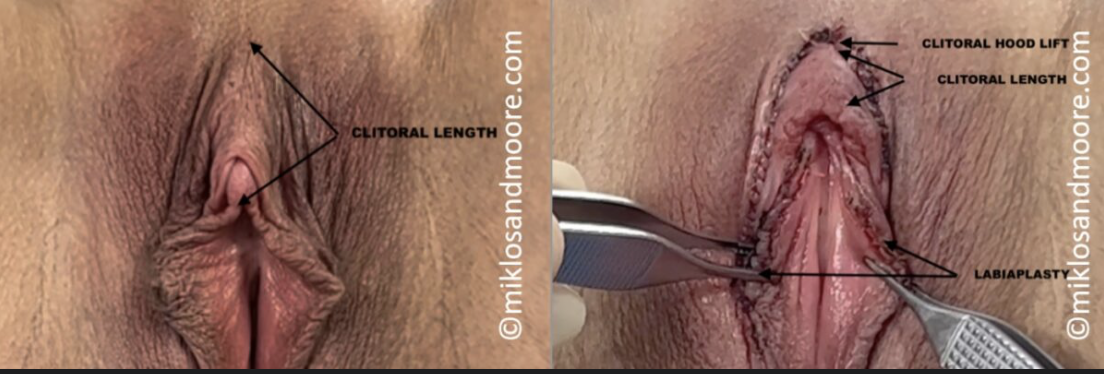
Before and after clitoropexy recovery images illustrating the healed appearance following surgery to reposition and refine the clitoral hood. Individual healing and surgical outcomes vary.
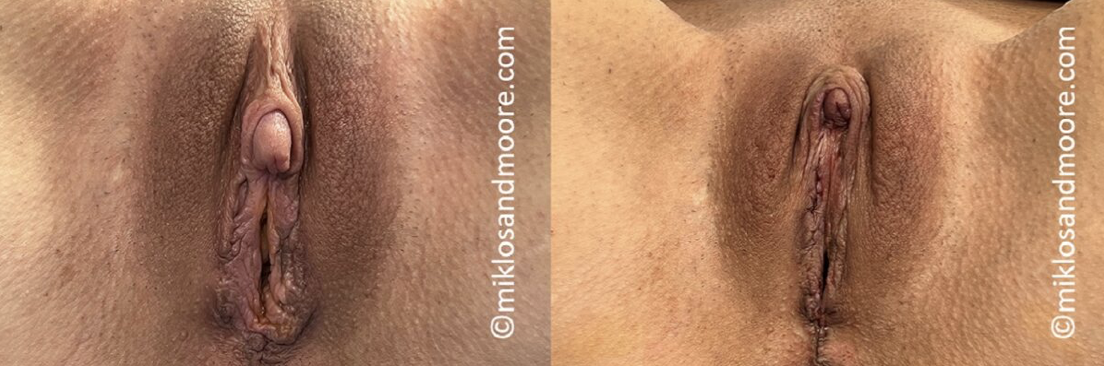
Clitoropexy recovery before and after photographs demonstrating the appearance after healing from clitoral repositioning surgery. Individual recovery times and results vary.
Why Recovery Is Different Than Other Cosmetic Vaginal Procedures
Every cosmetic gynecologic procedure has its own recovery pattern.
Labiaplasty patients often focus on incision healing.
Labia majora surgery patients usually notice pressure while sitting.
Fat transfer patients concentrate on protecting the transferred fat.
Clitoropexy recovery is different because patients are primarily aware of changes in tissue support and sensitivity.
The area often feels different long before it looks different.
Many women describe:
- A feeling of fullness.
- Mild pressure.
- Increased awareness of the clitoral region.
- Temporary sensitivity when clothing touches the area.
- Tightness while walking.
These sensations usually improve gradually as swelling decreases and the tissues adapt to their new position.
Because the clitoris contains an exceptionally rich network of sensory nerves, even minor swelling can temporarily change how the area feels during everyday activities.
Fortunately, these changes are usually temporary and become much less noticeable over time.
How Healing Begins Immediately After Surgery
Although patients often think healing starts once they arrive home, the recovery process actually begins while surgery is still taking place.
As soon as the procedure is completed, the body activates an intricate repair system.
Tiny blood vessels seal themselves.
Specialized inflammatory cells move into the surgical area.
Collagen production begins almost immediately.
These microscopic events cannot be seen, but they form the foundation for everything that follows over the coming months.
During the first several days, inflammation is actually beneficial.
It supplies oxygen, nutrients, and healing cells to the tissues while protecting the incision from infection.
Although swelling is often frustrating for patients, it represents one of the body’s most important healing mechanisms.
Without this early inflammatory response, wounds would not heal properly.
Understanding this helps explain why trying to eliminate all swelling is neither possible nor desirable.
The goal is healthy healing—not the complete absence of inflammation.
The First 48 Hours
Most women are pleasantly surprised by the amount of discomfort they experience during the first two days.
Rather than severe pain, patients typically describe:
- Mild soreness.
- Tightness.
- Fullness.
- Pressure.
- Increased sensitivity while walking.
Because local anesthetic is often used during surgery, discomfort may be minimal immediately afterward before gradually increasing later in the day.
During this period, resting is more important than remaining completely inactive.
Short walks around the house every few hours help maintain healthy circulation while avoiding unnecessary strain on the surgical site.
Many patients also become concerned when they first look at the surgical area.
Common findings include:
- Significant swelling.
- Mild bruising.
- Temporary asymmetry.
- Puffiness around the hood.
- Small amounts of spotting.
These findings are expected.
Perhaps the most important thing patients should remember is this:
The appearance during the first week has very little relationship to the final cosmetic result.
The tissues have not yet had an opportunity to settle into their new position.
Swelling alone can temporarily obscure nearly all of the refinement created during surgery.
For that reason, experienced surgeons encourage patients to evaluate their progress over months—not days.
The First Month of Clitoropexy Recovery
One of the most important things to understand after clitoropexy is that healing happens in stages. The incision may appear to heal fairly quickly, but the deeper tissues that were repositioned during surgery require considerably more time to stabilize.
For this reason, recovery should not be judged by how the area looks from one day to the next. Instead, focus on gradual improvement over several weeks and months.
Most patients notice meaningful progress every week, even though temporary swelling and sensitivity may fluctuate throughout the healing process.
Days 1–3: The Body Begins Stabilizing the Repair
During the first several days, your body is focused entirely on protecting and stabilizing the surgical site.
Inflammation increases blood flow to the area, allowing oxygen, nutrients, and healing cells to begin repairing the tissues that were repositioned during surgery.
Because clitoropexy involves supporting delicate tissue—not simply removing skin—it is completely normal to experience:
- A feeling of fullness
- Mild pressure beneath the hood
- Swelling around the clitoris
- Bruising
- Tightness while walking
- Minor spotting
Many women are surprised that discomfort is usually less intense than anticipated. Most describe recovery as feeling “different” rather than painful.
It is also common to become extremely aware of the surgical area during these first few days. Clothing that never attracted attention before may suddenly feel noticeable simply because the tissues are swollen.
This heightened awareness gradually improves as inflammation decreases.
Week One: Protecting the Surgical Repair
Unlike procedures that involve only skin, clitoropexy requires time for the deeper tissues to adapt to their new position.
Although the repair is secure, this is not the time to test it.
Patients are encouraged to avoid activities that place unnecessary pressure or repetitive movement on the healing tissues.
Examples include:
- Running
- Cycling
- Heavy lifting
- Squatting exercises
- Horseback riding
- Prolonged standing when possible
Normal walking is encouraged because it promotes healthy circulation, but moderation is important.
Many patients notice that swelling increases slightly toward the evening after spending more time on their feet.
This daily fluctuation is completely normal.
Morning often becomes the best time to evaluate healing because swelling has usually improved overnight.
Week Two: Swelling Begins to Reveal the Surgical Contour
By the second week, most patients begin noticing meaningful improvement.
The tissues often feel:
- Softer
- Less tender
- More comfortable while walking
- Less sensitive to clothing
Although swelling remains present, it usually begins revealing the improved contour created during surgery.
Many women worry because one side appears different from the other.
Perfect symmetry during recovery should never be expected.
One side frequently heals faster than the other due to natural differences in circulation, anatomy, and postoperative swelling.
As healing continues, these temporary differences often become much less noticeable.
Weeks Three and Four: Recovery Becomes Less Noticeable
During the third and fourth weeks, most women report thinking about the surgical site much less frequently.
Daily activities generally become easier.
Walking feels increasingly natural.
Tenderness continues improving.
The tissues begin feeling less firm as collagen remodeling progresses beneath the surface.
Although patients often assume healing is complete at this point, important changes are still occurring internally.
The supporting tissues continue strengthening while swelling gradually resolves.
Patience remains important because the final cosmetic appearance continues evolving for several months.
Changes in Sensation: What Is Normal?
Because clitoropexy involves tissue surrounding one of the body’s most sensitive structures, temporary changes in sensation are among the most common recovery concerns.
Fortunately, most of these changes represent normal healing rather than complications.
Increased Sensitivity
Some women notice that the clitoral area feels more sensitive than before surgery.
This may include:
- Increased awareness while walking
- Clothing feeling more noticeable
- Mild tenderness
- Greater sensitivity during light touch
These sensations are usually related to swelling rather than permanent changes in nerve function.
As inflammation decreases, sensitivity typically becomes much more comfortable.
Temporary Decreased Sensation
Other patients experience the opposite.
Instead of increased sensitivity, they notice temporary numbness around portions of the hood.
This occurs because swelling can temporarily alter how nearby nerve endings transmit sensation.
Small sensory nerves also require time to recover after surgery.
Most women notice gradual improvement as healing progresses.
Nerve recovery is considerably slower than skin healing, making patience especially important during the first several months.
Tingling and Itching
As tiny nerve fibers recover, unusual sensations frequently develop.
Patients commonly describe:
- Tingling
- Itching
- Brief “electric” sensations
- Pins and needles
- Occasional shooting sensations
Although these feelings can seem unusual, they often represent normal nerve recovery rather than a problem.
Many patients are reassured to learn that these symptoms usually become less frequent over time.
Five Recovery Concerns That Cause the Most Anxiety
Every week, Dr. Miklos and Dr. Moore answer many of the same recovery questions.
Fortunately, most concerns have reassuring explanations.
“The Clitoris Looks More Prominent Than Before.”
This is one of the most common misconceptions during early recovery.
Patients often expect immediate cosmetic improvement.
Instead, swelling temporarily enlarges the surrounding tissues, making the clitoral region appear more prominent.
As swelling resolves, the tissues gradually settle into their intended position.
Evaluating appearance during the first several weeks almost always leads to unnecessary worry.
“One Side Is Healing Faster.”
Completely symmetrical healing is uncommon.
One side may:
- Swell more.
- Bruise more.
- Feel firmer.
- Remain more sensitive.
This usually reflects normal healing rather than a surgical problem.
“The Area Feels Too Tight.”
Many women notice a feeling of tightness while walking or changing positions.
This occurs because the tissues are adapting to their new support while collagen develops beneath the surface.
The sensation gradually improves as swelling decreases and the tissues become more flexible.
“I Can Feel Small Firm Areas.”
Small areas of firmness beneath the skin commonly represent:
- Healing collagen
- Temporary swelling
- Normal scar maturation
- Dissolving sutures
These areas usually soften naturally over the following months.
“I’m Looking at It Every Few Hours.”
Perhaps the most common recovery mistake is examining the surgical site repeatedly throughout the day.
Swelling naturally changes from morning to evening.
Looking too frequently often creates unnecessary anxiety because small daily changes are mistaken for setbacks.
Patients are generally better served by comparing their recovery from week to week rather than hour to hour.
Most women are pleasantly surprised by how much improvement they recognize once they stop focusing on every minor fluctuation.
Returning to Normal Activities After Clitoropexy
One of the most encouraging parts of recovery is reaching the point where you stop thinking about the surgical area every time you move. Most women notice that each week becomes progressively easier, but it is important to remember that healing on the inside continues long after the skin appears healed.
Clitoropexy is unique because the procedure repositions and supports tissue around the clitoris. While the external incision often heals quickly, the deeper tissues need time to stabilize in their new position. Giving your body that time is one of the most important factors in achieving an excellent long-term result.
Returning to Work
Most patients who work at a desk are able to return within several days to one week, depending on their comfort level and whether additional procedures, such as labiaplasty, were performed at the same time.
During the first week back at work, it helps to:
- Stand and stretch every hour.
- Avoid sitting in one position all day.
- Wear loose, comfortable clothing.
- Stay hydrated throughout the day.
Women whose jobs involve prolonged standing, frequent bending, heavy lifting, or strenuous physical activity may require additional recovery time before returning to full duties.
Recovery should never be based solely on the calendar. If swelling increases significantly after returning to work, your body may simply be telling you to slow down for a few more days.
Exercise: Protecting the Surgical Repair
One of the biggest misconceptions about clitoropexy is that once discomfort improves, normal exercise can immediately resume.
Feeling better and being fully healed are not the same thing.
Although the incision may look excellent after several weeks, the tissues supporting the clitoris are still strengthening beneath the surface. Excessive movement or repetitive friction too early in recovery may increase swelling and discomfort.
Walking remains the best exercise during the early recovery period because it promotes healthy circulation without placing excessive stress on the surgical site.
Higher-impact activities should be resumed gradually after clearance from your surgeon.
Activities that typically require the greatest patience include:
- Running
- HIIT workouts
- Cycling
- Spin classes
- Horseback riding
- Rowing
- Heavy squats
- Deadlifts
- High-impact aerobics
Rather than trying to return to your previous fitness level immediately, increase activity gradually over several weeks. Mild swelling after your first few workouts is not unusual and often resolves with rest.
Clothing Can Make Recovery Easier
Patients are often surprised by how much clothing affects comfort after surgery.
Because the clitoral region is exposed to constant movement during walking, clothing that creates friction may become uncomfortable during the first several weeks.
Most women feel best wearing:
- Cotton underwear
- Loose shorts
- Soft pajama bottoms
- Athletic pants with minimal seams
- Loose dresses or skirts
Many temporarily avoid:
- Thongs
- Tight leggings
- Skinny jeans
- Compression garments
- Clothing with heavy stitching across the vulva
As swelling improves, patients usually transition back to their normal wardrobe without difficulty.
When Can You Resume Sexual Activity?
This is understandably one of the most common questions after clitoropexy.
Although many patients feel physically well within several weeks, intimacy places unique stresses on the tissues that were repositioned during surgery. Even gentle sexual activity creates movement and pressure that may interfere with healing if resumed too early.
For that reason, sexual activity should only resume after your surgeon confirms that healing is sufficient.
Many women also discover that the emotional aspect of returning to intimacy is just as significant as the physical recovery.
Questions such as:
- Will everything feel normal?
- Will I notice increased sensitivity?
- Will the area feel different?
- Will my partner notice a difference?
are extremely common.
Fortunately, these concerns usually diminish as healing progresses.
Some women experience temporary increased sensitivity during the early weeks.
Others notice temporary numbness.
Still others simply describe a feeling that the area is “different” because swelling has not completely resolved.
These sensations generally become more natural over time as the tissues soften and adapt.
The most important advice is not to judge the long-term functional result during the first several weeks of recovery.
Long-Term Healing
One of the greatest mistakes patients make is assuming recovery ends when the stitches dissolve.
In reality, healing continues long after the incision has closed.
Over the following months:
- Swelling continues decreasing.
- Scar tissue softens.
- Collagen remodels.
- Supporting tissues become stronger.
- Sensation continues normalizing.
- The final contour gradually develops.
Many women notice subtle improvements for several months after surgery.
This gradual refinement is one reason experienced surgeons encourage patience before evaluating the final cosmetic outcome.
When Should You Contact Your Surgeon?
Although complications are uncommon, certain symptoms deserve prompt evaluation.
You should contact your surgeon if you experience:
- Heavy bleeding
- Rapidly increasing swelling
- Fever over 101°F
- Thick drainage or foul odor
- Increasing redness surrounding the incision
- Severe pain that worsens instead of improving
- Difficulty urinating
- Separation of the incision
Fortunately, most postoperative concerns prove to be part of normal healing rather than true complications.
If you are uncertain whether something is normal, it is always appropriate to contact your surgeon.
Why Surgeon Experience Matters
Clitoropexy is one of the most technically demanding procedures in cosmetic gynecology because it requires balancing aesthetics with preservation of normal anatomy and function.
Removing too much tissue or placing unnecessary tension on delicate structures can affect both appearance and recovery. Successful surgery depends on understanding the intricate relationship between the clitoris, clitoral hood, surrounding blood vessels, sensory nerves, and supporting tissues.
Dr. John Miklos and Dr. Robert Moore have dedicated their careers to female pelvic reconstructive and cosmetic surgery. They have authored numerous peer-reviewed scientific publications, developed innovative surgical techniques, and trained physicians throughout the United States and internationally. Their extensive experience allows them to perform clitoropexy with careful attention to both cosmetic refinement and preservation of normal sensation.
Patients benefit not only from their surgical expertise but also from comprehensive postoperative care, individualized recovery plans, and close follow-up throughout the healing process.
Frequently Asked Questions
How long does clitoropexy recovery take?
Most women return to many normal daily activities within one to two weeks. Complete tissue remodeling, scar maturation, and resolution of subtle swelling may continue for several months.
Is swelling normal after clitoropexy?
Yes. Swelling is expected and often reaches its peak during the first few days before gradually improving. Temporary fullness does not reflect the final surgical result.
Will clitoropexy affect sensation?
Temporary changes in sensation may occur during healing because of swelling and normal nerve recovery. When performed by an experienced surgeon, the procedure is designed to preserve normal clitoral sensation while improving appearance.
Why does one side look different?
Temporary asymmetry is extremely common during recovery. Differences in swelling and healing between the two sides usually become less noticeable as inflammation resolves.
When can I return to exercise?
Walking is encouraged early, but running, cycling, horseback riding, heavy lifting, and other high-impact activities should be postponed until your surgeon confirms that healing is adequate.
When can I resume sexual activity?
Sexual activity should only resume after clearance from your surgeon. Allowing the tissues sufficient time to heal helps protect the surgical repair and maximize long-term results.
When will I see my final results?
Although the appearance improves steadily during the first several weeks, most patients appreciate their final contour after several months, once swelling has resolved and the tissues have fully matured.
Schedule a Consultation with Miklos & Moore
If you are considering clitoropexy or have questions about recovery, Dr. John Miklos and Dr. Robert Moore provide comprehensive consultations and personalized treatment plans based on your anatomy, goals, and lifestyle. Their decades of experience in female pelvic reconstruction and cosmetic gynecologic surgery have made Miklos & Moore an internationally recognized destination for women seeking advanced procedures with an emphasis on both beautiful cosmetic outcomes and preservation of normal function.