
CLITORAL HOOD REDUCTION RECOVERY: PRECISION MATTERS DURING HEALING
Recovery after clitoral hood reduction requires careful healing in one of the body’s most delicate anatomical areas. While mild swelling, tenderness, and temporary sensitivity are expected during the early stages of recovery, meticulous surgical technique and attentive postoperative care help support a comfortable healing process. Drs. John Miklos and Robert Moore have decades of experience performing advanced cosmetic and reconstructive vaginal procedures, using precise techniques designed to preserve natural anatomy, minimize scarring, and maintain normal sensation whenever possible. Every patient receives personalized recovery instructions and ongoing follow-up to monitor healing and answer questions throughout recovery. As swelling resolves and the tissues mature, most women experience improved comfort, enhanced confidence, and natural-looking long-term results.
Clitoral Hood Reduction Recovery: A Complete Guide to Healing, Swelling, Sensation & Returning to Normal Activities
For many women, the recovery period after clitoral hood reduction surgery is filled with anticipation as well as uncertainty. Questions about swelling, healing, appearance, sensitivity, and returning to normal activities are completely natural. While the procedure itself is relatively small compared with many other cosmetic surgeries, it involves one of the most delicate and highly specialized areas of the female anatomy. As a result, patients often pay much closer attention to every change they notice during recovery than they would after surgery elsewhere on the body.
The good news is that recovery is generally much easier than most women expect.
Unlike larger operations that require extensive downtime, clitoral hood reduction is typically performed as an outpatient procedure, allowing patients to return home the same day. Most women describe the recovery as involving mild soreness, swelling, and temporary sensitivity rather than significant pain. Understanding what is normal—and what is not—can make the entire healing process far less stressful.
One of the biggest misconceptions about recovery is that patients expect to see their final results almost immediately. In reality, the opposite is often true. During the first week, the surgical area may actually appear fuller, puffier, or less defined than it did before surgery. This temporary swelling is simply part of the body’s normal inflammatory response and should never be mistaken for the final outcome.
Another common misconception involves sensation. Because the clitoral hood surrounds one of the body’s most sensitive structures, many women worry that surgery will permanently change sexual function or sensitivity. These concerns are understandable, but when clitoral hood reduction is performed by an experienced surgeon with an in-depth understanding of female genital anatomy, the procedure is designed to preserve the nerves and blood vessels responsible for normal sensation while removing carefully selected excess tissue.
At Miklos & Moore, Dr. John Miklos and Dr. Robert Moore have dedicated decades to advancing female cosmetic and reconstructive pelvic surgery. They have authored numerous peer-reviewed scientific publications, lecture internationally, and have helped educate surgeons around the world on advanced pelvic reconstructive and cosmetic techniques. Their philosophy is that successful surgery extends beyond the operating room. Excellent outcomes also depend on patient education, realistic expectations, meticulous follow-up care, and understanding the normal stages of healing.
This guide explains what most women experience during recovery, what changes are considered normal, how healing progresses over time, and when it may be appropriate to contact your surgeon.
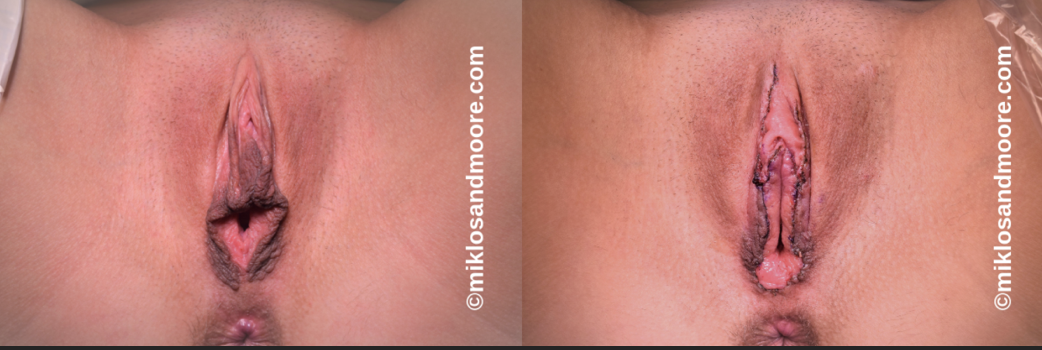
Before and immediate after clitoral hood reduction photographs demonstrating the surgical result immediately following the procedure before swelling and healing have occurred. Final results develop as recovery progresses.
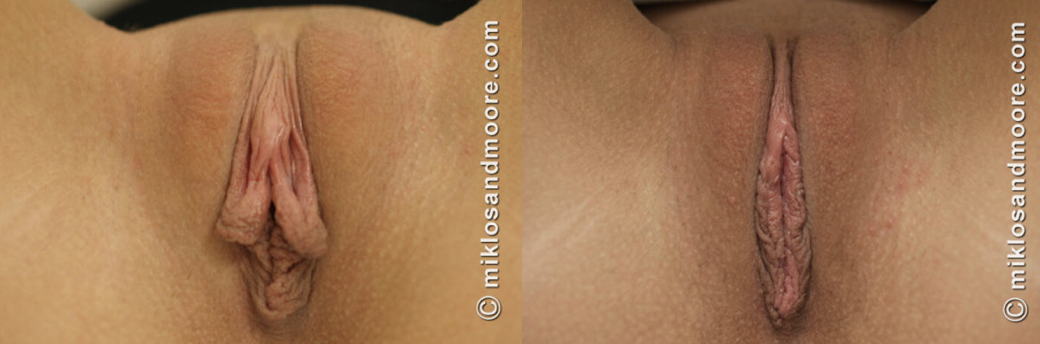
Healed clitoral hood reduction before and after photographs demonstrating the final appearance after complete recovery. Individual healing times and surgical results vary.
Understanding What Was Changed During Surgery
Many recovery guides begin by discussing swelling and pain without first explaining what was actually changed during surgery. Understanding the procedure itself makes the healing process much easier to appreciate.
The clitoral hood is a natural fold of skin that covers and protects the clitoris. Every woman has a different amount of hood tissue. In some women, the hood is naturally longer or thicker, while others notice changes over time due to aging, childbirth, hormonal changes, or genetics.
A clitoral hood reduction is designed to reshape excess tissue while preserving the normal protective function of the hood. The procedure does not involve operating on the clitoris itself. Instead, the surgery focuses on carefully reducing redundant skin so the area appears more balanced with the surrounding anatomy.
Because only skin and superficial soft tissue are reshaped, recovery is usually faster than patients expect. However, the tissues surrounding the clitoris contain an exceptionally rich network of tiny blood vessels and sensory nerves. That is one of the reasons even a small amount of swelling can temporarily make the area feel very different.
During surgery, the body immediately begins its healing response. Tiny blood vessels seal themselves, inflammatory cells move into the surgical area, and new collagen production begins almost immediately. These microscopic changes continue long after the visible incision appears healed.
Patients often assume that once the stitches dissolve, recovery is complete. In reality, dissolving sutures are only one milestone in a much longer process of tissue remodeling that continues beneath the surface for several months.
How Healing Actually Occurs
Healing after clitoral hood reduction happens in stages rather than all at once. Knowing these stages often helps patients avoid unnecessary anxiety.
Inflammation
The first stage begins immediately after surgery.
Inflammation is the body’s natural repair mechanism. Increased blood flow delivers oxygen, nutrients, and specialized healing cells to the surgical site.
Although inflammation causes swelling and tenderness, it is also essential for proper healing.
Without this response, wounds would not repair themselves.
Tissue Repair
Over the next several weeks, the body begins producing new collagen fibers that strengthen the incision.
This is why the tissues often feel firmer than expected during the early stages of recovery.
Many women worry that firmness means scar tissue is developing abnormally.
In reality, temporary firmness is simply part of normal collagen formation.
Remodeling
The final stage is remodeling.
Over several months, collagen fibers reorganize themselves, scars soften, swelling gradually disappears, and the tissues become increasingly flexible.
This explains why the surgical area continues improving long after patients believe they have finished healing.
One of the most important lessons patients can learn is that recovery is not measured by days—it is measured by gradual improvement over time.
The First 24 Hours After Surgery
The first day is often much easier than patients imagine.
Because local anesthetic is frequently used during surgery, many women experience very little discomfort immediately afterward. As the anesthetic gradually wears off, mild soreness or tenderness usually develops.
Most patients spend the remainder of the day resting at home.
Short walks around the house are encouraged to promote healthy circulation, but strenuous activity should be avoided.
During the first evening, it is completely normal to notice:
- Mild spotting
- Swelling around the hood
- A feeling of fullness
- Tenderness when walking
- Increased awareness of the surgical area
Many women are surprised that they are able to urinate without significant discomfort. Others notice mild stinging when urine contacts the healing tissues. This sensation generally improves quickly during the first several days.
Emotionally, the first day is often a mixture of excitement and curiosity. Many patients want to examine the surgical area immediately. While it is reasonable to become familiar with your anatomy, it is equally important to remember that what you see during the first 24 hours bears little resemblance to the final result.
In fact, many experienced surgeons encourage patients not to judge the appearance of the clitoral hood during the first week because swelling temporarily obscures the refined contour created during surgery.
The First Month of Recovery: What to Expect Week by Week
No two women heal exactly the same, but there are predictable milestones that most patients experience after clitoral hood reduction surgery. One of the most reassuring things to remember is that recovery is not a straight line. You may feel significantly better one day and notice slightly more swelling the next after spending several hours walking, exercising, or simply being more active than usual.
That doesn’t mean something is wrong—it simply means your body is still healing.
Understanding these normal fluctuations can help reduce unnecessary anxiety during recovery.
Days 1–3: Swelling Reaches Its Peak
The first several days are when the body’s inflammatory response is most active.
During this time, the clitoral hood may appear:
- Larger than expected
- Puffy
- Firm to the touch
- Slightly uneven
- Mildly bruised
Many women are surprised because they expected the hood to look smaller immediately after surgery. Instead, postoperative swelling temporarily masks the final contour that was created during the procedure.
This swelling is completely normal.
Because the surgical area is relatively small, even a modest amount of fluid can make the hood appear dramatically enlarged. Patients should resist the temptation to judge their cosmetic result during these first few days.
Walking may produce a feeling of rubbing or pressure rather than true pain. Most women describe the discomfort as similar to having a small bruise rather than experiencing severe postoperative pain.
During this period it is helpful to:
- Rest frequently.
- Walk around the house several times each day.
- Wear loose, breathable clothing.
- Stay well hydrated.
- Follow all postoperative instructions provided by your surgeon.
The goal is to allow your body to heal while avoiding unnecessary irritation.
Days 4–7: The Area Begins to Settle
By the middle of the first week, many patients notice that discomfort has already improved significantly.
Although swelling remains obvious, it often begins becoming softer rather than continuing to increase.
This is also when patients frequently notice healing changes such as:
- Mild itching
- Tightness
- Small amounts of dried blood
- Tiny dissolving stitches becoming visible
- Less tenderness when walking
Itching deserves special mention because it often worries patients.
In reality, itching is usually a sign that the skin is repairing itself.
As new tissue forms and tiny nerve endings begin recovering, itching commonly develops around the incision. While it can be annoying, it generally improves on its own and should not be treated by scratching the area.
Some women also notice that the hood appears uneven during this stage.
This happens because swelling rarely develops identically on both sides.
One side may heal faster than the other, making temporary asymmetry completely normal during the first several weeks.
Week Two: Confidence Begins to Return
For many patients, the second week marks an important turning point.
Simple daily activities become much easier.
Walking feels more natural.
Tenderness continues decreasing.
Many women are able to wear comfortable clothing without constantly thinking about the surgical area.
This is often when patients begin returning to desk work if they have not already done so.
Although the tissues remain swollen, the hood usually starts looking more refined as inflammation gradually subsides.
Patients sometimes become discouraged during this stage because improvement slows compared with the dramatic changes seen during the first week.
Remember that healing naturally becomes more gradual as recovery progresses.
The body has moved beyond the initial inflammatory phase and has entered a longer period of tissue remodeling that cannot be rushed.
Weeks Three and Four: The Healing Becomes Less Noticeable
By the end of the first month, many women report that they spend much less time thinking about their recovery.
The incision becomes increasingly difficult to identify.
Bruising has typically resolved.
Walking, sitting, and wearing everyday clothing become progressively more comfortable.
Although the surgical area may still feel slightly firm, this firmness represents normal collagen remodeling rather than a problem.
At this stage, patients frequently begin appreciating the improved contour created during surgery.
However, subtle swelling often remains.
For this reason, surgeons generally advise patients not to evaluate their final cosmetic result during the first month.
Healing beneath the surface continues long after the visible incision appears healed.
Five Things That Worry Patients Most (And Why They’re Usually Normal)
Every week, surgeons are asked many of the same recovery questions. Fortunately, most concerns turn out to be completely normal.
Understanding these common situations can help patients feel more confident throughout recovery.
“My Clitoral Hood Looks Bigger Than Before Surgery.”
This is probably the most common concern after clitoral hood reduction.
Ironically, surgery designed to reduce excess tissue often makes the hood appear temporarily larger.
The reason is simple.
Swelling develops within a very small space.
Because there is little room for fluid to spread out, the tissues become noticeably fuller during the first several days.
As swelling gradually disappears, the refined contour created during surgery becomes much more apparent.
Patients should remember that swelling—not excess tissue—is usually responsible for this temporary appearance.
“One Side Looks Different Than the Other.”
Perfectly symmetrical swelling almost never occurs.
One side may appear:
- Higher
- Fuller
- Firmer
- More bruised
- Slightly more sensitive
These differences usually reflect normal healing rather than differences in the surgical result.
As inflammation resolves over the following weeks, the tissues generally become much more symmetrical.
“I Can Feel Small Lumps.”
Small firm areas beneath the skin are another frequent concern.
In most cases these represent:
- Normal swelling
- Healing collagen
- Dissolving stitches
- Temporary scar firmness
They are usually part of normal recovery.
As collagen remodels over the following months, these firm areas gradually soften and become less noticeable.
“The Stitches Are Still There.”
Absorbable sutures do not disappear overnight.
Some dissolve quickly.
Others remain visible for several weeks depending on the type of suture used and how quickly each patient’s body absorbs the material.
Patients should never pull on stitches that appear loose.
Even if part of the suture is visible, it may still be supporting healing tissue beneath the surface.
If a stitch becomes bothersome, your surgeon can determine whether it should simply be left alone or safely removed during a follow-up visit.
“I’m Constantly Checking the Area.”
This may be the most common recovery mistake of all.
Because the surgery involves such an intimate area, many women understandably become hyperaware of every change.
Looking several times a day often creates unnecessary anxiety because healing naturally changes from morning to evening.
After walking, swelling may increase slightly.
After resting overnight, it often decreases again.
These daily fluctuations are expected.
Rather than evaluating your recovery hour by hour, it is far more helpful to compare your progress week by week.
Most women are pleasantly surprised by how much improvement they see when they step back and look at the bigger picture instead of focusing on small daily changes.
Returning to Daily Life After Clitoral Hood Reduction
One of the most encouraging milestones during recovery is reaching the point where you stop thinking about the surgical site every hour of the day. Most women find that each week brings noticeable improvements in comfort, allowing them to return to their normal routines with greater confidence.
Although everyone heals at a different pace, the decision to resume work, exercise, travel, and sexual activity should be based on how well the tissues have healed, not simply on how many days have passed since surgery. Looking healed on the outside does not always mean the deeper tissues have fully recovered.
The following guidelines provide a general overview of what most patients can expect, but your surgeon’s recommendations should always take priority.
Returning to Work
Many women are pleasantly surprised by how quickly they feel well enough to return to work.
Patients with office-based or sedentary jobs often return within several days, particularly if they are able to stand, stretch, and change positions throughout the day.
However, returning to work is different from returning to full activity.
Even if you feel well, long hours of sitting can increase pressure on the surgical area and contribute to temporary swelling by the end of the day. Taking short breaks every hour to walk for a few minutes can improve circulation and reduce discomfort.
Women whose occupations involve lifting, climbing, prolonged standing, or physically demanding work may need additional recovery time before safely returning to their normal responsibilities.
Rather than comparing your recovery to someone else’s, focus on listening to your own body. Mild fatigue during the first couple of weeks is common, and resting when needed often supports a smoother recovery.
Exercise: Knowing When to Resume Physical Activity
One of the biggest mistakes patients make is assuming that feeling better means they have completely healed.
Exercise places repeated stress on healing tissues, particularly in an area that naturally experiences movement and friction throughout the day.
Walking is encouraged almost immediately because it improves circulation and helps prevent stiffness.
More strenuous exercise should be resumed gradually and only after your surgeon determines that healing is progressing appropriately.
Activities that typically require the longest recovery include:
- Running
- High-intensity interval training (HIIT)
- Cycling and spin classes
- Horseback riding
- Rowing
- Heavy weightlifting
- Deep stretching or yoga positions that place tension across the pelvis
Many of these activities create repetitive pressure or friction against the clitoral hood. Returning too early may increase swelling and prolong recovery, even if it does not cause significant pain.
When you do return to exercise, begin slowly. Your first workout should not be as intense as your preoperative routine. Allow your body time to adapt, and remember that mild swelling after increased activity is often a sign that your tissues still need additional healing time.
Choosing Comfortable Clothing During Recovery
Clothing can have a surprisingly large impact on recovery.
Because the clitoral hood sits in an area of constant movement, tight clothing may rub against healing tissues throughout the day.
During the first several weeks, many women are most comfortable wearing:
- Loose cotton underwear
- Soft athletic shorts
- Loose-fitting pants
- Dresses or skirts
- Breathable sleepwear
These garments reduce friction while allowing air to circulate around the healing tissues.
Many patients temporarily avoid:
- Thongs
- Tight leggings
- Skinny jeans
- Compression garments
- Clothing with thick seams positioned directly over the vulva
As swelling resolves, fitted clothing usually becomes comfortable again.
Bathing and Personal Hygiene
Keeping the surgical area clean is important, but excessive cleaning can actually irritate healing tissues.
Most patients can shower soon after surgery according to their surgeon’s instructions.
When showering:
- Allow warm water to gently flow over the area.
- Avoid scrubbing the incision.
- Use mild, fragrance-free cleansers only if recommended.
- Pat the area dry rather than rubbing.
Many women find that gently rinsing with lukewarm water after using the restroom is more comfortable than wiping alone during the first several days.
Baths, swimming pools, hot tubs, lakes, and oceans should generally be avoided until the incision has healed completely and your surgeon confirms that immersion in water is safe.
When Can You Resume Sexual Activity?
For many patients, this is the question they think about most during recovery.
Although external healing often progresses quickly, the tissues beneath the surface require considerably more time to regain their strength and flexibility.
Resuming sexual activity too early can increase swelling, irritate the incision, and delay healing.
More importantly, premature friction can make an otherwise comfortable recovery unnecessarily painful.
Before returning to sexual activity, your surgeon should confirm that the incision has healed appropriately.
Even after receiving clearance, many women benefit from taking things slowly.
It is common to feel slightly anxious the first time after surgery.
Questions such as:
- Will everything feel normal?
- Will I be more sensitive?
- Will I notice discomfort?
- Will the appearance be different?
are completely understandable.
For most women, confidence gradually returns as healing continues.
Temporary changes in sensitivity are common during the early stages of recovery and should not be mistaken for permanent changes.
As swelling resolves and tissues soften, sensation generally becomes more predictable and natural.
When Should You Contact Your Surgeon?
Although complications after clitoral hood reduction are uncommon, patients should know when something deserves medical attention.
Contact your surgeon promptly if you experience:
- Heavy bleeding that does not improve
- Fever
- Rapidly increasing swelling
- Significant redness spreading away from the incision
- Thick drainage or foul odor
- Severe pain that continues worsening
- Difficulty urinating
- Separation of the incision
Fortunately, most postoperative questions involve normal healing rather than true complications.
If you are uncertain whether something is normal, contacting your surgeon is always appropriate. Early reassurance—or early treatment if needed—is preferable to waiting and worrying.
Why Experience Matters
Clitoral hood reduction may appear to be a relatively small procedure, but it requires an exceptional understanding of female genital anatomy. The objective is not simply to remove excess tissue. The procedure must preserve the delicate nerves, blood vessels, and natural protective function of the clitoral hood while creating a balanced, aesthetically pleasing appearance.
This combination of cosmetic precision and functional preservation is what distinguishes experienced surgeons from those who perform the operation only occasionally.
Dr. John Miklos and Dr. Robert Moore have devoted their careers to female pelvic reconstructive and cosmetic gynecologic surgery. Together they have performed thousands of advanced vaginal and vulvar procedures, published extensively in peer-reviewed medical journals, and taught surgical techniques to physicians around the world.
Their philosophy is simple: an excellent surgical result is measured not only by how the area looks, but by how naturally it heals and functions long after recovery is complete.
Frequently Asked Questions
How long does clitoral hood reduction recovery take?
Most women resume many normal daily activities within one to two weeks, but complete healing continues for several months. Swelling, scar remodeling, and subtle changes in sensation gradually improve throughout this period.
Why does my clitoral hood look larger after surgery?
Postoperative swelling is the most common reason. Because swelling develops in a very small area, even a small amount of inflammation can temporarily make the hood appear fuller than it will once healing is complete.
Is numbness normal after surgery?
Yes. Some women experience temporary numbness, while others notice increased sensitivity. Both responses are usually part of normal healing and often improve as swelling resolves and the tissues recover.
When will the swelling go away?
Most swelling improves significantly during the first several weeks, although subtle swelling may continue to resolve over several months.
Can I speed up healing?
Following your surgeon’s instructions, avoiding nicotine, maintaining a healthy diet, staying hydrated, limiting unnecessary friction, and attending follow-up appointments all support optimal healing.
When will I see my final results?
Most women appreciate significant improvement within the first few months, but final scar maturation and tissue remodeling can continue for six months or longer.
Schedule a Consultation with Miklos & Moore
Whether you are considering clitoral hood reduction or are preparing for surgery, understanding the recovery process can help you approach healing with realistic expectations and greater confidence.
Dr. John Miklos and Dr. Robert Moore combine decades of surgical experience with individualized postoperative care to help patients achieve natural-looking results while preserving normal function and sensation. If you have questions about clitoral hood reduction or would like to learn whether the procedure is right for you, scheduling a consultation is the first step toward receiving a personalized treatment plan tailored to your anatomy and aesthetic goals.