
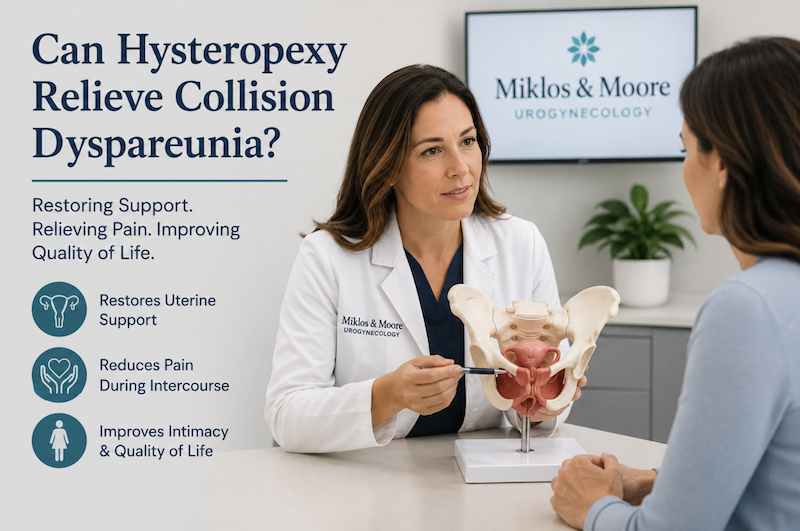
Can Hysteropexy Relieve Collision Dyspareunia?
A Comprehensive Guide to Pain During Intercourse and Uterine Prolapse
Expert Insight from Miklos and Moore Urogynecology
Understanding Collision Dyspareunia (Deep Pain During Intercourse)
Dyspareunia refers to pain during sexual intercourse. Collision dyspareunia is a specific type of deep dyspareunia, where discomfort occurs when penetration reaches deeper structures—most commonly the cervix or uterus.
Patients often describe:
- A sharp, deep pain with penetration
- A sensation of “hitting something” internally
- Pain that worsens with deeper thrusting or certain positions
- Avoidance of intimacy due to discomfort
This is not uncommon—and importantly, it is often treatable once the cause is correctly identified.
The Overlooked Cause: Uterine Prolapse
One of the most underdiagnosed causes of deep dyspareunia is uterine prolapse.
When prolapse occurs:
- The cervix descends lower into the vaginal canal
- The uterus becomes more exposed during intercourse
- Even normal penetration can result in repetitive cervical impact
This altered anatomy creates a direct mechanical reason for pain—often described as “collision pain.”
Why This Type of Pain Is Often Misdiagnosed
Many women are told their pain is due to:
- Hormonal changes
- Vaginal dryness
- General pelvic discomfort
While these can contribute, they often miss the structural cause.
At Miklos and Moore Urogynecology, evaluation focuses on identifying whether:
- The cervix is abnormally low
- Prolapse is contributing to symptoms
- Pain correlates with anatomical position
This level of specialization is critical—because treatment must match the cause.
What Is Hysteropexy?
Hysteropexy is a uterus-preserving prolapse repair that lifts and secures the uterus back into its natural anatomical position.
Unlike hysterectomy, the uterus is not removed. Instead, it is:
- Suspended using native tissue or surgical mesh
- Reattached to strong supporting structures in the pelvis
- Restored to a more normal, elevated position
Common approaches include:
- Laparoscopic or robotic hysteropexy
- Vaginal hysteropexy techniques
- Native tissue suspensions
How Hysteropexy Can Relieve Collision Dyspareunia
When prolapse is the root cause, hysteropexy directly addresses the problem.
Mechanism of Improvement:
- Elevates the cervix upward → reduces direct impact during intercourse
- Restores normal vaginal length and axis
- Improves pelvic support and alignment
What Patients Often Experience:
- Reduced or eliminated deep pain
- Improved comfort with penetration
- Greater confidence and return to normal intimacy
For the right patient, this can be life-changing.
How to Tell If Your Pain Is Caused by Prolapse
Not all dyspareunia is the same. Clues that prolapse may be contributing include:
- Pain only with deep penetration
- A sensation of pressure or bulging
- Feeling like the cervix is being “hit”
- Symptoms improve with position changes
- Coexisting symptoms like:
- Vaginal heaviness
- Pelvic pressure
- Visible or felt bulge
A proper pelvic exam is essential to confirm this.
When Hysteropexy Will NOT Fully Resolve Pain
This is critical for setting expectations.
Hysteropexy may not fully relieve pain if other conditions are present, such as:
- endometriosis
- Pelvic floor muscle spasm or tension
- Scar tissue from prior surgery
- Ovarian pathology
- Nerve-related pelvic pain
In these cases, a multidisciplinary approach may be needed.
Hysteropexy vs Hysterectomy: Which Is Better for Sexual Function?
This is one of the most common questions.
Hysteropexy Advantages:
- Preserves the uterus
- Maintains natural anatomical relationships
- Avoids potential changes in vaginal length or support
- Often associated with excellent sexual function outcomes
- This surgery will not shorten the vagina
- Will not result in scar tissue at the deepest point in the vagina as the uterus is not removed
Hysterectomy Considerations:
- May be necessary in cases of uterine disease
- Can be combined with prolapse repair
- Outcomes vary depending on technique and surgeon expertise
At Miklos and Moore Urogynecology, the approach is individualized to optimize both anatomical correction and sexual function.
What Makes a Successful Outcome?
Not all prolapse surgeries are equal.
Success depends on:
- Accurate diagnosis of the pain source
- Choosing the correct surgical technique
- Surgeon experience with complex pelvic floor reconstruction
For patients with collision dyspareunia, the goal is not just to “fix prolapse,” but to:
restore comfortable, functional anatomy
Recovery and Return to Intimacy
Typical recovery after hysteropexy includes:
- Light activity within 1–2 weeks
- Avoiding heavy lifting for ~12 weeks
- Return to intercourse after healing (usually ~6 -12 weeks)
Most patients notice gradual improvement as:
- Swelling resolves
- Support structures stabilize
- Confidence returns
Frequently Asked Questions
Can uterine prolapse cause pain during sex?
Yes. A low cervix can be repeatedly impacted during intercourse, causing deep pain.
Does hysteropexy improve sexual function?
For patients whose pain is due to prolapse, many experience significant improvement in comfort and function.
Will lifting the uterus stop cervical pain?
If cervical impact is the cause, elevating the uterus often reduces or eliminates the pain.
Can pain continue after prolapse surgery?
Yes—if other causes like muscle tension or endometriosis are present. It may also occur due to vaginal scar tissue and vaginal shortening (which is no possible with the hysteropexy)
Is the cervix removed in hysteropexy?
No. The uterus and cervix are preserved and repositioned.
Is mesh always required?
No. The patient has the option of synthetic mesh, allogenic grafts (such as pigskin, human cadaveric tissue and native tissue options exist depending on the case.
How long before I can have sex after surgery?
Typically about 6 -12 weeks, depending on healing.
Can prolapse come back after hysteropexy?
There is always some risk, but outcomes are excellent in experienced hands.
When to Seek a Specialist Evaluation
You should consider evaluation if you experience:
- Deep pain during intercourse
- A sensation of internal “collision”
- Pelvic pressure or vaginal bulge
- Changes in sexual function
These symptoms are common—but highly treatable with the right expertise.
The Bottom Line
- Collision dyspareunia is often caused by cervical impact during intercourse
- Uterine prolapse is a frequent—and treatable—underlying cause
- Hysteropexy can relieve pain by restoring normal anatomy and elevating the cervix
The key is identifying the true source of pain and choosing a treatment strategy that addresses both structure and function.
Considering a Second Opinion?
For women dealing with complex pelvic floor symptoms, a specialized evaluation can provide clarity—and a path back to comfort and confidence.
Insurance Coverage for Hysteropexy and Prolapse-Related Pain
One of the most important—and often misunderstood—aspects of treatment is insurance coverage.
Unlike cosmetic procedures, uterine prolapse surgery (including hysteropexy) is considered a medically necessary condition when symptoms are present, such as:
- Pelvic pressure or vaginal bulge
- Pain during intercourse (including collision dyspareunia)
- Urinary or bowel dysfunction
- Difficulty with normal daily activities
Because of this, many insurance plans may cover all or a significant portion of the procedure when properly documented.
At Miklos and Moore Urogynecology, patients are guided through:
- Insurance verification
- Determining medical necessity
- Understanding out-of-pocket costs
- Financing options when applicable
The key distinction is this:
This is not cosmetic surgery—it is functional pelvic floor reconstruction.
When collision dyspareunia is caused by prolapse, treatment is often classified as restorative and medically indicated, not elective.
Why Experience Matters: The Miklos & Moore Difference
When it comes to complex pelvic floor conditions like prolapse and dyspareunia, surgeon experience is one of the most important factors influencing outcomes.
Miklos and Moore Urogynecology is internationally recognized for advanced pelvic reconstruction, and their experience is not typical of most practices.
Proven Surgical Expertise
- Over 45 years of combined surgical experience
- More than 4000 laparoscopic Sacro colpopexy / hysteropexy procedures performed
- Reported ~98% success/cure rates in prolapse repair for uterus or vaginal vault
These procedures are highly technical and require:
- Advanced laparoscopic skill
- Deep understanding of pelvic anatomy
- Precision in restoring vaginal support and function
International Leaders in Urogynecology
- Patients travel from all 50 states and over 50 countries of countries for their care
- Recognized as international authorities in laparoscopic and reconstructive vaginal surgery
- Among the first surgeons to combine urogynecology + advanced laparoscopic + aesthetic vaginal reconstruction training
This combination is rare—and critical—when treating conditions that affect both function and sexual health.
A Center of Excellence for Complex Cases
Many patients who seek care at Miklos and Moore Urogynecology:
- Have been told “nothing is wrong”
- Have persistent pain after prior surgery
- Are seeking a second or third opinion
- Have complex or recurrent prolapse
Their approach focuses on:
- Identifying the true source of symptoms
- Offering uterine-preserving options when appropriate
- Restoring both anatomy and quality of life
Why This Matters for Collision Dyspareunia
Collision dyspareunia is not just about pain—it’s about precision diagnosis and surgical execution.
If the cervix is not elevated correctly, or if vaginal support is not fully restored:
- Pain may persist
- Sexual function may not improve
- Additional procedures may be needed
That’s why choosing a surgeon with extensive experience in hysteropexy and pelvic reconstruction is critical to achieving the best outcome.
The Bottom Line
- Hysteropexy is often covered by insurance when medically necessary
- Collision dyspareunia caused by prolapse is a treatable condition
- Surgical expertise plays a major role in outcomes—especially for sexual function
For patients dealing with deep pain during intercourse, the right diagnosis—and the right surgeon—can make a life-changing difference.