
Botched Labiaplasty Second Opinion: Surgical Experience Matters
Women who are unhappy with the cosmetic or functional results of a previous labiaplasty may benefit from a second opinion before undergoing another procedure. Dr. John Miklos and Dr. Robert Moore are fellowship-trained urogynecologists and high-volume cosmetic gynecologic surgeons near Atlanta, Georgia, with decades of experience in labiaplasty and complex revision surgery. They evaluate problems including excessive tissue removal, asymmetry, scarring, pain, clitoral hood distortion, and unsatisfactory cosmetic results. Women travel to Miklos & Moore from across the United States and around the world seeking their expertise in botched labiaplasty and revision surgery to determine what can safely and realistically be corrected.
Botched Labiaplasty Second Opinion: Can a Bad Labiaplasty Be Corrected
A labiaplasty that produces an unexpected cosmetic or functional result can be extremely frustrating. Some women are unhappy with asymmetry or remaining tissue, while others experience excessive tissue removal, scarring, discomfort, painful intercourse, distortion of the clitoral hood, or changes they never anticipated before surgery.
When a woman believes she has had a botched labiaplasty, one of the most important decisions is what to do next.
Before undergoing another operation, obtaining a labiaplasty second opinion from a surgeon experienced in revision surgery can help determine what went wrong, whether additional surgery is appropriate, and what can realistically be improved.
Dr. John Miklos and Dr. Robert Moore are fellowship-trained urogynecologists and high-volume cosmetic gynecologic surgeons near Atlanta, Georgia, with decades of experience in labiaplasty, vaginal reconstruction, and complex revision surgery. Women travel to Miklos & Moore from across the United States and internationally seeking second opinions after unsatisfactory or failed cosmetic gynecologic procedures.
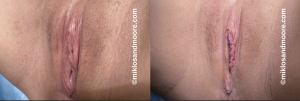
Before and immediately after photographs demonstrating revision labiaplasty. Early postoperative swelling, sutures, and tissue changes are expected and do not represent the final healed result.
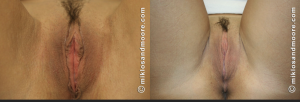
Before and after photographs showing healed results following revision surgery for a previously unsatisfactory labiaplasty.
What Is Considered a Botched Labiaplasty?
There is no single definition of a botched labiaplasty.
Healing takes time, and swelling, asymmetry, tenderness, and changes in appearance can occur during the normal recovery period. An early postoperative appearance does not necessarily represent the final surgical result.
However, some women continue to experience significant cosmetic or functional problems after healing is complete.
Common concerns may include:
- Uneven or asymmetric labia
- Too much labial tissue remaining
- Excessive removal of the labia minora
- Irregular or scalloped edges
- Uncomfortable scar tissue
- Pain or pulling
- Painful intercourse
- Distortion around the clitoral hood
- An unnatural or overly operated appearance
- Changes in the vaginal opening or surrounding anatomy
- Dissatisfaction with the overall cosmetic result
Determining whether another operation can improve the result requires a careful examination of the remaining anatomy.
Why Get a Second Opinion After a Bad Labiaplasty?
Revision labiaplasty is different from primary labiaplasty.
During the first operation, the surgeon is generally working with tissue that has not previously been surgically altered.
During revision surgery, there may be less tissue available, scar tissue, altered blood supply, distorted anatomical landmarks, and changes produced by the original surgical technique.
That can significantly limit what can safely be done.
A second opinion from an experienced revision surgeon can answer an important question:
Is another operation likely to improve the problem—or could additional surgery make it worse?
The goal should never be simply to operate again.
The goal is to determine what can safely and realistically be corrected.
What Happens When Too Much Labia Is Removed?
Over-resection is one of the more difficult problems in revision labiaplasty.
If excessive labia minora tissue has been removed, the surgeon cannot simply replace tissue that is no longer present.
This makes prevention extremely important and reconstruction considerably more challenging.
Depending on the individual anatomy and amount of remaining tissue, reconstructive options may sometimes be available. In other situations, additional surgery may provide limited benefit or carry unacceptable risk.
Women who believe too much tissue was removed should therefore be particularly cautious about undergoing another procedure without obtaining an experienced second opinion.
Can Uneven Labia Be Corrected After Labiaplasty?
Asymmetry is a common reason women seek revision.
Some natural asymmetry exists in virtually all female anatomy, so perfectly identical sides should not necessarily be the objective.
However, significant differences can sometimes remain after surgery because of uneven tissue removal, healing, scarring, or differences in the original anatomy.
Depending on the amount and location of remaining tissue, revision surgery may be able to improve symmetry.
The surgeon must balance improvement against the risk of removing too much additional tissue.
What If Too Much Tissue Was Left Behind?
Some women have the opposite problem.
They undergo labiaplasty but feel that insufficient tissue was removed or that the original concern remains.
In these situations, revision may be technically more straightforward than reconstructing an over-resected labia, but the surgeon still needs to evaluate scar tissue, blood supply, anatomy, and the previous incision pattern before removing additional tissue.
More aggressive removal is not necessarily better.
The objective should be a natural result that preserves function and appropriate anatomy.
Clitoral Hood Problems After Labiaplasty
The relationship between the labia minora and clitoral hood is important to the overall appearance of the vulva.
In some women, reducing the labia without appropriately considering the clitoral hood can create imbalance or make pre-existing hood tissue appear more prominent.
Other women develop asymmetry or distortion following previous surgery.
This does not mean that every patient requires clitoral hood reduction.
An experienced cosmetic gynecologic surgeon should evaluate the labia, clitoral hood, clitoris, and surrounding structures as one anatomical unit before recommending revision.
Scarring After Labiaplasty
Scar tissue can sometimes contribute to discomfort or an irregular appearance following labiaplasty.
The appropriate treatment depends on where the scar is located, how much tissue remains, and whether the scar is producing a cosmetic concern, functional problem, or both.
Revision surgery itself creates additional scar tissue, which is another reason repeated operations should be approached carefully.
Pain After Labiaplasty
Persistent pain after appropriate healing deserves evaluation.
The cause may not always be obvious.
Pain can potentially involve scar tissue, tension, irritation, altered anatomy, or another condition unrelated to the original surgery.
A revision operation should not be performed simply because pain exists.
The first step is trying to determine why the patient is experiencing pain and whether additional surgery is likely to address the underlying cause.
When Should You Consider Revision Labiaplasty?
Women should generally allow sufficient time for swelling and postoperative changes to resolve before judging the final cosmetic result, unless there is a complication requiring earlier medical attention.
Once healing has progressed, a revision consultation may be appropriate when there is persistent:
- Significant asymmetry
- Unwanted remaining tissue
- Excessive tissue removal
- Distortion
- Painful scar tissue
- Functional discomfort
- Clitoral hood imbalance
- Cosmetic dissatisfaction
The appropriate timing for revision depends on the original surgery, healing, symptoms, and individual anatomy.
Why Experience Matters in Revision Labiaplasty
Revision surgery often requires considerably more judgment than primary labiaplasty.
The surgeon cannot start over with the patient’s original anatomy.
Instead, the surgeon must work with what remains after the first operation.
That requires evaluating tissue availability, scar location, vascular supply, symmetry, clitoral hood anatomy, and the patient’s realistic expectations.
A high-volume surgeon who has seen many different labiaplasty results—including complications and previous unsuccessful surgeries—may have a broader perspective on what can and cannot safely be improved.
Dr. Miklos and Dr. Moore: Labiaplasty Second Opinions in Atlanta, Georgia
Dr. John Miklos and Dr. Robert Moore have spent decades performing female pelvic reconstructive and cosmetic gynecologic surgery.
Their experience includes primary labiaplasty as well as women seeking correction after previous cosmetic gynecologic procedures performed elsewhere.
Their background as fellowship-trained urogynecologists provides extensive knowledge of female pelvic and vulvar anatomy, while their cosmetic gynecologic practice has exposed them to a wide range of labial anatomy and surgical results.
For women researching the best doctor for a botched labiaplasty, objective experience is more meaningful than a marketing claim.
Patients should consider:
- How frequently the surgeon performs labiaplasty
- Experience with revision labiaplasty
- Experience correcting surgery performed elsewhere
- Understanding of clitoral and vulvar anatomy
- Before-and-after revision results
- Years performing cosmetic gynecologic surgery
- Experience with complicated cases
Drs. Miklos and Moore’s combination of reconstructive and cosmetic surgical experience makes their Atlanta-area practice a destination for women seeking another opinion after an unsatisfactory labiaplasty.
Women Travel From Around the World for Revision Labiaplasty Second Opinions
A woman unhappy with previous labiaplasty surgery does not necessarily have to limit her second opinion to surgeons near her home.
Women travel to Miklos & Moore from throughout the United States and internationally for cosmetic gynecologic and revision surgery evaluations.
This is especially relevant when the original surgery has substantially altered the anatomy.
In a difficult revision case, experience may be more important to the patient than geographic convenience.
What Should You Bring to a Labiaplasty Second Opinion?
If available, bring your original operative report and any before-and-after photographs from the first procedure.
It can also be helpful to explain specifically what concerns you.
Rather than simply saying, “I don’t like it,” identify whether the primary issue is asymmetry, pain, tissue loss, scarring, appearance, clitoral hood changes, or another problem.
That allows the surgeon to determine whether the concern can realistically be addressed.
Questions to Ask a Revision Labiaplasty Surgeon
Before undergoing another operation, ask:
What do you believe went wrong with my original labiaplasty?
Can my anatomy realistically be improved?
How much tissue remains?
Would additional tissue need to be removed or reconstructed?
Could another operation make the problem worse?
Have you treated patients with a similar complication?
How frequently do you perform revision labiaplasty?
What result is realistically achievable?
A trustworthy second opinion should include a discussion of limitations as well as possibilities.
A Second Opinion Is Only as Valuable as the Experience Behind It
Women seeking help after an unsuccessful labiaplasty are often already considering another operation.
That makes the experience of the second surgeon especially important.
Drs. Miklos and Moore provide labiaplasty second opinions and revision evaluations near Atlanta, Georgia, for women concerned about results from previous surgery.
Their high-volume cosmetic gynecologic and reconstructive surgical experience allows them to evaluate whether revision is appropriate, what can realistically be corrected, and whether leaving the anatomy alone may sometimes be the better choice.
For women traveling from elsewhere in Georgia, across the United States, or internationally, the objective remains the same:
Understand what happened, determine what can safely be improved, and avoid repeating the mistakes of the original surgery.
Frequently Asked Questions
Can a botched labiaplasty be fixed?
Some unsatisfactory labiaplasty results can be improved with revision surgery, while others are considerably more difficult to correct. The options depend on what was done during the original procedure, how much tissue remains, scar formation, and the patient’s current anatomy.
Who should I see for a botched labiaplasty?
Consider a surgeon with substantial experience performing both primary and revision labiaplasty. Revision experience is particularly important because previously operated anatomy can be more complicated than a first-time procedure.
Can labia grow back after too much is removed?
Removed labial tissue does not simply grow back. When significant over-resection has occurred, reconstructive options depend on the remaining anatomy and require individual evaluation.
Can uneven labia after labiaplasty be corrected?
In some cases, yes. The ability to improve asymmetry depends on how much tissue remains on each side and what caused the asymmetry.
Should I go back to my original labiaplasty surgeon or get a second opinion?
Returning to the original surgeon can provide useful information about what was performed. However, obtaining an independent second opinion from a surgeon experienced in revision labiaplasty can provide another assessment before deciding whether to undergo additional surgery.
Do women travel to Miklos & Moore for revision labiaplasty?
Yes. Their Atlanta-area practice evaluates women from Georgia, throughout the United States, and internationally who are seeking second opinions or revision options following previous cosmetic gynecologic surgery.