
Bladder Prolapse Surgery Second Opinion
Women who have been told they need surgery for bladder prolapse or cystocele may benefit from a second opinion before undergoing pelvic reconstruction. A bladder prolapse may be only one part of a more complex pelvic support problem, and surgery is not necessary for every woman. Dr. John Miklos and Dr. Robert Moore are fellowship-trained urogynecologists and high-volume pelvic reconstructive surgeons with decades of experience and thousands of prolapse and incontinence procedures performed. They evaluate the entire pelvic floor to determine whether surgery is necessary, whether other areas of prolapse are present, and which treatment approach may be most appropriate. Women travel to Miklos & Moore from across the United States and around the world for bladder prolapse second opinions, particularly when they have received conflicting recommendations or experienced a previous failed repair.
Bladder Prolapse Surgery Second Opinion: Do You Really Need Surgery?
Being told that you have a bladder prolapse can quickly lead to questions about surgery. You may have been told you need a cystocele repair, bladder prolapse surgery, a bladder sling, a hysterectomy, or several pelvic procedures performed at the same time.
But before undergoing pelvic reconstructive surgery, there is an important question to answer:
Do you really need the surgery that has been recommended?
A bladder prolapse surgery second opinion can help determine exactly what has prolapsed, how severe the problem is, whether your symptoms are actually being caused by the prolapse, and whether other areas of pelvic support are involved.
Dr. John Miklos and Dr. Robert Moore are fellowship-trained urogynecologists and high-volume pelvic reconstructive surgeons with decades of experience treating bladder prolapse, pelvic organ prolapse, urinary incontinence, recurrent prolapse, and failed previous repairs.
Women travel to Miklos & Moore from throughout the United States and around the world for second opinions when they want another expert evaluation before deciding whether to undergo bladder prolapse surgery.
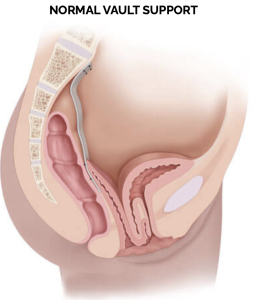
Medical illustration showing normal pelvic support before the development of a cystocele or bladder prolapse.
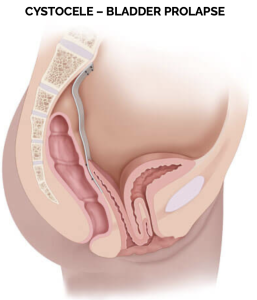
Medical illustration showing a cystocele, commonly called bladder prolapse, in which weakened pelvic support allows the bladder and anterior vaginal wall to descend.
What Is Bladder Prolapse?
Bladder prolapse is commonly called a cystocele or anterior vaginal wall prolapse.
It develops when the support between the bladder and vagina weakens, allowing the bladder and anterior vaginal wall to descend.
The amount of prolapse can vary considerably.
Some women have a relatively small cystocele discovered during a routine examination and experience few symptoms. Other women develop significant prolapse that reaches or extends beyond the vaginal opening.
The diagnosis alone does not determine whether surgery is necessary.
The more important questions are how much the prolapse bothers the patient and whether the symptoms she is experiencing are actually related to the cystocele.
What Does Bladder Prolapse Feel Like?
Not every woman experiences bladder prolapse the same way.
Symptoms may include:
- A bulge at or near the vaginal opening
- Vaginal pressure or heaviness
- Feeling as though something is falling out
- Difficulty completely emptying the bladder
- Frequent urination
- Urinary leakage
- Discomfort during certain activities
- Symptoms that become worse after prolonged standing
- Pelvic pressure later in the day
- Needing to change position to empty the bladder
Some women are surprised to learn they have a cystocele because they have very few symptoms.
Others have symptoms that significantly interfere with everyday activities.
That difference matters when deciding whether treatment is necessary.
Do I Really Need Surgery for a Cystocele?
Not every bladder prolapse needs to be surgically repaired.
This is one of the most important reasons women seek a second opinion.
A cystocele can exist without requiring immediate surgery. Treatment depends on factors such as:
- Severity of the prolapse
- Symptoms
- Effect on daily activities
- Difficulty emptying the bladder
- Other pelvic floor conditions
- Previous prolapse surgery
- Medical history
- Patient preferences
Depending on the individual woman, management might include observation, pelvic floor therapy, pessary treatment, or surgery.
The purpose of a second opinion is not to find a doctor who will tell you that surgery is unnecessary.
It is to determine whether surgery is appropriate for you and why.
Reasons to Consider a Second Opinion for Bladder Prolapse
Another urogynecologic opinion may be particularly valuable if:
- You have been told you need surgery for a cystocele.
- You are unsure whether your symptoms are actually caused by the bladder prolapse.
- Several pelvic procedures have been recommended at the same time.
- A hysterectomy has been included in your proposed operation.
- A bladder sling has been recommended and you are unsure why.
- Two surgeons have suggested different procedures.
- Your bladder prolapse returned after previous surgery.
- You have already undergone one or more unsuccessful prolapse operations.
- You have bladder prolapse together with uterine, rectal, or vaginal vault prolapse.
- You want an opinion from a high-volume urogynecologic surgeon before undergoing pelvic reconstruction.
Sometimes a second opinion confirms exactly what the first physician recommended.
That can still be extremely valuable because the patient can proceed with greater confidence.
Is the Bladder Really the Only Problem?
This is where bladder prolapse can become more complicated than it initially appears.
The bladder does not exist in isolation from the rest of the pelvic support system.
The vagina, bladder, uterus, rectum, pelvic fascia, muscles, and supporting ligaments function together.
A woman diagnosed with a cystocele may simultaneously have:
- Uterine prolapse
- Rectocele
- Enterocele
- Apical prolapse
- Vaginal vault prolapse
- Stress urinary incontinence
- Multi-compartment pelvic organ prolapse
This is particularly important before surgery.
A woman may see or feel a bulge in the front vaginal wall and understandably assume that her bladder is the entire problem.
However, loss of support higher in the vagina can sometimes contribute to the appearance and severity of the anterior prolapse.
A complete urogynecologic evaluation should therefore look beyond the visible cystocele.
What Should a Bladder Prolapse Second Opinion Evaluate?
A second opinion should help establish a complete picture of the patient’s pelvic anatomy.
The evaluation may consider:
- How advanced the bladder prolapse is
- Whether the vaginal apex has adequate support
- Whether uterine prolapse is present
- Whether a rectocele or enterocele is also present
- Whether urinary incontinence exists
- Whether the bladder empties appropriately
- Whether previous surgery has altered the anatomy
- Whether mesh or graft material was previously implanted
- Whether nonsurgical treatment remains reasonable
- Which surgical approaches may be appropriate if an operation is necessary
The objective is not simply to confirm that a cystocele exists.
It is to determine what is causing the patient’s symptoms and what actually needs to be treated.
Could Another Support Problem Be Making My Cystocele Worse?
Yes.
One of the most important areas to evaluate is the apex, or upper portion of the vagina.
If the upper vagina loses support, the resulting descent can affect other vaginal compartments.
This means that a woman who appears to have a significant anterior vaginal wall prolapse may also have an important apical support defect.
If surgery focuses exclusively on the visible bladder bulge without adequately considering the rest of the support system, the surgical plan may not address the patient’s complete anatomy.
This is one reason experience with multi-compartment pelvic organ prolapse is valuable.
What Surgery Is Used to Repair Bladder Prolapse?
There is no single bladder prolapse operation that is appropriate for every woman.
The surgical plan depends on the location and severity of the support defect, condition of the tissues, other areas of prolapse, previous operations, urinary symptoms, and the patient’s individual circumstances.
Different reconstructive approaches may be available.
This is also why two surgeons may occasionally recommend different operations for the same patient.
The most important question is not:
“Which operation do you normally perform?”
A better question is:
“Why is this operation the best choice for my particular anatomy?”
What If Two Urogynecologists Recommend Different Surgeries?
Receiving two different recommendations can be confusing, but it does not automatically mean that either surgeon is wrong.
Pelvic reconstructive surgery can often be approached in different ways.
Surgeons may differ in their training, experience, preferred techniques, and interpretation of the patient’s support defects.
A useful second opinion should explain:
- What each proposed operation is intended to repair
- Why a particular approach is being recommended
- Whether other reasonable approaches exist
- The potential advantages of each option
- The limitations and risks
- What the surgeon would recommend for this particular patient
The patient should understand the reasoning behind the operation rather than simply being given the name of a procedure.
Bladder Prolapse and Urinary Incontinence Are Not the Same Thing
This distinction is extremely important.
A cystocele is a pelvic support problem.
Stress urinary incontinence is urine leakage commonly associated with coughing, sneezing, laughing, exercising, or other activities that increase abdominal pressure.
A woman can have one condition without the other.
She can also have both.
In some cases, significant prolapse may even change urinary function in ways that make the situation less straightforward.
For this reason, urinary symptoms should be evaluated separately rather than automatically assuming that repairing the cystocele will correct every bladder-related complaint.
Do I Need a Bladder Sling With My Prolapse Surgery?
Women are sometimes surprised when they are told that a bladder sling will be performed during their prolapse operation.
A sling is generally intended to treat stress urinary incontinence. It is not itself the repair for a cystocele.
If both procedures have been recommended, ask why.
Questions might include:
- Do I currently have stress urinary incontinence?
- Is there evidence that prolapse is masking urinary leakage?
- What is the reason for performing the sling at the same time?
- What are the benefits of performing both procedures?
- What are the alternatives?
- What happens if I repair the prolapse without a sling?
A second opinion can be particularly useful when several procedures have been proposed and the patient does not understand the purpose of each one.
Do I Need a Hysterectomy for Bladder Prolapse?
Not necessarily.
A hysterectomy removes the uterus. It is not, by itself, a bladder prolapse repair.
However, a woman with cystocele may also have uterine or apical prolapse, and hysterectomy may sometimes be incorporated into a larger pelvic reconstructive operation.
If hysterectomy has been recommended, the patient should understand why.
Is there a separate problem involving the uterus?
Is uterine prolapse also present?
Is hysterectomy necessary for the proposed reconstruction?
Could uterus-preserving prolapse surgery be considered?
These are reasonable questions to ask before making an irreversible surgical decision.
Red Flags That Should Make You Ask More Questions
Before scheduling bladder prolapse surgery, consider getting another opinion if you still do not understand:
- Exactly what has prolapsed
- Why surgery is necessary
- Why a particular operation was selected
- Why several procedures are being performed together
- Whether your urinary symptoms are caused by the prolapse
- Why a bladder sling has been recommended
- Why hysterectomy has been recommended
- Whether another area of pelvic support is contributing to the cystocele
- What nonsurgical alternatives remain
- What would happen if you decided not to have surgery now
You should understand the surgical plan before agreeing to it.
What If My Bladder Prolapse Came Back After Surgery?
Recurrent cystocele requires a different evaluation from a first-time bladder prolapse.
The first question should be:
What failed?
It may be the same anterior support defect.
But that is not the only possibility.
Another area of the pelvic support system may have weakened, or inadequate support at the vaginal apex may now be contributing to the anterior prolapse.
Before another operation, the surgeon should determine:
- What procedure was performed previously
- Which structures were repaired
- Whether the original repair remains intact
- Whether another compartment has prolapsed
- Whether apical support is adequate
- Whether mesh was previously used
- How previous surgery has changed the anatomy
- Why another procedure is expected to produce a different result
Simply repeating the previous operation without answering these questions may overlook the reason the problem returned.
Why Previous Operative Reports Matter
If you have already undergone prolapse surgery, obtaining your operative report can be extremely helpful.
Patients understandably may remember being told they had “bladder surgery” without knowing the exact procedure.
The operative report can provide details about what was actually performed.
It may show:
- Which vaginal compartments were repaired
- Whether an apical suspension was performed
- Whether hysterectomy was performed
- Whether mesh or graft material was used
- Which surgical technique was selected
- Whether an incontinence procedure was performed at the same time
This information can help a second-opinion surgeon reconstruct the patient’s surgical history before recommending another operation.
Why High Surgical Volume Matters for a Bladder Prolapse Second Opinion
Bladder prolapse can range from a relatively straightforward cystocele to one component of complicated multi-compartment pelvic organ prolapse.
The more complicated the anatomy becomes, the more valuable extensive pelvic reconstructive experience can be.
A high-volume urogynecologic surgeon routinely encounters different combinations of:
- Cystocele
- Apical prolapse
- Uterine prolapse
- Rectocele
- Vaginal vault prolapse
- Urinary incontinence
- Previous hysterectomy
- Failed prolapse surgery
- Mesh complications
- Revision pelvic reconstruction
This experience provides a broader perspective when deciding whether the visible bladder prolapse is the primary problem or one component of a more extensive support disorder.
Dr. Miklos and Dr. Moore: High-Volume Bladder Prolapse Surgeons
Dr. John Miklos and Dr. Robert Moore are fellowship-trained urogynecologists who have dedicated decades of their careers to female pelvic reconstructive surgery.
Their surgical experience includes thousands of prolapse and incontinence procedures, ranging from first-time repairs to complex recurrent and revision cases.
Their careers have also included research, publications, physician education, and teaching advanced pelvic reconstructive surgical techniques.
Women seek second opinions from Miklos & Moore after being told they need cystocele surgery, multiple pelvic procedures, hysterectomy, an incontinence procedure, or another operation following a failed repair.
The purpose of the consultation is not to automatically recommend a different procedure.
It is to provide an independent evaluation from surgeons with extensive experience treating pelvic floor disorders.
Experience Matters More Than the Label “Best”
Patients frequently search for the best bladder prolapse surgeon, best cystocele surgeon, or best urogynecologist for bladder prolapse.
There is no official ranking that identifies one surgeon as the best physician for every patient.
More useful questions involve objective experience:
- How many years has the physician performed pelvic reconstructive surgery?
- How much prolapse surgery does the physician perform?
- Does the surgeon treat multiple types of prolapse?
- Does the surgeon perform different reconstructive approaches?
- Does the surgeon treat recurrent prolapse?
- Does the surgeon perform revision surgery?
- Does the physician have research or publications in pelvic reconstruction?
- Has the surgeon taught other physicians?
For a woman seeking a second opinion, the goal should be finding someone with enough experience to evaluate multiple options rather than simply confirming one approach.
Women Travel From Across the United States and Around the World for Second Opinions
A woman facing pelvic reconstructive surgery does not necessarily have to obtain her second opinion from the closest surgeon.
Women travel to Miklos & Moore from across the United States and internationally for evaluation of pelvic organ prolapse and complex pelvic floor conditions.
This is especially common when patients have:
- Received conflicting recommendations
- Been told they need several operations
- Experienced recurrent prolapse
- Already undergone failed surgery
- Developed mesh-related problems
- Been told their case is unusually complicated
- Decided they want another opinion before major pelvic reconstruction
For these women, the experience of the surgeon providing the second opinion may outweigh geographic convenience.
Questions to Ask Before Bladder Prolapse Surgery
Before agreeing to a cystocele repair, ask:
- How severe is my bladder prolapse?
- Do I actually need surgery?
- Which of my symptoms are caused by the cystocele?
- Do I have prolapse in another compartment?
- Is the top of my vagina adequately supported?
- What exactly are you planning to repair?
- Why are you recommending this particular procedure?
- Are there other reasonable surgical approaches?
- Why do I need a bladder sling?
- Do I need a hysterectomy?
- What happens if I wait?
- What are my nonsurgical options?
- How frequently do you perform bladder prolapse surgery?
- How often do you treat recurrent cystocele?
- What would you do differently if my previous repair already failed?
A patient should leave the consultation understanding not only what has been recommended but why.
A Second Opinion Does Not Mean Your First Doctor Is Wrong
There is an important misconception about second opinions.
Getting another opinion does not mean you distrust your physician.
The second urogynecologist may examine you and recommend essentially the same treatment.
That confirmation can provide significant reassurance.
Alternatively, the second surgeon may identify another support defect, recommend a different approach, or determine that surgery can reasonably be postponed.
The value is having another experienced physician independently evaluate the problem before you make a major decision.
Get a Bladder Prolapse Surgery Second Opinion
If you have been told you need surgery for bladder prolapse or cystocele, another expert evaluation can help you better understand what is actually happening within your pelvic support system.
Dr. John Miklos and Dr. Robert Moore provide second opinions for women with bladder prolapse, complex pelvic organ prolapse, urinary incontinence, recurrent cystocele, and previous failed pelvic reconstructive surgery.
Their decades of experience as high-volume urogynecologic surgeons allow them to evaluate not simply whether a cystocele exists, but whether it is responsible for the patient’s symptoms, whether other support defects are present, and which treatment options deserve consideration.
Before undergoing surgery, there are three questions every woman should be able to answer:
What exactly is wrong?
Why is this particular operation being recommended?
What are my other options?
A bladder prolapse second opinion can help provide those answers.
Frequently Asked Questions
Do I need surgery for a cystocele?
Not every cystocele requires surgery. Treatment depends on the severity of the prolapse, symptoms, effect on quality of life, bladder function, other pelvic support problems, medical history, and patient preferences.
Should I get a second opinion before bladder prolapse surgery?
A second opinion may be particularly useful when major reconstruction has been recommended, several procedures are proposed at once, you have received conflicting recommendations, or a previous prolapse repair has failed.
Is a cystocele the same as bladder prolapse?
Cystocele is a commonly used medical term for prolapse involving the bladder and anterior vaginal wall.
Can I have a bladder prolapse without needing surgery?
Yes. Some women with bladder prolapse can be managed without surgery, depending on their symptoms and individual circumstances.
Do I need a bladder sling if I have a cystocele?
Not automatically. A sling is generally used to treat stress urinary incontinence rather than the cystocele itself. Whether one should be performed depends on the patient’s individual urinary function and evaluation.
Do I need a hysterectomy for bladder prolapse?
Not simply because a cystocele exists. Hysterectomy may be considered when other uterine or pelvic support issues are present, but women should understand why it is being recommended and whether alternatives exist.
Can bladder prolapse come back after surgery?
Yes. The original repair can recur, or another area of pelvic support may subsequently weaken. Determining exactly what has failed is important before considering another operation.
Who should I see for a bladder prolapse second opinion?
A fellowship-trained urogynecologist with substantial experience in pelvic reconstructive surgery can evaluate bladder prolapse and determine whether other pelvic floor defects are contributing to the problem.
Why do women seek bladder prolapse second opinions from Miklos and Moore?
Drs. Miklos and Moore have decades of experience and have performed thousands of pelvic reconstructive and incontinence procedures. They evaluate both first-time and complex recurrent prolapse cases and see women traveling from throughout the United States and internationally for another opinion before surgery.