
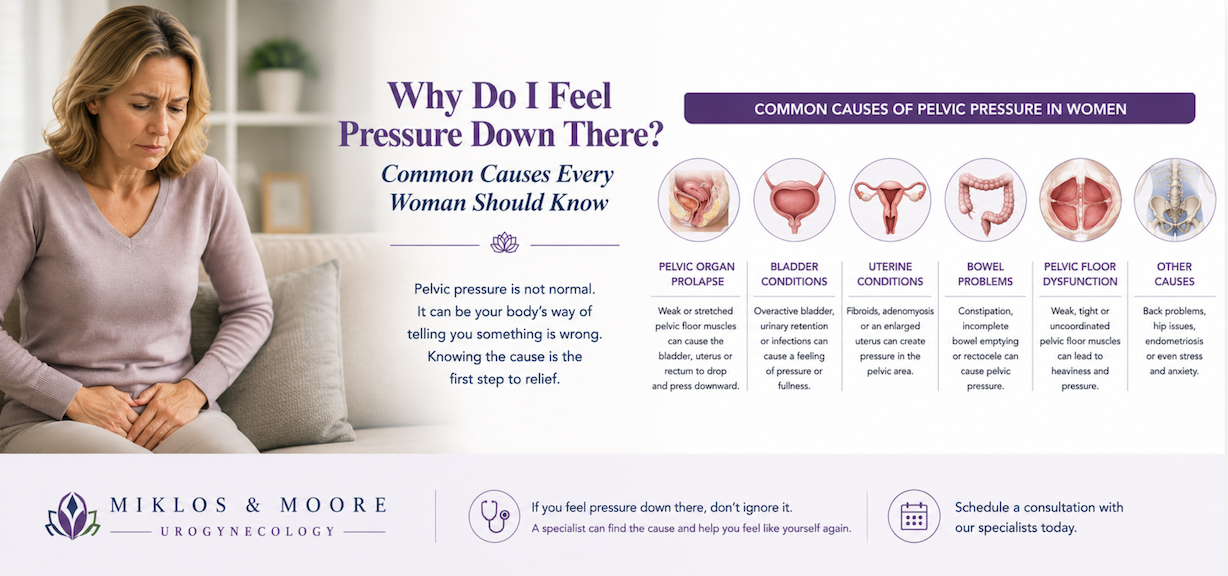
Why Do I Feel Pressure Down There? Common Causes Every Woman Should Know
“It feels like something is pushing down.”
“There’s this constant pressure that wasn’t there before.”
“By the end of the day it feels heavy.”
Women describe pelvic pressure in dozens of different ways.
Some say it feels like they’re carrying extra weight.
Others say it feels like they’re sitting on something.
Some notice it only after standing for a long time.
Others feel it almost every day.
Whatever words you use, pelvic pressure is your body’s way of telling you that something has changed.
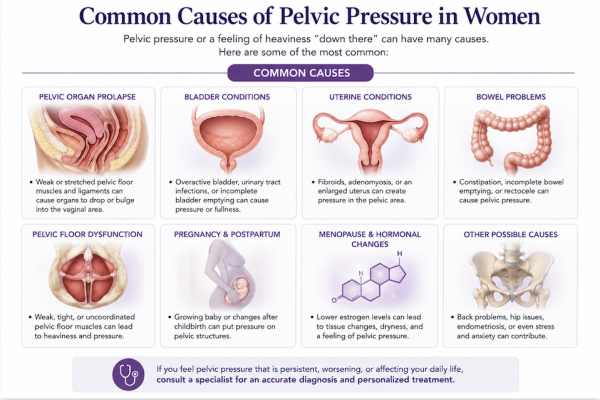
Pelvic pressure or heaviness can have several causes, including pelvic organ prolapse, bladder and uterine conditions, bowel problems, pelvic floor dysfunction, pregnancy, postpartum changes and menopause.
The challenge is that many different conditions can cause this sensation. Some are relatively minor and improve with conservative treatment, while others require further evaluation.
The good news is that pelvic pressure is a symptom—not a diagnosis.
Once the underlying cause is identified, treatment can often provide significant relief.
What Does Pelvic Pressure Feel Like?
Every woman experiences it a little differently.
You might describe it as:
- Pressure in the vagina
- Heaviness between your legs
- A pulling sensation
- Feeling like something is dropping
- Fullness inside the vagina
- Feeling like you’re sitting on a ball
- A constant downward pressure
- Pressure that gets worse as the day goes on
Some women experience one symptom.
Others experience several at the same time.
Pelvic Organ Prolapse Is One Possible Cause
One of the most common reasons women experience pelvic pressure is pelvic organ prolapse.
Pelvic organ prolapse occurs when the muscles and connective tissues supporting the pelvic organs weaken, allowing the bladder, uterus, rectum, or vaginal walls to descend.
Many women describe prolapse as:
“Something is falling.”
“Everything feels heavy.”
“There’s pressure all the time.”
Interestingly, the severity of the pressure doesn’t always match the degree of prolapse. Some women with mild prolapse have significant symptoms, while others with more advanced prolapse notice surprisingly little discomfort.
Childbirth Can Change Pelvic Support
Pregnancy and vaginal delivery place enormous strain on the pelvic floor.
During childbirth, muscles and ligaments stretch to allow delivery of the baby.
For many women, those tissues recover well.
For others, they never regain their previous strength.
This can lead to:
- Pelvic pressure
- Vaginal laxity
- Urinary leakage
- Prolapse
- Reduced pelvic support
Symptoms may appear shortly after delivery or gradually develop years later.
Aging and Menopause Can Also Contribute
Pelvic pressure isn’t limited to women who have had children.
As estrogen levels decline during menopause, changes occur throughout the pelvic floor.
These changes may affect:
- Connective tissue strength
- Collagen production
- Muscle support
- Tissue elasticity
For some women, these natural changes contribute to the gradual development of pelvic floor disorders.
Sometimes the Problem Isn’t Prolapse
This surprises many women.
Pelvic pressure can also result from:
- Pelvic floor muscle dysfunction
- Chronic constipation
- Bladder disorders
- Vaginal cysts
- Uterine fibroids
- Endometriosis
- Pelvic congestion
- Previous pelvic surgery
The symptom itself doesn’t tell us which condition is responsible.
That’s why a proper evaluation is so important.
Does the Pressure Get Worse Throughout the Day?
Many women notice a pattern.
They wake up feeling relatively normal.
As the day goes on:
- Standing becomes uncomfortable.
- Walking feels heavier.
- Exercise becomes more difficult.
- Pressure gradually increases.
Then, after lying down for a while, the symptoms improve.
This pattern is particularly common in women with pelvic support disorders because gravity places increasing stress on weakened support tissues throughout the day.
Other Symptoms That May Occur
Pelvic pressure often occurs together with:
- A vaginal bulge
- Urinary leakage
- Difficulty emptying the bladder
- Constipation
- Pain during intercourse
- Lower back discomfort
- A feeling that something is falling out
- Difficulty inserting tampons
These additional symptoms provide important clues when determining the underlying diagnosis.
Don’t Ignore Persistent Pressure
Many women convince themselves:
“It’s probably nothing.”
Or:
“I’m just getting older.”
Or:
“This is probably normal after kids.”
While pelvic pressure is common, persistent symptoms deserve evaluation—especially if they’re interfering with your daily activities or quality of life.
Early diagnosis often provides more treatment options and may help prevent symptoms from becoming more bothersome over time.
Finding the Cause Is the First Step Toward Feeling Better
Women often arrive at Miklos & Moore describing exactly what they’re feeling rather than naming a diagnosis. They don’t say, “I think I have a cystocele.” They say, “I feel pressure,” “It feels heavy,” or “Something just isn’t right.”
Those descriptions are incredibly valuable because they help guide the evaluation.
Dr. John Miklos and Dr. Robert Moore begin by listening carefully to each woman’s experience, followed by a comprehensive pelvic examination to determine the underlying cause. Because they have spent decades treating pelvic organ prolapse, urinary incontinence, childbirth-related pelvic floor injuries, and complex reconstructive conditions, they understand that similar symptoms can arise from very different disorders. Their work has earned national and international recognition, including professional awards, invitations to teach surgeons around the world, and authorship of numerous peer-reviewed medical publications. That experience allows them to develop treatment plans based on the diagnosis—not simply the symptom.
Treatment Depends on the Diagnosis
After identifying the cause, treatment may include:
- Pelvic floor physical therapy
- Lifestyle changes
- Pessary treatment
- Hormonal therapy
- Observation
- Robotic prolapse surgery
- Vaginal reconstructive surgery
- Urinary incontinence treatment
- Combination procedures
Every woman deserves a treatment plan that reflects her symptoms, anatomy, lifestyle, and goals.
Frequently Asked Questions
Is pelvic pressure normal after childbirth?
Some pressure is common during recovery, but symptoms that persist or worsen should be evaluated.
Does pressure always mean prolapse?
No. Several pelvic floor and gynecologic conditions can produce similar sensations.
Why does the pressure get worse at the end of the day?
Gravity places increasing stress on weakened pelvic support structures throughout the day, making symptoms more noticeable for some women.
Can physical therapy help?
Many women benefit from pelvic floor rehabilitation, particularly when muscle weakness contributes to their symptoms.
Will I need surgery?
Not necessarily. The appropriate treatment depends entirely on the underlying diagnosis.
How do I know what’s causing the pressure?
A comprehensive pelvic floor examination is the best way to determine the source of your symptoms and identify the most appropriate treatment.
Conclusion
Pelvic pressure can be unsettling, but it doesn’t automatically mean something is seriously wrong. It simply means your body is asking you to pay attention.
Whether the cause is pelvic organ prolapse, muscle weakness, childbirth-related changes, menopause, or another pelvic floor condition, identifying the reason behind your symptoms is the first step toward feeling better.
You don’t need to know the medical term. You don’t need to diagnose yourself. You simply need a physician who listens carefully, understands what you’re feeling, and can help determine the cause so that together you can create the treatment plan that’s right for you.