
Preserve Your Uterus During Prolapse Surgery: Is Uterus-Preserving Surgery Right for You?
Can You Keep Your Uterus If You Have Pelvic Organ Prolapse?
For many years, women diagnosed with uterine prolapse were often told they needed a hysterectomy. Today, that’s no longer the only option.
Advances in female pelvic reconstructive surgery now allow many women to preserve their uterus while successfully treating pelvic organ prolapse. This approach, known as uterus-preserving prolapse surgery or hysteropexy, can restore normal pelvic support without removing the uterus.
If you’re asking questions like:
- Can I keep my uterus during prolapse surgery?
- Do I really need a hysterectomy?
- What is uterus-preserving prolapse surgery?
You’re not alone. These are among the most common concerns women have after being diagnosed with uterine prolapse.
At Miklos & Moore, preserving the uterus is an option for many patients, but it is not the right choice for everyone. The most important step is understanding all of your treatment options before making a decision.
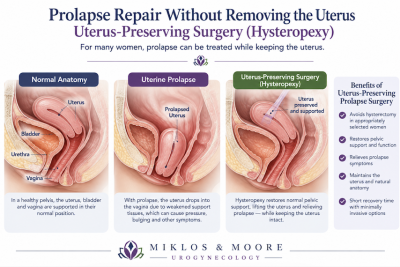
Medical illustration showing normal pelvic anatomy, uterine prolapse and uterus-preserving hysteropexy, which restores support while keeping the uterus intact.
Why Some Women Want to Preserve Their Uterus
Every woman’s reasons are personal.
Some wish to avoid removing a healthy organ. Others have emotional, cultural, religious, or personal beliefs that make preserving the uterus important. Some simply want to explore every treatment option before considering a hysterectomy.
Common reasons women choose uterus preservation include:
- Wanting to avoid a hysterectomy
- Believing the uterus is an important part of their body
- Wanting a less invasive approach when appropriate
- Personal or cultural values
- Confidence that their uterus is healthy
There is no “right” or “wrong” choice. The best decision is the one that aligns with your health, anatomy, and personal goals.
What Is Uterus-Preserving Prolapse Surgery?
Uterus-preserving prolapse surgery restores the uterus to its normal position without removing it.
The most common procedure is called a hysteropexy.
During hysteropexy, the uterus is lifted and supported using specialized reconstructive techniques. Depending on your anatomy, this may involve:
- Native tissue repairs using your own ligaments
- Sacrospinous hysteropexy
- Uterosacral ligament suspension
- Laparoscopic hysteropexy
- Robotic hysteropexy
- Sacrohysteropexy
The specific procedure depends on the type and severity of prolapse, as well as your surgeon’s evaluation.
Who May Be a Candidate for Uterus Preservation?
Many women with uterine prolapse are potential candidates, particularly if they:
- Have symptomatic uterine prolapse
- Have a healthy uterus
- Do not have abnormal uterine bleeding
- Do not have large fibroids causing symptoms
- Do not have uterine cancer or precancerous conditions
- Prefer to preserve their uterus
The only way to know if uterus-preserving surgery is appropriate is through a comprehensive pelvic examination by an experienced pelvic reconstructive surgeon.
When Is a Hysterectomy Still Recommended?
Although uterus preservation is an excellent option for many women, there are situations where removing the uterus may provide the safest or most effective treatment.
A hysterectomy may be recommended if you have:
- Uterine cancer
- Precancerous changes
- Large symptomatic fibroids
- Severe adenomyosis
- Persistent abnormal uterine bleeding
- Other uterine diseases that would not be corrected by preserving the uterus
Your surgeon should explain why one approach is recommended over another and discuss the risks and benefits of each.
Does Keeping the Uterus Affect Success Rates?
One of the biggest myths about prolapse surgery is that removing the uterus automatically produces a better repair.
Current research suggests that, for appropriately selected patients, uterus-preserving surgery can achieve excellent long-term outcomes comparable to prolapse repairs that include hysterectomy.
The durability of the repair depends on factors such as:
- Proper diagnosis
- Correct surgical technique
- Repair of all prolapsed compartments
- Tissue quality
- Surgeon experience
- Following postoperative instructions
Whether the uterus is removed is only one part of the overall treatment plan.
Benefits of Preserving the Uterus
Potential advantages of uterus-preserving surgery include:
- Retaining the uterus
- Restoring normal pelvic anatomy
- Excellent symptom relief
- High patient satisfaction
- Effective correction of uterine prolapse
- Minimally invasive options for many patients
- Avoiding removal of a healthy organ when appropriate
The decision should always be individualized based on your specific condition.
Recovery After Uterus-Preserving Surgery
Recovery varies depending on the type of surgery performed and whether additional prolapse repairs are needed.
Many women can expect:
- Walking the same day as surgery
- Mild to moderate postoperative discomfort
- Temporary restrictions on heavy lifting
- Gradual return to normal daily activities over several weeks
- Continued healing over the following months
Following your surgeon’s postoperative instructions is essential to protect the repair during healing.
Why Experience Matters in Uterus-Preserving Surgery
Preserving the uterus while correcting prolapse requires more than simply lifting the uterus. Successful surgery depends on restoring the complex network of ligaments and connective tissues that support the pelvic organs while addressing any associated bladder, vaginal, or rectal prolapse.
Drs. John Miklos and Robert Moore have devoted their careers to female pelvic reconstructive surgery. They are internationally recognized urogynecologic surgeons who have performed thousands of prolapse procedures, developed innovative surgical techniques, authored numerous peer-reviewed publications, and trained surgeons from around the world. Women frequently travel to their practice for second opinions and revision surgery after unsuccessful prolapse repairs performed elsewhere.
Their extensive experience allows them to evaluate each patient’s anatomy and determine whether uterus-preserving surgery is appropriate or whether another reconstructive approach would provide a better long-term outcome.
Why Women Travel to Miklos & Moore for Uterus-Preserving Prolapse Surgery
Choosing prolapse surgery is a significant decision, and many women seek a surgeon with extensive experience in pelvic floor reconstruction.
Patients from across the United States and internationally choose Drs. Miklos and Moore because they offer:
- Decades of exclusive focus on female pelvic reconstructive surgery
- Expertise in both uterus-preserving surgery and hysterectomy-based prolapse repair
- Individualized treatment plans rather than a one-size-fits-all approach
- Advanced minimally invasive, robotic, laparoscopic, and vaginal surgical techniques
- Comprehensive evaluation of all pelvic floor disorders, including bladder, bowel, and vaginal prolapse
- A long history of treating complex and recurrent prolapse cases referred by other physicians
Their philosophy is simple: recommend the procedure that is best for the patient—not the same procedure for every patient.
Schedule a Consultation
If you’ve been diagnosed with uterine prolapse and would like to explore the possibility of preserving your uterus, a consultation with an experienced pelvic reconstructive surgeon can help you understand your options.
At Miklos & Moore, every patient receives a comprehensive evaluation to determine whether uterus-preserving surgery, hysteropexy, hysterectomy with prolapse repair, or another reconstructive procedure is the most appropriate treatment.
Frequently Asked Questions
Can I keep my uterus during prolapse surgery?
Yes. Many women with uterine prolapse are candidates for uterus-preserving surgery, most commonly a hysteropexy. Whether this is appropriate depends on your anatomy and overall health.
Is uterus-preserving surgery as effective as a hysterectomy?
For carefully selected patients, uterus-preserving prolapse surgery can provide excellent long-term results comparable to prolapse repair performed with a hysterectomy.
What is a hysteropexy?
A hysteropexy is a procedure that repairs uterine prolapse while preserving the uterus. The uterus is lifted back into its normal position and supported using specialized reconstructive techniques.
Who should not have uterus-preserving surgery?
Women with uterine cancer, precancerous conditions, significant uterine disease, large symptomatic fibroids, or persistent abnormal bleeding may be better candidates for hysterectomy. Your surgeon can help determine which option is safest for you.
How long is recovery after uterus-preserving prolapse surgery?
Recovery depends on the specific procedure performed. Many women resume light daily activities within a few weeks, while complete healing continues over several months.
Why choose Drs. Miklos and Moore for uterus-preserving prolapse surgery?
Drs. Miklos and Moore have dedicated their careers exclusively to female pelvic reconstructive surgery and cosmetic gynecology. As internationally recognized, award-winning surgeons, they have performed thousands of prolapse procedures, pioneered innovative surgical techniques, published extensively in peer-reviewed medical journals, and trained physicians around the world. Their expertise includes both uterus-preserving prolapse surgery and complex revision cases, allowing them to recommend the treatment that best matches each patient’s anatomy, symptoms, and long-term goals.