
When an Enlarged Clitoris Causes Discomfort or Self-Consciousness
Some women naturally have a larger or more prominent clitoris that may extend beyond the surrounding clitoral hood or labial tissue. While this can simply be a normal anatomical variation, some women experience self-consciousness, embarrassment, unwanted visibility, increased sensitivity, irritation from clothing, or physical discomfort because of the prominence.
Dr. John Miklos and Dr. Robert Moore evaluate women with concerns involving a naturally enlarged or protruding clitoris, clitoral hood anatomy, and other complex cosmetic or functional concerns. A careful examination can determine whether the prominence involves the clitoris itself, the clitoral hood, its position, or a combination of anatomical factors.
Request a consultation with Miklos & Moore to discuss your concerns and learn which treatment options may be appropriate for your individual anatomy.
Understanding a Naturally Prominent or Protruding Clitoris
Every woman’s anatomy is different, and there is a wide range of normal variation in the size, shape, and visibility of the clitoris. Some women naturally have a larger or more prominent clitoris, while others may have a clitoris that protrudes beyond the surrounding clitoral hood and labial tissue.
For many women, this causes no physical or emotional concern. For others, however, a noticeably protruding clitoris can cause self-consciousness, embarrassment, irritation from clothing, increased sensitivity, discomfort during physical activity, or concerns during intimacy.
Some women have noticed the difference since puberty and have spent years wondering whether their anatomy is normal. Others may only become concerned after comparing their appearance with photographs or discussing the issue with a partner.
The important point is that a naturally prominent clitoris does not automatically mean something is medically wrong. When the appearance or symptoms are bothersome, however, a specialized evaluation can determine exactly what is contributing to the prominence and whether treatment is appropriate.
Dr. John Miklos and Dr. Robert Moore evaluate women with complex cosmetic and functional concerns involving the clitoris, clitoral hood, labia, vagina, and surrounding pelvic anatomy.
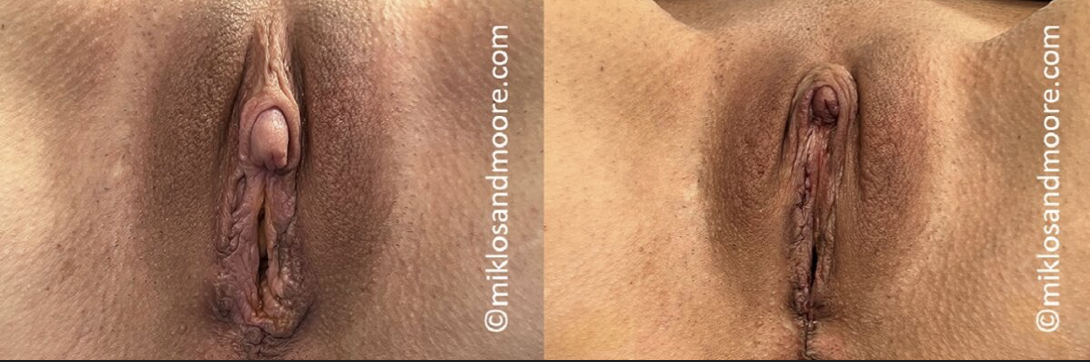
Before and after clinical photographs showing treatment of a naturally enlarged clitoris with significant prominence.
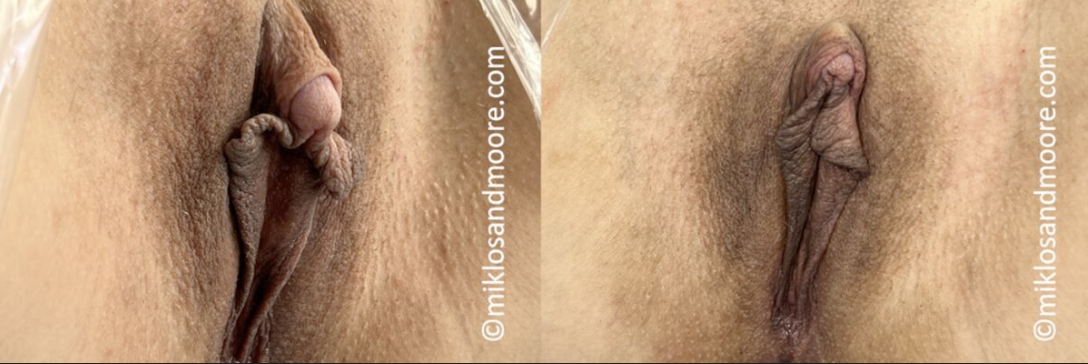
Before and after photographs demonstrating surgical correction of a protruding clitoris and improvement in its overall prominence.
What Is a Protruding Clitoris?
The clitoris is an important sensory organ consisting of considerably more anatomy than the small external portion that can be seen.
The visible portion is known as the clitoral glans. It is normally partially or substantially covered by folds of tissue known as the clitoral hood.
In some women, the clitoral glans is naturally more prominent and may extend beyond the surrounding hood.
Women often describe this as:
- My clitoris sticks out
- My clitoris is too large
- I have a long clitoris
- My clitoris is always visible
- My clitoris protrudes through the hood
- My clitoris looks different
- I have had a large clitoris since puberty
- I am embarrassed by the size of my clitoris
These descriptions can represent several different anatomical situations.
That distinction matters because the appropriate treatment—if any—is determined by which structure is actually responsible for the appearance.
Can You Be Born With a Large Clitoris?
Yes. There is substantial natural variation in female genital anatomy, and some women simply have a more prominent clitoris than others.
A woman may have noticed the appearance since childhood or puberty without experiencing any recent change.
However, congenital or longstanding clitoral enlargement can sometimes be associated with hormonal, developmental, or genetic conditions. For that reason, a woman with significant clitoral enlargement should not assume that the issue is purely cosmetic without appropriate evaluation.
The medical history is particularly important.
A specialist may ask whether the enlargement has always been present, whether it developed during puberty, whether it appeared suddenly later in life, and whether there are other symptoms suggesting hormonal changes.
Is an Enlarged Clitoris Genetic?
Sometimes genetics or congenital development may contribute to genital anatomy, but “genetic enlarged clitoris” is not a single diagnosis.
Clitoral size can be influenced by anatomy, development, hormones, and certain medical conditions.
Some women simply inherit anatomical characteristics that result in more prominent genital tissue. Other cases may involve androgen exposure or an endocrine condition.
This is why the underlying cause should be considered before treatment.
For a woman who has had the same anatomy for many years and has no other symptoms, the situation may be entirely different from someone experiencing rapid, unexplained clitoral growth.
Clitoral Size Varies Considerably Between Women
There is no single appearance that defines a normal vulva.
The size and shape of the labia minora, labia majora, clitoral hood, and visible portion of the clitoris vary considerably.
Some women have a clitoris that is almost completely covered by the hood. Others have a visible clitoral glans even when they are not sexually aroused.
Neither appearance automatically represents a problem.
Treatment should therefore not be based simply on whether a woman’s anatomy looks different from someone else’s.
The relevant questions are whether there is an underlying medical issue and whether the anatomy is creating a genuine concern for the individual patient.
Why Does My Clitoris Stick Out?
A clitoris can appear to protrude for several reasons.
The clitoris itself may be larger or longer than average. The clitoral hood may provide less coverage. The surrounding labial anatomy may make the clitoris appear more prominent. There may also be differences in the position or support of the clitoral structures.
Some women have a combination of these anatomical characteristics.
A physical examination can distinguish among:
- True clitoral enlargement
- A naturally prominent clitoral glans
- Clitoral protrusion
- Reduced clitoral hood coverage
- Excess clitoral hood tissue
- Clitoral hood asymmetry
- Clitoral positional differences
- Prominent labial tissue
- Hormone-related clitoral enlargement
This distinction becomes especially important if surgery is being considered.
A Large Clitoris and Excess Clitoral Hood Are Not the Same Thing
Women frequently use the terms interchangeably, but the clitoris and clitoral hood are separate structures.
The clitoral hood is the fold of tissue covering and protecting the external clitoris.
Some women who believe their clitoris is excessively large actually have prominent or redundant clitoral hood tissue.
Others have true enlargement of the clitoris itself.
And some women have both.
Clitoral hood reduction modifies excess surrounding hood tissue. It does not reduce the actual clitoris.
A clitoropexy addresses aspects of clitoral position and support.
Surgery involving true clitoral enlargement is different again and requires particularly careful consideration because of the clitoris’s sensory nerves and blood supply.
An accurate anatomical diagnosis is therefore essential.
When a Protruding Clitoris Causes Physical Discomfort
A prominent clitoris does not necessarily cause symptoms.
However, increased exposure can create discomfort for some women.
A protruding clitoris may rub against underwear, jeans, leggings, exercise clothing, or other garments. Certain activities can increase pressure or friction.
Women may notice discomfort with:
- Cycling
- Horseback riding
- Running
- Exercise
- Tight clothing
- Prolonged sitting
- Sexual activity
Some women describe excessive sensitivity rather than pain.
Because the clitoral glans is normally protected to varying degrees by the hood, increased exposure may make direct contact more noticeable.
The specific source of the discomfort should be identified before considering surgery.
Feeling Embarrassed About a Prominent Clitoris
For some women, the concern is primarily cosmetic rather than physical.
A woman may have been self-conscious about her anatomy since adolescence. She may avoid certain clothing, feel uncomfortable changing around others, or experience embarrassment during intimate relationships.
These concerns are personal.
A physician should neither tell a woman that she must change her anatomy nor dismiss a concern simply because the anatomy may fall within natural variation.
The objective of a consultation is to provide accurate information about the anatomy and allow the patient to make an informed decision.
Some women feel considerably better simply learning that their anatomy represents a natural variation.
Others continue to experience significant personal distress and want to understand whether treatment is possible.
When Should Clitoral Enlargement Be Medically Evaluated?
A longstanding prominent clitoris is different from a clitoris that suddenly begins increasing in size.
New, unexplained, or rapidly progressive clitoral enlargement should be medically evaluated.
This is particularly important when enlargement occurs with other changes that could indicate increased androgen activity.
A physician may consider the patient’s medications, hormone exposure, medical history, age, and associated symptoms.
Women taking testosterone or androgen-containing hormone treatments should also inform their physician because these medications can influence clitoral tissue.
The underlying cause should be understood before cosmetic treatment is considered.
Can a Protruding Clitoris Be Corrected?
Potential treatment depends entirely upon the anatomy and the patient’s goals.
Not every prominent clitoris requires treatment, and surgery is not appropriate for everyone.
Depending upon the underlying anatomical issue, a surgeon may discuss procedures involving surrounding tissue, clitoral hood anatomy, clitoral position, or—in carefully selected circumstances—true clitoral enlargement.
There is no universal operation for a “large clitoris.”
Treatment must be customized to the individual anatomy.
Clitoral Reduction Surgery
Surgery intended to reduce true clitoral prominence is substantially different from routine labiaplasty or clitoral hood reduction.
The clitoris has an extensive nerve and vascular supply that is critical to sensation and sexual function.
Any surgical procedure involving clitoral tissue must therefore be approached conservatively and with a detailed understanding of this anatomy.
Potential surgical goals may include improving excessive protrusion while protecting:
- Clitoral sensation
- Nerve structures
- Blood supply
- Sexual function
- Surrounding anatomy
- Natural appearance
A patient’s desire for a smaller appearance must always be balanced against the importance of preserving function.
Why Preserving Clitoral Sensation Is So Important
Cosmetic appearance cannot be the only consideration when operating around the clitoris.
The sensory nerves supplying the clitoris are critical to sexual sensation. Damage to these structures could potentially produce altered or diminished sensation.
For this reason, women considering surgery should understand exactly what procedure is being recommended and which anatomical structures will be altered.
The surgeon should also be able to explain whether the concern actually requires surgery on the clitoris or whether modifying surrounding tissue may accomplish the patient’s objective.
Clitoral Hood Reduction vs. Clitoral Surgery
A woman with prominent tissue above or beside the clitoris may benefit from evaluation for clitoral hood reduction rather than surgery involving the clitoris itself.
Clitoral hood reduction removes or reshapes selected redundant folds of hood tissue.
It should not be confused with clitoral reduction.
Similarly, a woman concerned about the position or projection of the clitoral structures may require a different approach.
This is one of the most important reasons not to choose a procedure based solely on photographs or terminology found online.
Two women who both say, “My clitoris sticks out,” may have completely different anatomy.
What About Clitoropexy?
Clitoropexy is another specialized procedure involving clitoral positioning and support.
It is not synonymous with clitoral reduction or clitoral hood reduction.
For selected anatomical concerns, addressing position may be more appropriate than reducing tissue.
Again, the correct procedure depends upon what is actually causing the prominence.
Dr. Miklos and Dr. Moore’s experience with clitoropexy, clitoral hood procedures, cosmetic gynecology, and reconstructive surgery allows the anatomy to be evaluated comprehensively rather than treating every concern with the same operation.
Previous Surgery Can Make Treatment More Complicated
Some women seeking treatment have already undergone labiaplasty, clitoral hood reduction, clitoropexy, or another cosmetic gynecologic procedure.
Revision cases can be considerably more complex.
Previous surgery may alter:
- Tissue availability
- Scar patterns
- Clitoral exposure
- Symmetry
- Blood supply
- Sensation
- Relationship between the hood and clitoris
In these situations, additional surgery should be planned carefully.
The goal is not simply to remove more tissue.
In some cases, excessive previous tissue removal may actually be contributing to unwanted clitoral exposure.
Experience Matters in Clitoral and Cosmetic Gynecologic Surgery
Surgery involving the clitoral region requires specialized knowledge of female genital anatomy and careful surgical technique.
Dr. John Miklos and Dr. Robert Moore have extensive experience in advanced cosmetic gynecology, urogynecology, vaginal reconstruction, clitoral hood procedures, clitoropexy, and revision surgery.
Their experience treating both cosmetic and functional pelvic conditions allows them to evaluate how the clitoris, clitoral hood, labia, vagina, and surrounding structures relate to one another.
This is particularly important for women with unusual anatomy or those who have undergone previous procedures.
What Happens During a Consultation?
The consultation should begin with a conversation—not an assumption that surgery is necessary.
The surgeon needs to understand exactly what bothers the patient.
Questions may include:
- Has your clitoris always appeared this way?
- When did you first notice the prominence?
- Has its size changed?
- Are you taking testosterone or other hormones?
- Do you experience rubbing or irritation?
- Is the area excessively sensitive?
- Does it interfere with exercise or clothing?
- Are you primarily concerned about appearance?
- Have you undergone previous genital surgery?
- What would you like to change?
An examination can then determine which anatomical structures are contributing to the concern.
Setting Realistic Expectations
Women considering cosmetic genital surgery should have realistic expectations.
The objective should not be to create an artificial standard of what female anatomy is “supposed” to look like.
Instead, treatment should address a specific concern while preserving normal anatomy and function.
For some patients, the best recommendation may be no surgery.
For others, a carefully selected procedure may improve protrusion, discomfort, excessive exposure, or a cosmetic concern.
The decision should be individualized.
Protruding Clitoris Before and After Surgery
Before-and-after photographs can be useful when researching treatment, but they must be interpreted carefully.
Patients differ in baseline anatomy, degree of clitoral prominence, clitoral hood anatomy, labial anatomy, previous surgery, and treatment goals.
A photograph showing another patient’s result cannot predict exactly what another woman’s result will look like.
Before-and-after photographs are most useful for demonstrating the types of anatomical concerns a surgeon has previously treated.
When to Seek a Specialist
Consider seeking a specialized evaluation if:
- Your clitoris has always been unusually prominent and it bothers you
- Your clitoris protrudes beyond the surrounding tissue
- Clothing causes rubbing or irritation
- You experience unwanted hypersensitivity
- You are embarrassed or self-conscious about the appearance
- You are unsure whether the problem is the clitoris or clitoral hood
- You are considering clitoral reduction
- You are considering clitoral hood reduction or clitoropexy
- You previously underwent cosmetic genital surgery and are unhappy with the result
- Your clitoris has recently or rapidly increased in size
A consultation can help distinguish normal anatomical variation from a condition requiring further medical evaluation.
Expert Evaluation With Miklos & Moore
Women concerned about a naturally enlarged or protruding clitoris deserve an evaluation that considers both appearance and function.
Dr. John Miklos and Dr. Robert Moore have extensive surgical experience with complex female genital anatomy, cosmetic gynecology, clitoral hood surgery, clitoropexy, vaginal reconstruction, and revision procedures.
The first step is determining whether the concern involves the actual clitoris, its position, the clitoral hood, surrounding labial tissue, or a combination of anatomical factors.
Only after the anatomy and patient’s goals are understood should treatment be considered.
Request a consultation with Miklos & Moore to discuss a protruding or enlarged clitoris and learn which treatment options may be appropriate for your individual anatomy.
Frequently Asked Questions
Can a woman naturally have a large clitoris?
Yes. Clitoral size and visibility vary naturally. A larger or more visible clitoris does not automatically indicate a medical problem.
Why has my clitoris always stuck out?
It may reflect your natural anatomy, including the size of the visible clitoris, the amount of clitoral hood coverage, clitoral position, or surrounding labial anatomy.
Is a protruding clitoris genetic?
Genetic and developmental factors can influence anatomy, but significant clitoral enlargement can have several causes. “Genetic enlarged clitoris” is not a single medical diagnosis.
Can a large clitoris be made smaller?
Surgical options may be available for carefully selected patients, but treatment depends on the actual anatomy. Protecting clitoral nerves, blood supply, sensation, and sexual function is essential.
Is clitoral reduction the same as clitoral hood reduction?
No. Clitoral hood reduction modifies tissue surrounding the clitoris. True clitoral reduction involves the clitoris itself and is a distinctly different procedure.
Can a protruding clitoris cause discomfort?
Yes. Some women experience rubbing, irritation, excessive sensitivity, or discomfort with clothing, exercise, cycling, or other activities.
Should sudden clitoral enlargement be evaluated?
Yes. New or rapidly progressive enlargement should be medically evaluated, particularly when there is no known explanation such as androgen exposure.
Can Miklos & Moore evaluate previous clitoral surgery?
Yes. Dr. Miklos and Dr. Moore evaluate patients with concerns following previous cosmetic gynecologic or clitoral procedures, including complex revision cases.