
Failed TVT/TOT Bladder Sling Surgery Second Opinion


Women experiencing problems after TVT or TOT bladder sling surgery may benefit from a second opinion before undergoing another procedure. Persistent urinary leakage, difficulty emptying the bladder, urinary urgency, pelvic or groin pain, painful intercourse, mesh exposure, or recurrent infections can have different causes and require careful evaluation. Dr. John Miklos and Dr. Robert Moore are fellowship-trained urogynecologists with decades of experience treating urinary incontinence, mesh complications, failed bladder slings, and complex revision cases. They evaluate whether the sling is actually responsible for the symptoms and whether revision, partial or more extensive removal, another continence procedure, or a nonsurgical approach should be considered. Women travel to Miklos & Moore from across the United States and around the world seeking second opinions after failed TVT/TOT sling surgery, particularly when previous treatment has failed or surgeons have recommended different approaches.

TVT – TOT Bladder Sling Failed Surgery Second Opinion: What Can Be Done Next?

When a TVT or TOT bladder sling does not produce the expected result—or creates new symptoms—the situation can become far more complicated than the original stress urinary incontinence problem.

Some women continue to leak urine after surgery. Others develop difficulty urinating, urinary urgency, pelvic pain, recurrent urinary tract infections, painful intercourse, or complications involving the sling or mesh. Some women have already undergone one or more attempts to revise or remove the sling and are still experiencing problems.

At that point, another operation should not be the automatic next step.

A TVT/TOT bladder sling failed surgery second opinion can help determine what went wrong, whether the sling is actually responsible for the symptoms, and what treatment options may now be appropriate.

Dr. John Miklos and Dr. Robert Moore are fellowship-trained urogynecologists with decades of experience in female pelvic reconstructive surgery, urinary incontinence procedures, mesh complications, and complex revision surgery. Women travel to Miklos & Moore from across the United States and internationally for evaluation after previous bladder sling procedures.
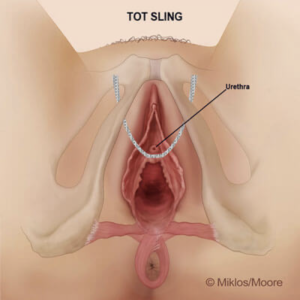
TOT bladder sling showing transobturator mesh placement beneath the urethra

Medical illustration showing the position and pathway of a TOT (transobturator tape) sling used to support the urethra and treat stress urinary incontinence.
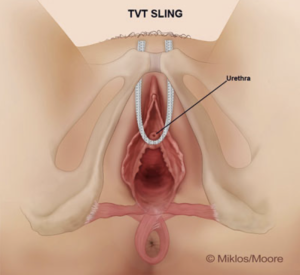
TVT bladder sling showing retropubic mesh placement beneath the urethra

Medical illustration showing the position and pathway of a TVT (tension-free vaginal tape) sling used to support the urethra for treatment of stress urinary incontinence.

What Are TVT and TOT Bladder Slings?

TVT and TOT are types of midurethral sling procedures used primarily to treat stress urinary incontinence.

TVT generally refers to tension-free vaginal tape, while TOT refers to a transobturator tape approach.

Although both procedures are intended to support the urethra and reduce stress urinary leakage, the path and positioning of the sling differ.

That difference can become particularly important when evaluating complications or planning revision surgery.

A woman seeking a second opinion should ideally know which type of sling was implanted, although previous operative records can often provide this information.

What Does a “Failed” Bladder Sling Mean?

There is no single definition of failed sling surgery.

For one woman, failure may mean she continues leaking exactly as she did before surgery.

For another, the incontinence improves but she develops an entirely new problem.

Women may seek a second opinion because of:

  • Persistent stress urinary incontinence
  • Recurrent leakage after initial improvement
  • Difficulty emptying the bladder
  • Slow or interrupted urinary stream
  • Urinary retention
  • New urinary urgency or frequency
  • Recurrent urinary tract infections
  • Pelvic or vaginal pain
  • Groin pain
  • Pain during intercourse
  • Vaginal mesh exposure or erosion
  • Suspected bladder or urethral involvement
  • Complications following previous sling revision or removal

These problems do not necessarily have the same cause and should not automatically receive the same treatment.

My Bladder Sling Didn’t Work — Why?

This is often the first question a patient wants answered.

Unfortunately, there may not be one simple explanation.

Persistent or recurrent leakage may occur because the original incontinence was more complicated than expected, the sling no longer provides adequate support, the patient’s condition changed over time, or another urinary disorder is contributing to the symptoms.

Before recommending another sling or another operation, the surgeon needs to determine what type of urinary problem exists now.

Not all urine leakage is stress urinary incontinence.

That distinction matters enormously when considering revision surgery.

What If the Sling Worked but Caused New Problems?

This is a very different situation.

A woman may no longer leak when she coughs or sneezes but may now struggle to empty her bladder, experience pain, or develop urinary urgency.

In these cases, simply asking whether the sling “worked” does not adequately describe the outcome.

The more important questions are:

  • Did the sling correct the original stress incontinence?
  • What symptoms developed after surgery?
  • When did those symptoms begin?
  • Could the sling’s position or tension be contributing?
  • Is mesh exposure or another complication present?
  • Would altering the sling improve one problem but cause the original leakage to return?

Revision decisions frequently involve balancing several competing considerations.

Difficulty Urinating After TVT or TOT Surgery

Some women develop problems emptying their bladder after sling placement.

Symptoms can include:

  • Weak urinary stream
  • Starting and stopping while urinating
  • Straining to urinate
  • Feeling that the bladder remains full
  • Taking much longer to urinate
  • Urinating frequently because the bladder does not empty completely
  • Recurrent urinary infections
  • Urinary retention

The timing of these symptoms is important.

Difficulty urinating that begins immediately after surgery may raise different questions than urinary problems that develop months or years later.

A second-opinion evaluation should determine whether obstruction from the sling is actually present rather than assuming the sling is responsible for every urinary symptom.

Pain After a TOT or TVT Sling

Pain following sling surgery deserves careful evaluation.

The location of the pain can provide important clues.

A patient may describe vaginal pain, pelvic pain, groin discomfort, pain with intercourse, or pain associated with certain movements.

The approach used for the original sling may also matter when considering the anatomy involved.

Most importantly, pain after sling surgery does not automatically mean the entire sling must be removed.

The cause of the pain should be investigated before another operation is planned.

Mesh Exposure or Erosion After Bladder Sling Surgery

Mesh-related complications can occur after sling placement.

Depending on the individual situation, mesh may become exposed through vaginal tissue or involve surrounding structures.

The terminology patients encounter can be confusing because words such as exposure, erosion, extrusion, and complication are sometimes used differently.

What matters clinically is determining:

  • Where the mesh is located
  • How much mesh is involved
  • Whether the vagina is affected
  • Whether the bladder or urethra may be involved
  • Whether infection or inflammation is present
  • Whether the finding actually explains the patient’s symptoms

This is another reason an experienced evaluation is important before proceeding with revision surgery.

Do I Need My Entire Bladder Sling Removed?

Not necessarily.

This is one of the most important questions for women seeking a second opinion.

The appropriate treatment depends on the specific complication, symptoms, sling type, sling location, previous procedures, and findings during examination and testing.

In some situations, treatment may involve a limited revision.

In others, more extensive surgery may be considered.

And some women may not require sling removal at all.

The decision should be individualized rather than based solely on the fact that mesh is present.

Partial Sling Removal vs. Complete Sling Removal

Patients frequently arrive at a consultation after receiving very different recommendations.

One surgeon may recommend cutting or releasing part of the sling.

Another may recommend partial removal.

Another may recommend a more extensive excision.

These recommendations can sound contradictory, but they may reflect different interpretations of the problem or different surgical experience.

A second opinion should clarify what portion of the sling is believed to be causing the problem and what the surgeon expects removal or revision to accomplish.

Equally important, the patient should understand what symptoms may not improve after surgery.

Could Removing the Sling Make Me Leak Again?

Yes, this possibility should be discussed.

The sling was originally placed to treat stress urinary incontinence.

Changing, releasing, or removing that support can potentially affect continence.

This creates an important tradeoff in some revision cases.

The objective may be to address a complication while minimizing the likelihood of creating another significant problem.

Patients should understand this possibility before consenting to revision surgery.

Should Another Sling Be Put In?

If a sling failed to control stress urinary incontinence, another procedure may eventually be considered.

But automatically placing another sling without determining why the first operation failed may not be appropriate.

Before repeat incontinence surgery, questions should include:

  • Does the patient still have true stress urinary incontinence?
  • Is urgency contributing to the leakage?
  • Is there urinary obstruction?
  • Is the previous sling still present?
  • Has previous surgery altered the urethral anatomy?
  • Is pelvic organ prolapse affecting urinary function?
  • What alternatives to another sling are available?

Revision surgery should begin with a new diagnosis, not merely a repeat of the previous procedure.

Why the Original Operative Report Is So Important

Women often know they had “a bladder sling” but do not know exactly what was implanted.

For a second opinion, the original operative report can be extremely valuable.

It may identify:

  • Whether a TVT or TOT approach was used
  • The specific sling or mesh product
  • How the procedure was performed
  • Whether other pelvic procedures were performed simultaneously
  • Whether complications occurred during surgery
  • Whether prolapse surgery was also performed

If additional revision operations have already occurred, those operative reports are important as well.

For complicated cases, reconstructing the complete surgical history can be one of the most valuable parts of the evaluation.

What to Bring to a TVT/TOT Sling Second Opinion

When available, bring:

  • Original operative report
  • Records from subsequent sling revisions
  • Implant or mesh information
  • Urodynamic testing
  • Cystoscopy reports
  • Imaging studies
  • Urine testing history
  • Records of recurrent urinary infections
  • Previous pelvic surgery records
  • A timeline showing when symptoms began

Even if you cannot obtain every record, you can still be evaluated.

What If I’ve Already Had Sling Revision Surgery?

This is where experience with complex revision surgery becomes particularly important.

After one or more revision procedures, the anatomy may no longer resemble the anatomy present before the original operation.

There may be scar tissue, portions of sling remaining, changes in urethral support, and effects from other pelvic procedures.

A woman who has already undergone multiple operations should understand exactly what another surgeon proposes to do differently.

The question becomes less about the original sling and more about the anatomy that exists today.

Why High Surgical Volume Matters in Failed Sling Cases

A straightforward first-time incontinence procedure and a complicated sling revision are very different surgical situations.

Revision cases can require experience with:

  • TVT procedures
  • TOT procedures
  • Midurethral sling complications
  • Mesh exposure
  • Urinary obstruction
  • Recurrent stress urinary incontinence
  • Previous sling excision
  • Pelvic organ prolapse
  • Scarred or altered anatomy
  • Multiple previous pelvic surgeries

High-volume reconstructive experience can be especially valuable when several of these problems exist simultaneously.

Dr. Miklos and Dr. Moore: TVT/TOT Failed Sling Second Opinions

Dr. John Miklos and Dr. Robert Moore are fellowship-trained urogynecologists with decades of experience in female pelvic medicine and reconstructive surgery.

Their practice evaluates women with urinary incontinence, complications following previous sling procedures, mesh-related problems, recurrent symptoms, and complex pelvic reconstructive histories.

Patients may come to Miklos & Moore after receiving very different recommendations about sling revision or removal.

The objective of the second opinion is not simply to recommend another operation.

It is to answer three fundamental questions:

What is causing the problem now?

Is the previous TVT or TOT actually responsible?

What treatment provides a reasonable balance between correcting the complication and preserving urinary function?

Women Travel From Across the United States and Internationally for Complex Sling Cases

Failed or complicated sling surgery can lead women to search far beyond their local area for another opinion.

This is especially true when a patient has already undergone multiple procedures or has received conflicting recommendations regarding mesh removal, sling revision, or another continence operation.

Women travel to Miklos & Moore from across the United States and around the world seeking evaluation of complicated urogynecologic and reconstructive problems.

For a woman contemplating another operation after an unsuccessful procedure, specialized revision experience can become more important than geographic convenience.

Questions to Ask Before Another TVT/TOT Sling Operation

Before undergoing another operation, consider asking:

  • Why did my original sling fail?
  • Is my current leakage actually stress urinary incontinence?
  • Is the sling causing urinary obstruction?
  • Is mesh exposed or involving another structure?
  • Do I need the sling revised or removed?
  • How much sling needs to be removed?
  • Could removal cause my stress incontinence to return?
  • What happens if I don’t have another operation?
  • Are there nonsurgical options?
  • If another continence procedure is recommended, why?
  • How many complicated sling revisions does the surgeon treat?
  • What would this surgery do differently from my previous operation?

The patient should understand both what another operation might improve and what it may not improve.

When a Second Opinion Is Especially Important

Consider another opinion if:

  • Your TVT or TOT did not correct your urinary leakage.
  • Your incontinence returned after initially improving.
  • You developed difficulty urinating after surgery.
  • You developed pelvic, vaginal, or groin pain.
  • Mesh exposure or erosion has been diagnosed.
  • Complete sling removal has been recommended.
  • Another surgeon recommends only partial removal.
  • You have received conflicting surgical recommendations.
  • Another bladder sling has been proposed.
  • You have already undergone an unsuccessful revision.
  • You have had multiple previous pelvic surgeries.
  • You do not clearly understand why another operation is necessary.

These are precisely the situations where another experienced perspective may change—or confirm—the treatment plan.

A Second Opinion May Confirm the Original Recommendation

Getting another opinion does not mean the first surgeon made a mistake.

After reviewing the records, examining the patient, and performing any necessary testing, Drs. Miklos and Moore may agree with the treatment already proposed.

That confirmation itself can be valuable.

Alternatively, the evaluation may identify another explanation for the patient’s symptoms or another approach worth considering.

The goal is not to obtain a different answer.

The goal is to obtain an independent, experienced assessment before undergoing another potentially complex operation.

Get a Second Opinion After Failed TVT or TOT Bladder Sling Surgery

If your TVT or TOT bladder sling failed, your urinary symptoms returned, or you developed complications following surgery, another operation should begin with a careful reassessment of the original diagnosis, the procedure performed, and your current anatomy.

Dr. Miklos and Dr. Moore provide second opinions for women with failed bladder sling procedures, recurrent urinary incontinence, voiding problems, mesh complications, and previous unsuccessful revision surgeries.

With decades of experience in urogynecology and complex female pelvic reconstructive surgery, they can evaluate not simply what operation you had, but what is causing your symptoms today and what should happen next.

Frequently Asked Questions

Why would a TVT or TOT bladder sling fail?

Persistent or recurrent symptoms can have several causes. The original stress incontinence may persist or return, urinary symptoms may have another cause, or complications related to the sling may develop. An individualized evaluation is necessary.

Can a TVT or TOT sling be removed?

Sling revision or removal may be considered in certain circumstances, but the extent of surgery depends on the patient’s symptoms, sling location, complication, previous operations, and other factors.

Will removing my bladder sling stop my pain?

Not necessarily. Pain after sling surgery can have different causes, so determining whether the sling is responsible is important before surgery.

Can bladder sling removal cause incontinence?

Changing or removing urethral support can potentially result in recurrent stress urinary incontinence. This possibility should be discussed before revision surgery.

Should I have another sling if my first one failed?

Not automatically. Before another incontinence procedure, the cause and type of current urinary leakage should be established.

Should I get a second opinion before bladder sling removal?

A second opinion can be particularly valuable when complete removal has been recommended, surgeons disagree about the appropriate revision, symptoms are complex, or previous revision surgery has already failed.

Who should I see for a failed TVT or TOT sling?

A urogynecologist experienced in urinary incontinence, mesh complications, pelvic reconstructive surgery, and complex revision procedures can evaluate the problem and available treatment options.

Why seek a TVT/TOT sling second opinion from Miklos and Moore?

Drs. Miklos and Moore have decades of experience in urogynecology, urinary incontinence surgery, mesh complications, and complex pelvic reconstruction. They evaluate women from throughout the United States and internationally who are seeking another opinion after previous bladder sling surgery.

CONTACT US

For your confidential Consultation