
Vaginal Mesh Surgery Second Opinion
Women experiencing complications from vaginal mesh or considering mesh removal, revision, or another pelvic surgery may benefit from obtaining a second opinion before proceeding. Mesh-related surgery can be complex because previous procedures may have created scar tissue, altered normal pelvic anatomy, or placed mesh near the bladder, urethra, vagina, bowel, nerves, and other important structures. Dr. John Miklos and Dr. Robert Moore are fellowship-trained urogynecologists and high-volume pelvic reconstructive surgeons near Atlanta, Georgia, with decades of experience evaluating and treating vaginal mesh complications, failed mesh procedures, recurrent prolapse, and complex revision cases. Women travel to Miklos & Moore from across the United States and around the world for second opinions to better understand whether surgery is necessary, whether partial or more extensive mesh removal should be considered, and what reconstructive options may be available.
Vaginal Mesh Surgery Second Opinion: When to See an Experienced Urogynecologis
If you have been told that you need vaginal mesh surgery, mesh removal, mesh revision, or another operation because of complications from a previous pelvic procedure, obtaining a second opinion from an experienced urogynecologist can be an important step before proceeding.
Mesh-related cases can be considerably more complicated than first-time pelvic floor surgery. Previous operations may have altered normal anatomy, created scar tissue, or placed mesh near the bladder, urethra, vagina, bowel, nerves, or other pelvic structures.
The question is often not simply whether mesh should be removed.
The more important questions may be:
What is actually causing the patient’s symptoms?
Is the mesh responsible?
Does all of the mesh need to be removed—or only part of it?
What happens to the original prolapse or incontinence problem if the mesh is removed?
Will pelvic reconstruction be necessary afterward?
Dr. John Miklos and Dr. Robert Moore are fellowship-trained urogynecologists near Atlanta, Georgia, with decades of experience in complex pelvic reconstructive surgery, mesh complications, revision surgery, and failed previous pelvic procedures.
For women facing another operation, a second opinion can provide an opportunity to have the entire case reconsidered before making a major surgical decision.
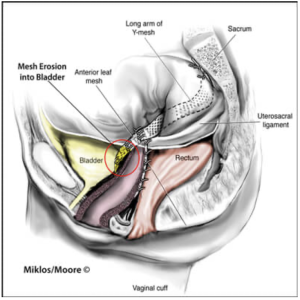
Medical illustration showing pelvic mesh erosion into the bladder, a complex mesh complication that may require evaluation by an experienced urogynecologic surgeon.
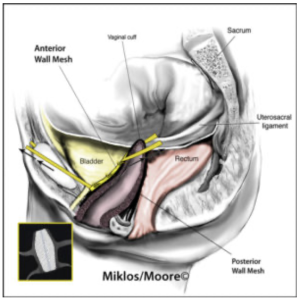
Medical illustration showing anterior and posterior vaginal wall mesh and its relationship to the bladder, vagina, rectum, and surrounding pelvic structures.
Why Get a Second Opinion Before Vaginal Mesh Surgery?
Pelvic mesh complications can be challenging because symptoms do not always identify the exact source of the problem.
Women may experience pelvic or vaginal pain, painful intercourse, bleeding, urinary symptoms, recurrent infections, vaginal mesh exposure, or other problems following previous surgery.
However, having symptoms after mesh surgery does not necessarily mean that every symptom is caused by the mesh.
A second opinion allows another experienced urogynecologist to independently review the patient’s symptoms, examination, previous procedures, operative reports, and available diagnostic information.
Sometimes the second opinion confirms the original recommendation.
In other situations, the evaluation may identify another potential explanation for the symptoms or a different treatment approach.
A Second Opinion Is Especially Important Before Mesh Removal
Removing pelvic mesh can be substantially different from placing it.
Once mesh has been implanted, surrounding tissue can heal around and through portions of the material. Scar tissue may develop, and the relationship between the mesh and surrounding pelvic structures can become complex.
Depending on the original operation, mesh may be located near important structures such as the:
- Bladder
- Urethra
- Vaginal wall
- Rectum
- Pelvic muscles
- Blood vessels
- Nerves
- Supporting pelvic structures
This is why the surgeon’s experience with mesh revision and removal surgery specifically can matter.
A physician who routinely performs primary prolapse or incontinence surgery does not necessarily have the same experience managing complicated mesh removal and reconstruction.
Partial vs. Complete Mesh Removal
One of the most important questions in a mesh second opinion may be how much mesh—if any—should be removed.
There is no single answer appropriate for every woman.
In some circumstances, treatment may involve addressing an exposed or problematic portion of mesh. Other cases may require more extensive removal.
More surgery is not automatically better.
Attempting extensive mesh removal can potentially increase surgical complexity and risk, while removing too little may not adequately address the underlying problem.
The appropriate strategy depends on factors including the type and location of the mesh, the patient’s symptoms, previous operations, physical examination, and the structures surrounding the implanted material.
A second opinion from a surgeon experienced in mesh complications can help a woman understand why a particular amount of mesh removal is being recommended.
What If Your First Surgeon Wants to Remove All of the Mesh?
Before undergoing extensive mesh removal, it is reasonable to ask why complete removal is being recommended and what risks and alternatives exist.
Questions may include:
Which portion of the mesh is causing the problem?
How do we know the mesh is responsible for my symptoms?
Can the problematic portion be treated without removing everything?
What structures are located around the mesh?
What could happen to my pelvic support after removal?
Will another reconstructive procedure be necessary?
These are exactly the types of questions that make a second opinion valuable.
What If Your Doctor Says the Mesh Cannot Be Removed?
Women sometimes seek another opinion after being told that mesh cannot be removed or that nothing more can be done.
Complexity does not necessarily mean that another operation is appropriate, and a second surgeon may ultimately agree with the original recommendation.
However, women with persistent symptoms may benefit from evaluation by a urogynecologist who regularly treats complex mesh and revision cases.
The objective is not necessarily to find a surgeon willing to operate.
The objective is to obtain an independent assessment from someone with substantial experience managing the problem.
Second Opinion After Failed Mesh Removal
Some women have already undergone one or more attempts at mesh removal and continue to experience symptoms.
These can be particularly challenging cases.
Previous removal procedures may leave residual mesh, additional scar tissue, altered anatomy, or recurrent pelvic floor problems.
Before another operation, it is important to understand what was originally implanted, what has already been removed, what remains, and whether the remaining mesh is actually responsible for the patient’s current symptoms.
Obtaining previous operative reports can be especially valuable in these cases.
Mesh Complications and Recurrent Pelvic Organ Prolapse
Another issue sometimes overlooked is the condition that the original mesh surgery was intended to treat.
If mesh was used to support pelvic organ prolapse, removing that support may affect pelvic stability.
A woman may therefore have two separate issues:
A mesh complication and pelvic organ prolapse.
Treatment planning needs to consider both.
The same concept applies to some procedures performed for urinary incontinence. Addressing complications from a previous operation can potentially affect the original functional problem.
An experienced pelvic reconstructive surgeon should evaluate what may happen after the problematic mesh is treated, not simply focus on removing material.
Why High Surgical Volume Matters for Mesh Revision
Revision pelvic surgery is fundamentally different from operating on anatomy that has never been surgically altered.
Scar tissue can obscure normal surgical planes. Previous operations may change anatomical landmarks. Mesh can be incorporated into surrounding tissues, and multiple pelvic problems may coexist.
This makes experience particularly relevant.
Dr. Miklos and Dr. Moore have spent decades performing urogynecologic and pelvic reconstructive surgery and have extensive experience evaluating women with complications following previous pelvic operations.
Their practice includes patients with:
- Vaginal mesh exposure or erosion
- Pelvic pain following mesh surgery
- Painful intercourse after mesh placement
- Urinary symptoms following previous surgery
- Previous unsuccessful mesh revision
- Residual mesh after previous removal
- Recurrent pelvic organ prolapse
- Failed previous pelvic reconstruction
- Complex revision pelvic surgery
For patients seeking another opinion, this experience provides the perspective of surgeons whose practices routinely include difficult and previously operated pelvic anatomy.
Dr. Miklos and Dr. Moore: Mesh Surgery Second Opinions in Atlanta, Georgia
Dr. John Miklos and Dr. Robert Moore are fellowship-trained urogynecologists and high-volume pelvic reconstructive surgeons near Atlanta, Georgia.
Their careers have included thousands of pelvic reconstructive, prolapse, incontinence, and related procedures, along with extensive experience treating complex and revision cases.
Their work has also included medical research, publications, physician education, and teaching advanced pelvic surgical techniques.
For women considering another mesh-related operation, this combination of surgical volume, urogynecologic training, and revision experience can be particularly valuable.
A second opinion from Miklos & Moore does not begin with the assumption that another operation is necessary.
It begins by determining what is causing the problem and what options are available.
Traveling to Atlanta for a Vaginal Mesh Second Opinion
Women do not necessarily have to limit a second opinion to physicians in their immediate area.
Patients travel to Miklos & Moore from throughout the United States and internationally for evaluation of complex pelvic floor and vaginal surgical problems.
This can be particularly relevant when a woman has already undergone multiple operations or has been given conflicting recommendations.
For an out-of-state patient, previous operative reports, imaging, medical records, and details regarding implanted mesh may help the surgeons understand the surgical history before determining appropriate next steps.
What Should You Bring to a Mesh Second-Opinion Consultation?
If available, patients should consider gathering:
- Operative reports from previous pelvic surgeries
- Information identifying the mesh or implant used
- Previous examination records
- Relevant imaging
- Cystoscopy or other diagnostic reports
- Records from previous mesh removal attempts
- A list of current symptoms
- A timeline showing when symptoms began
The more accurately the previous surgical history can be reconstructed, the more useful the second-opinion evaluation may be.
Questions to Ask During a Vaginal Mesh Second Opinion
A woman considering another mesh procedure should understand exactly what is being proposed.
Important questions include:
Do you believe the mesh is causing my symptoms?
Where is the problematic mesh located?
Do I need surgery?
How much mesh would you recommend removing?
Why are you recommending partial or more extensive removal?
What are the risks of leaving the mesh in place?
What are the risks of removing it?
Could removing the mesh cause my prolapse or incontinence to return?
Would reconstruction be required during the same operation or later?
How much experience do you have with mesh revision and removal?
A patient should leave the consultation understanding not merely what is recommended, but why.
When Should You Seek Another Urogynecology Opinion?
A second opinion may be particularly worthwhile when:
You have been told you need extensive mesh removal.
Your symptoms persist despite previous treatment.
A previous mesh removal procedure did not resolve the problem.
Different doctors have given you different recommendations.
You have recurrent prolapse in addition to mesh complications.
You have undergone multiple previous pelvic operations.
You have been told that nothing further can be done.
Or you simply want greater confidence before proceeding with another pelvic operation.
Seeking another opinion does not commit a woman to changing surgeons or undergoing surgery.
Sometimes the most reassuring second opinion is one that confirms the original treatment plan.
A Second Opinion Is Only as Valuable as the Experience Behind It
For a straightforward medical decision, another qualified physician may be sufficient.
For complicated mesh surgery, however, the experience of the physician providing the second opinion becomes particularly important.
A woman who has already undergone one or several pelvic operations may benefit from having her case reviewed by a high-volume urogynecologic surgeon experienced in complex pelvic reconstruction and revision surgery.
Drs. Miklos and Moore provide second-opinion evaluations near Atlanta, Georgia, for women with mesh complications, failed previous pelvic surgery, recurrent prolapse, and other complex urogynecologic conditions.
For women traveling from outside Georgia, their practice also evaluates patients from across the United States and internationally.
The purpose of that second opinion is straightforward:
Understand what went wrong, determine what is causing the current symptoms, and identify the most appropriate options before undergoing another operation.
Frequently Asked Questions
Should I get a second opinion before vaginal mesh removal?
For women considering significant mesh revision or removal, a second opinion can provide an independent assessment of whether the mesh appears to be causing the symptoms, whether surgery is appropriate, and what extent of treatment may be necessary.
What kind of doctor should give me a second opinion about vaginal mesh?
A urogynecologist specializes in female pelvic floor disorders and reconstructive pelvic surgery. For complicated mesh cases, experience with mesh complications and revision surgery is particularly important.
Can all vaginal mesh be removed?
The feasibility and advisability of mesh removal depend on the type of mesh, where it was placed, surrounding anatomy, previous surgeries, symptoms, and other individual factors. Complete removal is not automatically the appropriate goal for every patient.
Can prolapse return after mesh removal?
Depending on why the mesh was originally placed and which support structures are affected, recurrent prolapse may be a consideration. This is one reason treatment planning should address both the mesh complication and the patient’s overall pelvic support.
Can I get a second opinion after a failed mesh removal?
Yes. Women with persistent symptoms after previous mesh revision or removal can seek another evaluation. Previous operative reports and information about what mesh remains can be particularly useful.
Do Miklos and Moore see patients from outside Georgia for mesh complications?
Yes. Their Atlanta-area practice evaluates women who travel from other states and internationally for complex urogynecologic and revision pelvic surgery consultations.