
Hysteropexy for Uterine Prolapse
Hysteropexy is a uterus-preserving surgery that restores support to a prolapsed uterus without requiring hysterectomy. Dr. John Miklos and Dr. Robert Moore are high-volume urogynecologic surgeons near Atlanta, Georgia, with decades of experience performing pelvic organ prolapse and reconstructive surgery. Their extensive surgical experience allows them to evaluate whether hysteropexy, hysterectomy, or another prolapse repair is most appropriate for each woman’s individual anatomy and goals.
Hysteropexy for Uterine Prolapse: High-Volume Urogynecologic Surgery in Atlanta, Georgia
Women diagnosed with uterine prolapse are sometimes told that hysterectomy is the standard—or even the only—surgical solution. For many women, however, removing the uterus is not the only option.
Hysteropexy is a uterus-preserving prolapse surgery that restores support to the uterus rather than removing it. For appropriately selected women, it can provide an alternative to hysterectomy while correcting the underlying loss of pelvic support.
When considering hysteropexy, however, the experience and surgical volume of the urogynecologist matter. Pelvic organ prolapse is rarely as simple as moving one organ back into position. Successful reconstruction requires an understanding of the entire pelvic support system and the ability to recognize and repair multiple defects when they occur together.
Dr. John Miklos and Dr. Robert Moore are fellowship-trained urogynecologists near Atlanta, Georgia, who have dedicated decades of their careers to pelvic reconstructive surgery. Their experience includes thousands of prolapse and incontinence procedures, as well as complex, recurrent and previously failed pelvic floor surgeries.
For women searching for a high-volume prolapse surgeon or highly experienced urogynecologist in Georgia, Miklos & Moore offer both uterus-preserving and traditional approaches to pelvic organ prolapse based on each patient’s individual anatomy and goals.
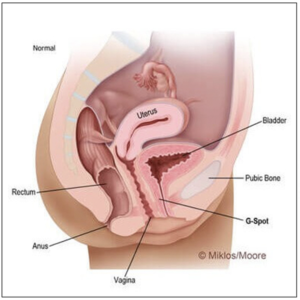
Normal pelvic anatomy showing the position of the uterus, bladder, vagina and rectum before pelvic organ prolapse.
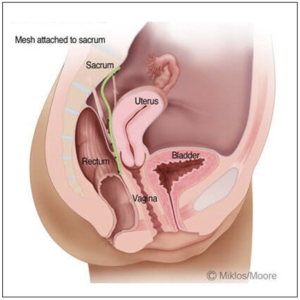
Hysteropexy preserves the uterus while restoring support to the uterus and vaginal apex. This illustration demonstrates a sacral suspension used to support the uterus.
What Is Hysteropexy? And Why Experience Matters
Hysteropexy is a surgical procedure designed to correct uterine prolapse while preserving the uterus.
Normally, the uterus is supported by ligaments, connective tissue and the pelvic floor. When these supporting structures weaken or become damaged, the uterus can descend toward or into the vaginal canal.
With more advanced uterine prolapse, the cervix or uterus may reach the vaginal opening or protrude outside it.
Instead of removing the uterus with a hysterectomy, hysteropexy restores support to the uterus and vaginal apex.
The fundamental difference is straightforward:
Hysterectomy removes the uterus. Hysteropexy preserves and resuspends the uterus.
For women who want to retain their uterus, understanding this distinction before agreeing to prolapse surgery is extremely important.
Does Uterine Prolapse Require a Hysterectomy?
No. A diagnosis of uterine prolapse does not automatically mean that the uterus must be removed.
Historically, hysterectomy has commonly been incorporated into surgery for uterine prolapse. However, the uterus itself is not necessarily the reason the prolapse occurred.
The underlying problem is often the failure of the structures supporting the uterus and upper vagina.
Removing the uterus does not, by itself, restore those supporting structures. Appropriate apical support remains an important component of prolapse reconstruction whether the uterus is removed or preserved.
Some women have additional uterine conditions that make hysterectomy appropriate. Others prefer hysterectomy after considering their alternatives.
But when there is no separate medical reason requiring removal of the uterus, some women may be candidates for hysteropexy.
Why Some Women Want to Preserve Their Uterus
There are many reasons a woman may prefer uterine preservation.
For some, keeping the uterus is simply a strong personal preference. Others want to avoid removal of a healthy organ when another reconstructive option may be available.
The important point is that women should be able to make that decision after understanding their surgical alternatives.
A consultation with an experienced urogynecologist should therefore address two separate questions:
Can the uterus safely be preserved?
And:
Which prolapse repair provides the appropriate support for this woman’s anatomy?
Those questions cannot be answered simply by looking at the degree of uterine descent.
Why High Surgical Volume Matters in Hysteropexy
Hysteropexy is not a one-size-fits-all operation.
The uterus is only one part of a complex pelvic support system involving the vagina, bladder, rectum, pelvic fascia, muscles and supporting ligaments.
A woman who appears to have uterine prolapse may simultaneously have a cystocele, rectocele, enterocele, apical support defect or urinary incontinence.
Some women have several of these conditions at the same time.
A high-volume prolapse surgeon encounters these variations repeatedly.
That experience can be particularly important when determining which defects need to be repaired, which surgical approach is appropriate and whether preserving the uterus makes sense for the individual patient.
Surgical training provides the foundation. Years of repeatedly performing pelvic reconstructive surgery provide another level of experience.
Dr. Miklos and Dr. Moore: High-Volume Prolapse Surgeons in Georgia
Dr. John Miklos and Dr. Robert Moore have concentrated their surgical careers on urogynecology, pelvic organ prolapse and reconstructive pelvic surgery.
Together, they report performing more than 4,000 laparoscopic prolapse and incontinence procedures during their careers.
Their experience extends across a broad spectrum of pelvic floor conditions, including:
- Uterine prolapse
- Cystocele or bladder prolapse
- Rectocele
- Enterocele
- Vaginal vault prolapse
- Multi-compartment pelvic organ prolapse
- Stress urinary incontinence
- Recurrent pelvic organ prolapse
- Failed previous prolapse repairs
- Mesh complications
- Complex and revision pelvic reconstruction
This volume is particularly relevant because two patients who are both diagnosed with “uterine prolapse” may have very different pelvic support defects.
One may have relatively isolated uterine descent.
Another may have significant loss of apical support accompanied by a cystocele and rectocele.
A third may have recurrent prolapse after one or more previous operations.
Recognizing these differences—and selecting an operation accordingly—is one of the reasons prolapse surgery experience matters.
Among the Most Experienced Urogynecologists in the Atlanta Area
Patients frequently search online for the best urogynecologist in Atlanta, top urogynecologist in Georgia, or most experienced prolapse surgeon.
There is no official ranking system that can designate one physician as the best urogynecologist for every patient or condition.
A better way to evaluate experience is to look at objective factors.
How long has the physician specialized in pelvic reconstructive surgery?
How many prolapse procedures has the surgeon performed?
Does the surgeon perform multiple types of prolapse reconstruction?
Does the surgeon treat recurrent and failed prolapse surgery?
Has the surgeon published research involving pelvic reconstruction?
Does the surgeon teach surgical techniques to other physicians?
Drs. Miklos and Moore have spent decades performing advanced pelvic reconstructive surgery. In addition to their surgical volume, their careers have included research, publications, physician education and teaching advanced surgical techniques.
Their Atlanta-area practice also receives women seeking second opinions and treatment for complicated or previously unsuccessful pelvic floor surgery.
This combination of decades of specialization, thousands of procedures and experience with difficult cases places Miklos & Moore among the highly experienced urogynecologic surgical practices in Georgia.
Hysteropexy Requires More Than Simply Lifting the Uterus
One of the most important concepts for women considering hysteropexy is that the objective is not merely to move the uterus upward.
The surgeon must determine why the uterus descended in the first place.
Which support structures failed?
Is the vaginal apex adequately supported?
Is the bladder also prolapsing?
Is there a rectocele?
Is there an enterocele?
Does the patient have stress urinary incontinence?
Has previous surgery changed the anatomy?
An experienced pelvic reconstructive surgeon evaluates these questions before determining the appropriate operation.
If several support defects are present, correcting only the most obvious prolapse may not adequately address the patient’s complete pelvic floor problem.
How Is Hysteropexy Performed?
There are different surgical techniques for preserving and suspending the uterus.
Depending on the patient’s anatomy and the surgeon’s recommendation, hysteropexy may be performed using vaginal or minimally invasive abdominal approaches, including laparoscopic or robotic surgery.
Different suspension techniques may also be appropriate for different patients.
This is another reason surgeon experience matters.
Ideally, the operation should be selected because it is appropriate for the patient’s anatomy—not simply because it is the only prolapse procedure a particular surgeon routinely performs.
Drs. Miklos and Moore have extensive experience with minimally invasive pelvic reconstructive surgery and multiple approaches to prolapse repair.
Hysteropexy vs. Hysterectomy for Uterine Prolapse
Neither operation is automatically the right choice for every woman.
Hysterectomy removes the uterus and may be appropriate when there is another uterine condition requiring treatment or when a woman prefers removal after discussing her options.
Hysteropexy preserves the uterus while restoring pelvic support and may be considered when uterine preservation is medically appropriate and desired by the patient.
The decision should take into account:
- The woman’s type and stage of prolapse
- The condition of the uterus
- Other pelvic floor defects
- Previous pelvic surgeries
- Medical history
- Surgical risks
- Personal preferences
- The surgeon’s assessment of the available reconstructive options
The key is individualized prolapse surgery rather than automatically performing the same operation on every patient.
Can Advanced Uterine Prolapse Be Treated Without Hysterectomy?
Advanced prolapse does not necessarily eliminate uterus-preserving surgery as an option.
The degree of uterine descent is important, but it is only one component of the evaluation.
Women with significant uterine prolapse may also have extensive defects involving the anterior, posterior or apical vaginal compartments.
For these patients, the experience of the prolapse surgeon becomes particularly important because several areas may require reconstruction during the same operation.
The goal is not simply uterus preservation.
The goal is durable reconstruction of the pelvic support system while preserving the uterus when appropriate and desired.
What About Recurrent Uterine Prolapse?
A woman whose prolapse has returned after previous surgery presents a different surgical challenge than someone undergoing her first prolapse operation.
Previous surgery can alter normal anatomy and create scar tissue. There may also be sutures, graft material or mesh from earlier procedures.
Most importantly, the surgeon needs to determine why the original repair failed.
Drs. Miklos and Moore regularly evaluate women with recurrent prolapse and previous failed pelvic reconstructive surgery.
For women facing a second or third prolapse operation, obtaining an evaluation from a high-volume urogynecologic surgeon experienced in revision surgery can provide another perspective on the cause of recurrence and available treatment options.
Experience With Complex and Multi-Compartment Prolapse
Some of the most challenging prolapse cases involve more than one compartment of the vagina.
A patient can simultaneously have:
Uterine or apical prolapse + cystocele + rectocele + enterocele.
Treating these patients requires considerably more than identifying a single bulge.
The surgeon must understand how the different support defects interact and develop a reconstructive plan for the complete pelvic floor.
Because Drs. Miklos and Moore routinely treat complex and recurrent pelvic floor disorders, their experience extends beyond straightforward first-time prolapse repairs.
That breadth of experience is particularly important for women whose symptoms have persisted despite previous treatment or who have been told they require extensive surgery.
Surgeons Who Have Taught Other Surgeons
Another consideration when evaluating surgical experience is whether a physician’s expertise has extended beyond treating his or her own patients.
Throughout their careers, Drs. Miklos and Moore have been involved in physician education, research and teaching advanced pelvic reconstructive techniques.
Surgeons have traveled to observe and learn techniques used in their Atlanta practice.
This type of physician-to-physician education represents a different level of professional experience than simply having performed a procedure during training.
For patients researching top or highly experienced urogynecologists, surgical teaching, publications and professional involvement can provide additional objective information about a surgeon’s background.
Should You Get a Second Opinion Before Hysterectomy for Prolapse?
If a woman has been told she needs a hysterectomy for uterine prolapse but strongly wants to retain her uterus, obtaining a second opinion can be reasonable.
That does not mean the original surgeon’s recommendation was incorrect.
There may be excellent reasons why hysterectomy was recommended.
A second opinion simply provides an opportunity to ask whether hysteropexy or another uterus-preserving approach is medically appropriate.
This becomes particularly valuable when the second opinion comes from a urogynecologist who routinely performs different types of pelvic reconstruction.
Questions to Ask a Hysteropexy Surgeon
Before choosing a surgeon, women should feel comfortable asking detailed questions about experience.
- How many prolapse operations do you perform?
- How frequently do you perform uterus-preserving prolapse surgery?
- Which hysteropexy techniques do you perform?
- How long have you been performing these procedures?
- Why are you recommending hysteropexy or hysterectomy in my case?
- Do I have prolapse involving more than one compartment?
- Do you perform both vaginal and minimally invasive prolapse surgery?
- Do you routinely treat recurrent prolapse?
- How many revision prolapse procedures do you perform?
- What alternatives are available if I want to preserve my uterus?
These questions help distinguish general surgical experience from extensive experience with pelvic organ prolapse specifically.
Choosing a High-Volume Hysteropexy and Prolapse Surgeon in Georgia
For women searching for a hysteropexy surgeon, surgical volume should be considered alongside training, technique and experience with complex pelvic reconstruction.
Dr. John Miklos and Dr. Robert Moore are fellowship-trained urogynecologists serving Atlanta, Alpharetta, Georgia and patients traveling from throughout the United States.
Their careers have included thousands of prolapse and incontinence procedures, decades of pelvic reconstructive surgery, complex and revision cases, research, publications and teaching other surgeons.
For a woman interested in preserving her uterus, their evaluation begins with determining exactly what has failed within the pelvic support system.
Hysteropexy may be an excellent option for some women. Hysterectomy may be more appropriate for others.
The important difference is having the experience to evaluate multiple options rather than assuming every uterine prolapse requires the same operation.
Frequently Asked Questions
What is hysteropexy?
Hysteropexy is a pelvic organ prolapse operation that restores support to a prolapsed uterus without removing the uterus.
Can uterine prolapse be repaired without hysterectomy?
Yes. Appropriately selected women may be candidates for uterus-preserving prolapse surgery. Whether hysteropexy is appropriate depends on the patient’s anatomy, uterine health, other pelvic support defects, previous surgeries and individual preferences.
Why should I choose a high-volume prolapse surgeon for hysteropexy?
High-volume prolapse surgeons routinely encounter different patterns of pelvic support failure, including multi-compartment and recurrent prolapse. This experience can be especially important when determining whether hysteropexy is appropriate and whether additional pelvic support defects need to be repaired.
Who is the best urogynecologist for hysteropexy in Georgia?
There is no official designation of a single “best” urogynecologist. Patients can compare physicians based on fellowship training, years of experience, prolapse surgical volume, experience with uterus-preserving procedures, revision surgery, publications and surgical teaching. Drs. Miklos and Moore are fellowship-trained urogynecologists near Atlanta with decades of pelvic reconstructive surgical experience.
How experienced are Dr. Miklos and Dr. Moore with prolapse surgery?
Drs. Miklos and Moore report performing more than 4,000 laparoscopic prolapse and incontinence procedures during their careers. Their practice also includes complex prolapse, recurrent prolapse and revision pelvic reconstructive surgery.
Can I see Dr. Miklos and Dr. Moore if another doctor recommended hysterectomy?
Yes. Women seeking another opinion about uterine prolapse can be evaluated to determine whether hysterectomy, hysteropexy or another reconstructive approach may be appropriate.
Do I have to live in Atlanta to see Miklos & Moore?
No. Their practice is located near Atlanta, Georgia, but they also evaluate women who travel from other parts of Georgia, the Southeast and across the United States for pelvic reconstructive surgery and complex urogynecologic conditions.