
High-Volume Prolapse Surgeons in Georgia
Choosing an experienced surgeon is especially important when treating pelvic organ prolapse. Dr. John Miklos and Dr. Robert Moore are fellowship-trained urogynecologists near Atlanta, Georgia, with decades of experience in pelvic reconstructive surgery. As high-volume prolapse surgeons, they routinely treat bladder prolapse, rectocele, uterine prolapse, vaginal vault prolapse, recurrent prolapse, and complex cases involving previous failed repairs. Their extensive surgical experience has made Miklos & Moore a destination for women throughout Georgia and across the United States seeking advanced urogynecologic care.
Why Experience Matters When Choosing a Urogynecologist
When considering surgery for pelvic organ prolapse, one of the most important questions a woman can ask is surprisingly simple:
How often does my surgeon actually perform prolapse surgery?
Pelvic organ prolapse surgery is not a single operation. A woman may have a cystocele, rectocele, uterine prolapse, vaginal vault prolapse, enterocele, or several areas of prolapse occurring at the same time. The appropriate repair can vary considerably depending on the patient’s anatomy, previous surgeries, symptoms, age, sexual activity, and the location and severity of the prolapse.
For women searching for a top urogynecologist in Georgia or the Atlanta area, surgical experience should therefore be an important part of the decision.
Dr. John Miklos and Dr. Robert Moore are fellowship-trained urogynecologists who have spent decades performing pelvic reconstructive surgery and treating women with both routine and highly complex pelvic floor disorders.
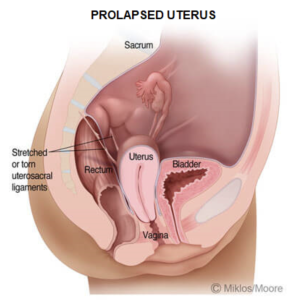
Uterine prolapse occurs when weakened pelvic support allows the uterus to descend into the vaginal canal. Experienced urogynecologists evaluate the entire pelvic support system when planning prolapse treatment.
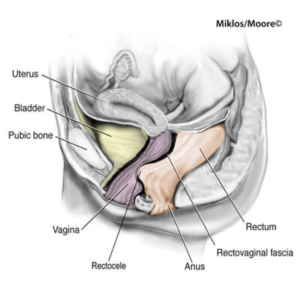
A rectocele develops when weakened tissue between the rectum and vagina allows the rectum to bulge toward the vaginal canal. Surgical treatment should address the specific pelvic support defect responsible for the prolapse.
What Is a High-Volume Prolapse Surgeon?
A high-volume prolapse surgeon is a physician whose surgical practice regularly includes pelvic organ prolapse and pelvic reconstructive procedures.
This is different from an OB/GYN who may occasionally perform prolapse surgery as one part of a much broader general gynecology practice.
Urogynecologists receive additional specialized training in Female Pelvic Medicine and Reconstructive Surgery. However, even among urogynecologists, the amount and complexity of prolapse surgery performed can vary significantly.
Some specialists primarily provide nonsurgical pelvic floor care. Others maintain surgical practices involving advanced prolapse reconstruction, recurrent prolapse, failed previous repairs, urinary incontinence, mesh complications, and complex pelvic anatomy.
Why Surgical Volume Matters in Pelvic Organ Prolapse
Experience becomes particularly important because prolapse frequently involves more than one area of pelvic support.
A surgeon must determine not only what is prolapsing, but why it is prolapsing and which supporting structures have failed.
For example, a woman who believes she has a bladder prolapse may also have apical support loss, a rectocele, an enterocele, or another defect contributing to her symptoms.
Treating only the most obvious defect may not always address the complete pelvic support problem.
A high-volume prolapse surgeon has typically encountered a much wider range of anatomy, surgical histories and complex presentations than a physician who performs these procedures only occasionally.
Dr. Miklos and Dr. Moore: Experienced Urogynecologists Near Atlanta, Georgia
Women searching for an experienced or top urogynecologist in Georgia often discover Dr. John Miklos and Dr. Robert Moore because their careers have been heavily focused on urogynecology, pelvic reconstruction and minimally invasive surgery.
Their Atlanta-area practice has treated women with pelvic floor disorders for decades, including patients with straightforward prolapse as well as women seeking help for recurrent or previously failed surgery.
Together, Drs. Miklos and Moore report performing more than 4,000 laparoscopic prolapse and incontinence procedures during their careers.
Their broader surgical practice has included thousands of patients from across the United States and internationally.
Their experience includes treatment of:
- Cystocele or bladder prolapse
- Rectocele
- Enterocele
- Uterine prolapse
- Vaginal vault prolapse
- Multi-compartment pelvic organ prolapse
- Recurrent pelvic organ prolapse
- Failed previous prolapse surgery
- Stress urinary incontinence
- Vaginal mesh complications
- Complex pelvic floor reconstruction
This concentration of experience is one reason women searching for highly experienced urogynecologists in Atlanta and throughout Georgia may consider Miklos & Moore for an evaluation or second opinion.
Experience With Laparoscopic Prolapse Surgery
Dr. Miklos and Dr. Moore have been involved in minimally invasive pelvic reconstructive surgery for decades.
Their experience includes procedures such as laparoscopic sacrocolpopexy, paravaginal repair, Burch urethropexy, enterocele repair and other reconstructive techniques.
Their work has also extended beyond performing these procedures.
Drs. Miklos and Moore have published extensively, participated in research, taught advanced surgical techniques and trained physicians in pelvic reconstructive surgery.
Surgeons from the United States and other countries have traveled to their Atlanta center to observe their surgical techniques.
For a patient evaluating a prolapse surgeon, this distinction can be meaningful: there is a difference between a physician who has learned to perform an operation and surgeons whose careers have included performing, researching, publishing and teaching advanced pelvic reconstructive surgery.
Not Every Prolapse Requires the Same Operation
One sign of an experienced urogynecologist is the ability to offer more than one approach to prolapse.
There is no single operation that is appropriate for every woman.
Depending on the diagnosis, treatment may involve vaginal surgery, laparoscopic or robotic surgery, suspension procedures, repairs of individual vaginal compartments, or combinations of procedures.
Some women do not require surgery at all.
A high-volume urogynecologist should be able to explain:
What is actually prolapsing?
How many areas of support are affected?
Which repair is being recommended?
Why is that repair appropriate for my anatomy?
Are there alternative surgical approaches?
What happens if I choose not to have surgery?
What is the likelihood that another area could prolapse later?
Those questions are especially important before committing to reconstructive pelvic surgery.
What About Women Whose Prolapse Surgery Has Already Failed?
Recurrent prolapse is different from a first-time prolapse.
Previous surgery may have changed normal anatomy, created scar tissue, altered vaginal support or involved mesh or permanent sutures. Determining why a previous repair failed can therefore be just as important as deciding how to repair the prolapse again.
Dr. Miklos and Dr. Moore regularly evaluate women who have already undergone pelvic floor surgery elsewhere.
Their practice has developed particular experience with:
- Recurrent prolapse
- Failed prolapse repairs
- Previous mesh surgery
- Mesh complications
- Complex revision surgery
- Multiple previous pelvic operations
Women facing a second or third operation may benefit from obtaining an opinion from a urogynecologist who frequently treats revision cases rather than simply repeating the original operation.
What Should You Ask a Prolapse Surgeon About Experience?
Women should feel comfortable asking very specific questions before surgery.
Ask your surgeon:
How many prolapse surgeries do you perform?
Ask about the particular operation being recommended—not simply the number of surgeries the physician performs overall.
How long have you been performing this procedure?
Years in practice alone do not necessarily indicate experience with a specific operation.
Do you treat recurrent prolapse?
Revision surgery can require different skills than first-time prolapse surgery.
Do you perform both vaginal and minimally invasive prolapse surgery?
A surgeon experienced with multiple approaches may be better positioned to recommend an operation based on the patient’s anatomy rather than the surgeon’s familiarity with only one technique.
How often do you treat women who have had previous failed repairs?
This can be particularly important for women seeking revision surgery.
Top Urogynecologists in Georgia: Look Beyond the Title
There is no official ranking that identifies one physician as the “best urogynecologist” or “best prolapse surgeon” in Georgia.
Patients should be cautious about choosing a surgeon based solely on advertising claims.
Instead, look for measurable indicators of expertise:
- Fellowship training in urogynecology
- Board certification
- Years devoted to pelvic reconstructive surgery
- Prolapse surgical volume
- Experience with multiple surgical approaches
- Experience treating failed and recurrent prolapse
- Published research
- Teaching other surgeons
- Recognition within the medical community
- Experience with complex pelvic floor disorders
These factors provide considerably more information than a website simply claiming that a physician is the “best.”
Why Women Travel to Atlanta for Dr. Miklos and Dr. Moore
Drs. Miklos and Moore have treated surgical patients from all 50 states and numerous countries.
Their Atlanta-area urogynecology practice has also served as an educational destination for surgeons seeking additional experience in advanced pelvic reconstructive techniques.
Dr. Miklos has received multiple professional recognitions during his career, including Castle Connolly Top Doctor recognition and awards from the American Association of Gynecologic Laparoscopists.
Dr. Moore has likewise received repeated Castle Connolly Top Doctor recognition and has participated extensively in clinical research, teaching and the development of minimally invasive pelvic reconstructive techniques.
Their combined background in urogynecology, reconstructive pelvic surgery and minimally invasive surgerydistinguishes their practice from general gynecology practices where prolapse represents only a small portion of the surgical caseload.
Looking for a High-Volume Prolapse Surgeon Near Atlanta?
Women diagnosed with pelvic organ prolapse do not necessarily need surgery. However, when surgery is being considered, the experience of the surgeon deserves careful consideration.
This becomes even more important for women with advanced prolapse, multiple areas of prolapse, previous hysterectomy, recurrent prolapse or a failed previous repair.
Dr. John Miklos and Dr. Robert Moore are fellowship-trained urogynecologists serving Atlanta, Alpharetta and women throughout Georgia and the Southeast.
For women searching for a high-volume prolapse surgeon, experienced urogynecologist, or top urogynecologist near Atlanta, Georgia, a consultation with Miklos & Moore can provide an opportunity to understand the exact type of prolapse, available treatment approaches and whether surgery is appropriate.
Frequently Asked Questions
Who is the best doctor to perform prolapse surgery?
There is no universally designated “best” prolapse surgeon. Women considering surgery should look for a physician with specialized urogynecology training and substantial experience performing the specific prolapse procedure being considered. Surgical volume, experience with complex cases, revision surgery, research and physician education can all be useful factors when comparing surgeons.
Should a urogynecologist perform prolapse surgery?
Urogynecologists specialize in pelvic floor disorders including pelvic organ prolapse, urinary incontinence and reconstructive pelvic surgery. For women with complicated, recurrent or multi-compartment prolapse, evaluation by a fellowship-trained urogynecologist can be particularly valuable.
How do I find a high-volume prolapse surgeon in Georgia?
Ask prospective surgeons how many prolapse operations they perform, which procedures they perform most frequently, how many years they have performed those operations and whether they routinely treat recurrent or failed prolapse repairs.
Are Dr. Miklos and Dr. Moore urogynecologists?
Yes. Dr. John Miklos and Dr. Robert Moore are fellowship-trained urogynecologists with extensive training and experience in Female Pelvic Medicine, reconstructive pelvic surgery and minimally invasive surgery. Their practice is based in the Atlanta, Georgia area.
Do Dr. Miklos and Dr. Moore treat recurrent or failed prolapse surgery?
Yes. A significant part of their practice involves evaluating complex pelvic floor problems, including recurrent prolapse, previous failed pelvic reconstruction and complications associated with prior pelvic surgery.
Is it worth traveling to see an experienced prolapse surgeon?
For straightforward cases, excellent care may be available locally. Women with complicated anatomy, recurrent prolapse, multiple failed surgeries or unusual pelvic floor problems sometimes choose to obtain a second opinion from a surgeon who treats these conditions frequently. The decision to travel depends on the individual diagnosis, available expertise and treatment options.