
MONSPLASTY RECOVERY: WHY SURGICAL EXPERIENCE MATTERS
Recovering from monsplasty involves more than allowing the incision to heal. Because the procedure reshapes one of the most visible and aesthetically important areas of the female anatomy, meticulous surgical technique plays a critical role in minimizing scarring, preserving natural contours, and achieving a smooth, balanced appearance. Drs. Miklos and Moore have performed thousands of cosmetic and reconstructive vaginal procedures and have developed techniques that emphasize precise tissue removal, careful wound closure, and optimal healing. Their individualized postoperative care, detailed recovery instructions, and decades of experience help patients recover comfortably while achieving natural-looking, long-lasting results. Most women experience steady improvement during the first several weeks, with continued refinement as swelling subsides and the tissues fully heal.
Monsplasty Recovery: Healing, Swelling, Scar Care & What to Expect After Surgery
Recovery after monsplasty is different from recovering after most cosmetic gynecologic procedures because the surgery focuses on the mons pubis, the fatty tissue located above the pubic bone. Rather than operating inside the vagina or reshaping the labia, monsplasty reduces excess tissue and lifts the pubic mound to create a smoother, more proportional contour.
Many women seek monsplasty because the mons pubis remains enlarged even after weight loss or because aging, pregnancy, or previous surgeries have caused the area to sag. While the cosmetic improvement can be dramatic, patients often have practical questions about recovery.
Common concerns include:
- How long will swelling last?
- Will I need to wear a compression garment?
- When can I stand up straight?
- How visible will the scar be?
- When can I exercise again?
These questions are understandable because recovery involves the lower abdomen as well as the pubic area.
The encouraging news is that most women recover with less discomfort than they anticipated. Tightness, swelling, and temporary numbness are common during the first several weeks, but severe pain is uncommon. Understanding the normal stages of healing helps patients recover with realistic expectations and greater confidence.
At Miklos & Moore, Dr. John Miklos and Dr. Robert Moore combine decades of experience in cosmetic gynecology and female pelvic reconstruction. Their approach to monsplasty emphasizes natural-looking contour, careful scar placement, and detailed postoperative care designed to support a smooth recovery while protecting the surgical result.
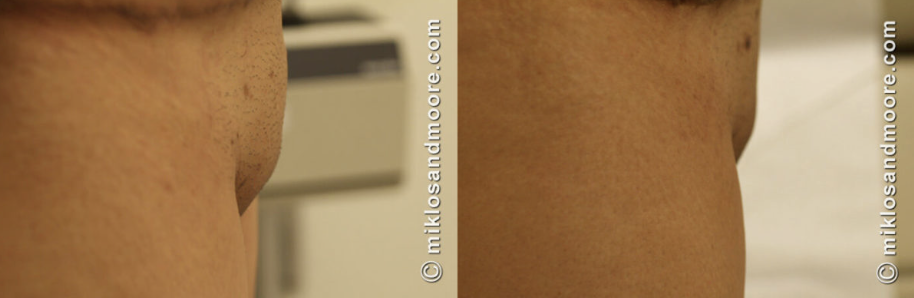
Before and after monsplasty recovery photos demonstrating the gradual reduction in swelling and the smoother, more proportionate appearance of the mons pubis as healing progresses after surgery.
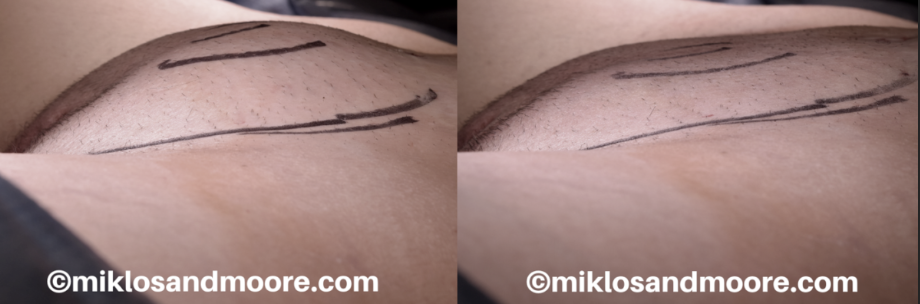
Healed before and after monsplasty photos demonstrating a flatter, more contoured mons pubis with natural-looking results after full recovery.
Understanding What Happens During Monsplasty
The mons pubis is the rounded area of soft tissue that sits directly above the vulva. In some women it becomes disproportionately prominent because of genetics, weight fluctuations, pregnancy, hormonal changes, or the natural aging process.
During monsplasty, excess skin, fat, or both may be removed to create a flatter, smoother contour. Depending on the patient’s anatomy, the procedure may also lift the tissues to reduce sagging over the pubic region.
Because surgery involves the skin, underlying fat, and supportive tissues of the lower abdomen, recovery is different from procedures performed entirely within the vulva or vagina.
Patients frequently notice:
- Tightness across the lower abdomen.
- Swelling above the pubic bone.
- Mild bruising.
- Temporary numbness around the incision.
- A feeling of pulling when standing completely upright.
These findings are expected and gradually improve as healing progresses.
How Healing Begins
Healing starts immediately after surgery.
Your body increases blood flow to the surgical site, allowing oxygen, nutrients, and specialized healing cells to begin repairing the incision.
During the first several days, inflammation causes swelling and firmness throughout the mons pubis.
Although swelling may temporarily make the area appear larger than expected, it is an essential part of the body’s normal healing response.
Over the following weeks, new collagen strengthens the incision while the tissues gradually adapt to their new contour.
Scar remodeling then continues for several months, allowing the incision to soften and become less noticeable over time.
Understanding this process helps explain why the final cosmetic result cannot be judged during the first few weeks.
The First 48 Hours
The first two days after monsplasty are generally focused on rest, controlling swelling, and protecting the incision.
Most women describe the discomfort as soreness, tightness, or pressure rather than severe pain.
Common findings include:
- Swelling of the mons pubis.
- Bruising.
- Mild drainage on the dressing.
- Tightness while standing.
- Temporary numbness around the incision.
Walking around the house several times each day is encouraged because it promotes healthy circulation and reduces the risk of blood clots.
However, patients should avoid prolonged standing, heavy lifting, or strenuous activity during this early phase of recovery.
The First Week: Swelling and Tightness Are Normal
The first week is often the most challenging—not because of pain, but because of swelling and limited mobility.
Many women notice that standing fully upright creates a sensation of tightness across the lower abdomen and pubic area. This occurs because the skin and supporting tissues are adapting to their new position.
During the first week, it is completely normal to experience:
- Swelling that changes throughout the day.
- Bruising extending into the pubic region.
- Tightness when standing.
- Mild tenderness around the incision.
- Temporary numbness near the scar.
Patients often find that mornings are the most comfortable because swelling has improved overnight. By evening, spending more time walking or standing may cause temporary fullness or swelling to return.
These daily changes are expected and usually become less noticeable with each passing week.
The First Two Weeks: Recovery Milestones
The first two weeks after monsplasty are focused on allowing the incision to heal while the swelling gradually begins to improve. Although many women notice daily progress, recovery is rarely linear. Some mornings the area may appear flatter and feel more comfortable, only for swelling to increase slightly after a day of walking, standing, or normal household activities.
This pattern is completely expected.
The goal during the first two weeks is not to eliminate swelling but to protect the surgical repair while your body begins the healing process.
Days 1–3: Swelling Reaches Its Peak
During the first several days after surgery, inflammation is at its highest level.
The mons pubis often appears:
- Fuller than expected
- Firm to the touch
- Mildly bruised
- Tight when standing
- Slightly uneven
Many women become concerned because they expected the area to look flatter immediately after surgery.
Instead, postoperative swelling temporarily masks the new contour.
This does not mean the procedure was unsuccessful.
In fact, swelling is a sign that your body has begun repairing the tissues.
During these first few days, patients often feel most comfortable resting with their hips and knees slightly bent rather than lying completely flat. This position reduces tension on the lower abdominal incision and may make standing easier when getting out of bed.
Standing Up Straight Takes Time
One of the most common questions after monsplasty is:
“Why can’t I stand completely straight?”
This temporary posture is expected.
Because excess skin has been removed and the tissues have been tightened, standing fully upright immediately after surgery may create a pulling sensation across the lower abdomen and mons pubis.
Most patients naturally walk with a slight forward bend for the first several days.
As swelling decreases and the tissues relax, standing upright becomes progressively easier.
Patients should never force themselves into an uncomfortable position simply to stand straighter.
Allowing your posture to improve naturally is usually the most comfortable approach.
Compression Garments: Why They Are Often Recommended
Many surgeons recommend wearing a compression garment after monsplasty to help support the surgical area during healing.
Compression may help:
- Reduce postoperative swelling
- Support the healing tissues
- Improve comfort while walking
- Minimize fluid accumulation beneath the skin
- Help patients feel more secure during movement
The type of garment and the length of time it should be worn vary depending on the extent of surgery and your surgeon’s preferences.
Because every patient is different, follow the specific instructions provided by your surgical team rather than recommendations found online.
Showering and Caring for the Incision
Patients are often surprised by how simple incision care is after monsplasty.
In most cases, the goal is to keep the incision clean, dry, and protected while allowing it to heal naturally.
When showering:
- Let warm water run gently over the incision.
- Avoid scrubbing the area.
- Use mild soap unless instructed otherwise.
- Pat the incision dry with a clean towel.
- Wear clean clothing afterward.
The incision should also be inspected regularly for signs of normal healing.
It is common to notice mild swelling, firmness, and bruising around the scar during the first several weeks.
Returning to Normal Walking
Walking is one of the best activities during early recovery.
Unlike strenuous exercise, short walks encourage healthy circulation and reduce stiffness without placing excessive stress on the incision.
Many patients notice that:
- Short walks feel comfortable.
- Longer walks increase swelling.
- Fatigue develops more quickly than expected.
These observations are completely normal.
Recovery should progress gradually.
There is no advantage to pushing through discomfort simply to become more active sooner.
The Five Most Common Recovery Concerns
Almost every monsplasty patient experiences moments during recovery when they wonder whether something is normal.
Fortunately, most concerns have reassuring explanations.
“The Mons Still Looks Large.”
This is the most common concern after surgery.
Patients often expect the pubic mound to appear completely flat immediately after the procedure.
Instead, swelling temporarily creates fullness that hides the final contour.
As inflammation decreases over the following weeks and months, the new shape gradually becomes more apparent.
The first week should never be used to judge the final cosmetic outcome.
“The Scar Feels Hard.”
Many women notice firmness beneath the incision.
This is usually caused by normal collagen production rather than abnormal scar tissue.
During healing, collagen creates a strong internal framework that supports the incision.
Over time, this firmness gradually softens as scar remodeling continues.
“The Area Feels Numb.”
Temporary numbness around the incision is extremely common.
Small sensory nerves are affected whenever skin is lifted or repositioned during surgery.
Most women notice gradual improvement over several months as these nerves recover.
Some areas regain sensation quickly, while others improve more gradually.
“One Side Is More Swollen.”
Perfectly symmetrical healing is uncommon.
One side may:
- Swell more.
- Bruise more.
- Feel firmer.
- Improve more slowly.
These temporary differences usually become much less noticeable as healing progresses.
“I’m Worried I’ll Stretch the Incision.”
Many patients become cautious about everyday activities such as standing, walking, reaching, or getting out of bed.
Normal movement rarely damages the repair.
The greater concern is returning to strenuous exercise or heavy lifting before the tissues have adequately healed.
Following your surgeon’s activity restrictions is the best way to protect your long-term result.
Scar Healing Begins Immediately
Although most patients focus on swelling during the first month, scar healing actually begins the day surgery is performed.
Initially, the incision may appear:
- Pink
- Slightly raised
- Firm
- More noticeable than expected
This is a normal part of early scar formation.
Over the following months, the scar typically becomes:
- Flatter
- Softer
- Lighter in color
- Less noticeable
Because Dr. Miklos and Dr. Moore carefully place incisions in areas that can often be concealed naturally, many patients find that the scar continues blending into the surrounding skin as healing progresses.
Returning to Everyday Activities After Monsplasty
One of the most common questions women ask after monsplasty is, “When will I feel normal again?” While many patients are pleasantly surprised by how quickly discomfort improves, it is important to remember that swelling and tissue remodeling continue well beyond the first few weeks.
The incision may appear to be healing nicely on the surface, but the tissues beneath the skin continue strengthening and adapting to their new contour. Allowing your body adequate time to recover is one of the most important factors in achieving a smooth, natural-looking result.
Every patient heals differently, but most women find that they become progressively more comfortable with each passing week.
Returning to Work
The timing of your return to work depends largely on the physical demands of your job.
Patients with office or sedentary occupations are often able to return within one to two weeks, especially if they can alternate between sitting and standing throughout the day.
If you work at a desk, consider:
- Standing and stretching every hour.
- Taking short walks during breaks.
- Wearing loose-fitting clothing.
- Avoiding prolonged sitting if it causes increased swelling.
Women with physically demanding occupations—including jobs that involve lifting, climbing, or prolonged standing—may need additional time before returning to full activity.
It is normal to feel more tired than expected during the first couple of weeks. Recovery requires energy, and allowing yourself adequate rest helps support the healing process.
Returning to Exercise
Exercise should be resumed gradually after monsplasty.
Although walking is encouraged almost immediately, strenuous exercise should wait until your surgeon confirms that healing has progressed appropriately.
Walking helps:
- Improve circulation.
- Reduce stiffness.
- Lower the risk of blood clots.
- Support healthy recovery.
More demanding activities should be postponed because they increase pressure across the healing incision.
These activities include:
- Running
- HIIT workouts
- Cycling
- Rowing
- Heavy weightlifting
- Squats
- Lunges
- Core exercises
- Contact sports
Many women feel physically capable of exercising before the tissues have completely healed.
Listening to your body—and following your surgeon’s recommendations—is the safest approach.
If swelling increases after activity, it often means your body simply needs more time before returning to a higher level of exercise.
Scar Healing and Long-Term Appearance
The scar created during monsplasty is often one of the biggest concerns before surgery.
Fortunately, scars improve dramatically with time.
During the first several weeks, the incision may appear:
- Pink
- Firm
- Slightly raised
- More noticeable than expected
These changes are a normal part of the body’s healing process.
Over the following months, the scar gradually:
- Softens
- Flattens
- Lightens in color
- Blends more naturally into the surrounding skin
Scar maturation is a gradual process.
Many patients continue seeing improvement for six months to one year after surgery.
Protecting the scar from excessive tension and following your surgeon’s scar-care recommendations can help optimize the final appearance.
When Will I See My Final Results?
One of the biggest mistakes patients make is evaluating their results too early.
Although a flatter contour often becomes noticeable within the first several weeks, swelling continues improving for months.
The final result develops gradually as:
- Swelling resolves.
- Skin adapts to its new position.
- Scar tissue softens.
- The tissues settle naturally over the pubic bone.
Many women notice subtle improvements long after they have resumed normal daily activities.
Patience is an important part of the recovery process.
When Should You Contact Your Surgeon?
Most patients recover without significant problems, but certain symptoms should always be reported promptly.
Contact your surgeon if you experience:
- Heavy bleeding from the incision.
- Fever greater than 101°F (38.3°C).
- Rapidly increasing swelling.
- Significant redness spreading around the incision.
- Thick yellow or green drainage.
- A foul odor from the wound.
- Severe pain that continues worsening instead of improving.
- Separation of the incision.
Most postoperative questions ultimately turn out to be part of normal healing, but your surgeon should always be informed if something does not seem right.
Why Experience Matters
Although monsplasty is often viewed as a cosmetic procedure, achieving an attractive result requires careful planning and a thorough understanding of lower abdominal and vulvar anatomy. The goal is not simply to remove excess skin or fat, but to create a smooth, natural transition between the lower abdomen and the vulva while minimizing visible scarring and preserving normal function.
Dr. John Miklos and Dr. Robert Moore have spent decades specializing in female pelvic reconstructive surgery and cosmetic gynecology. Their extensive surgical experience includes advanced reconstructive procedures, aesthetic genital surgery, and the management of complex revision cases. They have published numerous peer-reviewed scientific papers and regularly lecture to physicians around the world on advanced surgical techniques.
Every monsplasty procedure is customized to the patient’s anatomy and goals. Careful surgical planning, meticulous tissue handling, and comprehensive postoperative care help support predictable healing and natural-looking, long-lasting results.
Frequently Asked Questions
How long does monsplasty recovery take?
Most women return to many normal daily activities within one to two weeks. Swelling continues improving over several months, and final scar maturation may take six months to a year.
Is swelling normal after monsplasty?
Yes. Swelling is expected and is usually most noticeable during the first week. It gradually decreases over the following weeks, although mild swelling can persist for several months.
Why can’t I stand completely straight?
Tightness across the lower abdomen and mons pubis is common during the first several days because the skin and underlying tissues have been tightened. As healing progresses, standing upright becomes increasingly comfortable.
Will I need to wear a compression garment?
Many patients are instructed to wear a compression garment to support the surgical area, reduce swelling, and improve comfort. The type of garment and duration of use depend on your surgeon’s recommendations and the extent of your procedure.
Is numbness around the incision normal?
Yes. Temporary numbness is common because small sensory nerves are affected during surgery. Sensation often improves gradually over several months as the nerves recover.
When can I exercise again?
Walking is encouraged soon after surgery, but higher-impact activities such as running, heavy lifting, cycling, and strenuous workouts should wait until your surgeon confirms that healing is adequate.
How visible will my scar be?
The incision is carefully placed to make it as discreet as possible. Initially, the scar may appear pink and firm, but it usually becomes flatter, lighter, and less noticeable as it matures.
When will I see my final results?
Although you may notice improvement within the first month, the final contour develops gradually as swelling resolves and the tissues settle. Most patients appreciate their final result several months after surgery.
Schedule a Consultation with Miklos & Moore
If you are considering monsplasty or have questions about recovery, Dr. John Miklos and Dr. Robert Moore provide personalized consultations and comprehensive postoperative care designed to help you heal safely and achieve a natural, balanced appearance. Their decades of experience in cosmetic gynecology and female pelvic reconstruction allow them to tailor every procedure to the individual patient, with a focus on both aesthetic outcomes and long-term comfort.