
LABIA MINORA REDUCTION RECOVERY: HEALING WITH EXPERT CARE
Recovery after labia minora reduction is an important part of achieving a comfortable, natural-looking result. While temporary swelling, tenderness, and bruising are expected during the early stages of healing, most women experience steady improvement over the first several weeks. Drs. John Miklos and Robert Moore have performed thousands of cosmetic and reconstructive vaginal procedures, using meticulous surgical techniques designed to preserve natural anatomy, minimize scarring, and support a smooth recovery. Every patient receives personalized postoperative instructions and attentive follow-up care to help ensure proper healing. As swelling resolves and the tissues mature, most women enjoy improved comfort, greater confidence, and long-lasting aesthetic and functional results.
Labia Minora Reduction Recovery: How the Labial Edges Heal and What to Expect
One of the most common concerns women have after labia minora reduction surgery is whether their healing is progressing normally. Because the labia minora contain delicate tissue with an excellent blood supply, the area often heals remarkably well—but the first several weeks can involve swelling, firmness, unevenness, and temporary changes in sensation that may look alarming if you are not expecting them.
Unlike recovery after general labiaplasty, recovery following a labia minora reduction centers on how the newly contoured edges mature. During the first few weeks, the labial edges may appear thicker than expected, slightly irregular, or even larger than before surgery because postoperative swelling temporarily masks the final result.
At the Atlanta practice of Dr. John Miklos and Dr. Robert Moore, patients receive detailed postoperative instructions and personalized follow-up visits throughout recovery. Their decades of experience in female cosmetic and reconstructive pelvic surgery allow them to guide patients through every phase of healing while achieving natural-looking, functional results.
The First Week: Why Your Labia May Look Bigger Before They Look Smaller
Many women are surprised when they look in the mirror a few days after surgery.
Instead of seeing smaller labia, they often notice:
- Significant swelling
- Thick tissue edges
- Mild bruising
- Temporary asymmetry
- Puffiness around the incision
This is completely expected.
During the first week, inflammation causes fluid to accumulate throughout the surgical site. The newly shaped labia often appear much larger than they ultimately will once healing is complete.
This temporary swelling is one of the most common reasons patients worry unnecessarily.
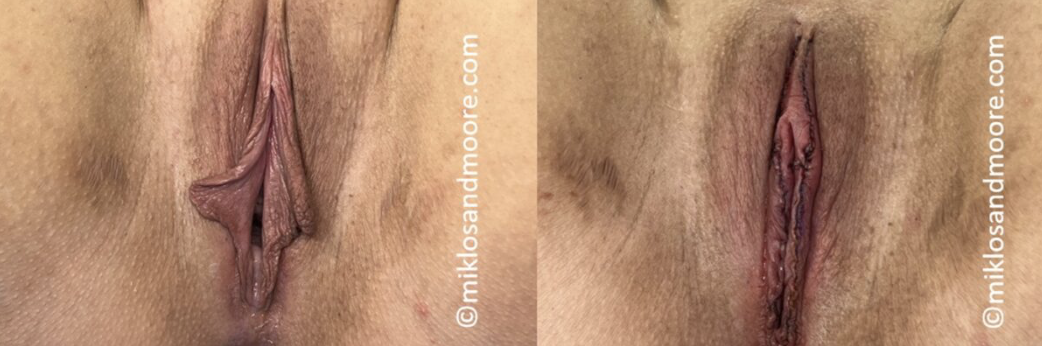
Before and immediate after labia minora reduction photographs showing the surgical result immediately following the procedure before swelling and healing have occurred. Final results develop as recovery progresses.
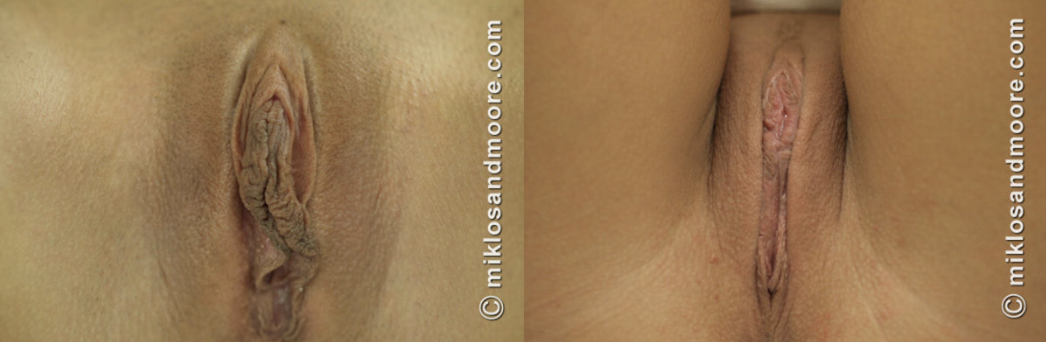
Healed labia minora reduction before and after photographs demonstrating the final appearance after recovery. Individual healing times and surgical results vary.
Understanding the Healing Edge
Unlike procedures involving deeper tissues, labia minora reduction heals along a very fine incision that follows the natural contour of the labia.
As healing progresses, the incision changes dramatically.
Initially it may appear:
- Firm
- Raised
- Slightly uneven
- Pink or red
Over the next several months, the tissue gradually softens.
The edge becomes smoother, thinner, and blends naturally with the surrounding anatomy.
For many patients, the incision eventually becomes extremely difficult to identify.
Why One Side Often Swells More Than the Other
Perfectly symmetrical swelling is uncommon.
One labium frequently appears larger than the other throughout recovery.
Several factors contribute to this, including:
- Natural differences in anatomy
- Variable blood flow
- Sleeping position
- Daily activity
- Individual healing response
Temporary asymmetry rarely reflects the final surgical result.
Dr. Miklos and Dr. Moore encourage patients to avoid evaluating symmetry until healing has progressed for several months.
When Do the Stitches Dissolve?
Most labia minora reductions are performed using absorbable sutures.
Patients often notice:
- Small knots
- Loose suture ends
- Tiny pieces of dissolving material
These sutures gradually dissolve over several weeks.
It is important not to pull or trim them unless instructed by your surgeon.
Changes in Sensation Are Usually Temporary
Because the labia contain numerous small sensory nerve endings, temporary changes in sensation are expected during recovery.
Patients may experience:
- Mild numbness
- Increased sensitivity
- Tingling
- Occasional shooting sensations
- Itching as nerves heal
These symptoms generally improve as swelling decreases and the nerves recover.
Persistent numbness is uncommon.
What If the Edges Don’t Look Smooth?
This is one of the most frequent postoperative questions.
Early healing often creates the appearance of:
- Small bumps
- Tiny ridges
- Uneven thickness
- Wavy edges
These irregularities frequently improve naturally as swelling resolves and scar tissue remodels.
Final contour should not be judged during the first several weeks after surgery.
Returning to Everyday Activities
Most patients recover surprisingly quickly.
Many women return to office work within several days, although prolonged sitting may still cause mild discomfort.
Light walking is encouraged almost immediately to promote healthy circulation.
More strenuous exercise should wait until healing has progressed appropriately.
Activities that place direct pressure on the labia—including cycling, horseback riding, rowing, or spinning—usually require additional healing time before they can be resumed comfortably.
Intimacy After Labia Minora Reduction
Although many women begin feeling significantly better within several weeks, the tissues continue strengthening beneath the surface.
Sexual activity should generally be postponed until your surgeon confirms that healing is complete.
Returning too early may increase swelling, discomfort, or place unnecessary tension on the healing incision.
Helping Your Incision Heal Beautifully
Patients can help optimize healing by:
- Wearing loose clothing
- Keeping the area clean and dry
- Avoiding nicotine
- Following all postoperative instructions
- Attending scheduled follow-up appointments
- Avoiding unnecessary friction during recovery
Because the labia have an excellent blood supply, most patients experience outstanding scar healing over time.
When Should You Call Your Surgeon?
Although recovery is usually uncomplicated, you should contact your surgeon if you experience:
- Heavy bleeding
- Increasing redness
- Fever
- Foul-smelling drainage
- Severe pain that worsens instead of improving
- Separation of the incision
Prompt evaluation allows potential issues to be addressed early.
Why Surgical Technique Influences Recovery
Recovery is influenced as much by surgical precision as by the body’s healing response.
Dr. John Miklos and Dr. Robert Moore have spent decades refining advanced cosmetic vaginal surgical techniques. They have authored numerous peer-reviewed publications, lecture internationally, and are recognized for their expertise in female pelvic reconstructive and aesthetic surgery.
Their meticulous tissue handling, careful preservation of normal anatomy, and individualized postoperative care are designed to promote smoother healing and natural cosmetic outcomes.
Frequently Asked Questions
Why do my labia look larger after surgery?
Postoperative swelling temporarily makes the labia appear thicker than their final size. This gradually improves over the following weeks.
How long do the stitches stay in?
Most absorbable sutures dissolve naturally over several weeks, although small pieces may remain visible for a short time.
Is uneven swelling normal?
Yes. Temporary asymmetry is extremely common during healing and usually resolves as swelling decreases.
Will the incision always feel firm?
No. The incision gradually softens over several months as scar tissue matures.
When will I see my final results?
Most patients appreciate the majority of their cosmetic improvement by three months, with continued refinement occurring for up to six months or longer.