
LABIAPLASTY RECOVERY: EXPERT CARE THROUGH EVERY STAGE OF HEALING
Successful labiaplasty recovery depends on more than time alone. Careful surgical technique, individualized postoperative instructions, and close follow-up all play an important role in achieving a comfortable recovery and natural-looking results. Drs. John Miklos and Robert Moore have performed thousands of cosmetic and reconstructive vaginal procedures, using advanced techniques that prioritize symmetry, tissue preservation, and minimal scarring. Their comprehensive postoperative care helps patients understand what to expect during each stage of healing while providing reassurance throughout the recovery process. As swelling subsides and the tissues mature, most women experience greater comfort, improved confidence, and lasting satisfaction with both the appearance and function of the labia.
Labiaplasty Recovery: Week-by-Week Healing, Swelling, Pain & What to Expect
Choosing to have labiaplasty is a deeply personal decision. For some women, the goal is to relieve discomfort caused by enlarged labia that rub against clothing, interfere with exercise, or cause irritation during intimacy. Others seek surgery to improve symmetry or achieve a more balanced appearance. Regardless of the reason, one of the first questions patients ask is the same:
“What will recovery be like?”
Fortunately, recovery after labiaplasty is generally much easier than many women anticipate. Although the procedure involves delicate tissue, the vulva has an excellent blood supply, which supports healing. Most patients experience swelling, tenderness, and bruising during the first several weeks, but severe pain is uncommon. As healing progresses, everyday activities become easier, swelling gradually subsides, and the final contour begins to emerge.
One of the biggest challenges during recovery is managing expectations. Looking at the surgical area during the first week can be unsettling because the labia often appear larger, firmer, or more uneven than expected. These changes are almost always related to postoperative swelling—not the final surgical result.
It is also important to understand that recovery is not simply about waiting for stitches to dissolve. The visible incision heals relatively quickly, but the deeper tissues continue remodeling for months. Collagen strengthens the surgical site, swelling slowly resolves, scars mature, and the labia gradually soften until they look and feel increasingly natural.
At Miklos & Moore, Dr. John Miklos and Dr. Robert Moore have performed thousands of cosmetic and reconstructive vaginal procedures. Their experience extends beyond cosmetic surgery alone. As internationally recognized urogynecologists, they have authored numerous peer-reviewed publications, taught advanced surgical techniques throughout the world, and developed procedures designed to improve both appearance and function. Every patient receives individualized postoperative instructions and scheduled follow-up care to ensure healing progresses as expected.
Understanding what happens during each stage of recovery helps reduce unnecessary anxiety and allows patients to focus on steady improvement rather than day-to-day fluctuations.
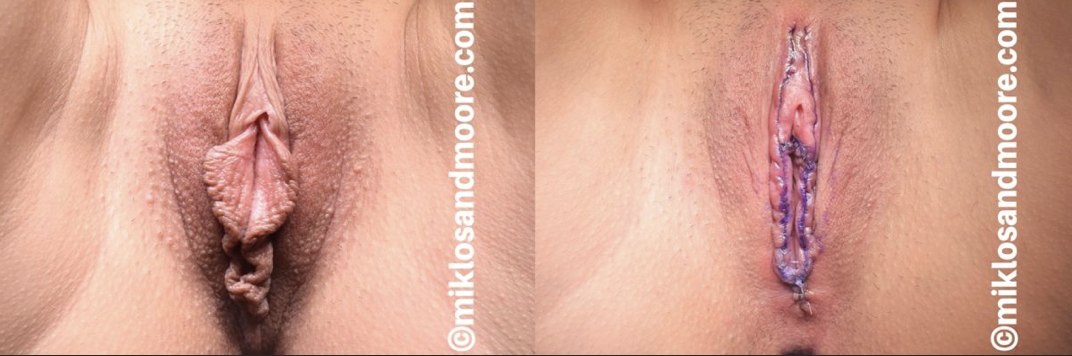
Before and immediate after labiaplasty photographs demonstrating the surgical result at the completion of the procedure before postoperative swelling has resolved. Final results develop as healing progresses.
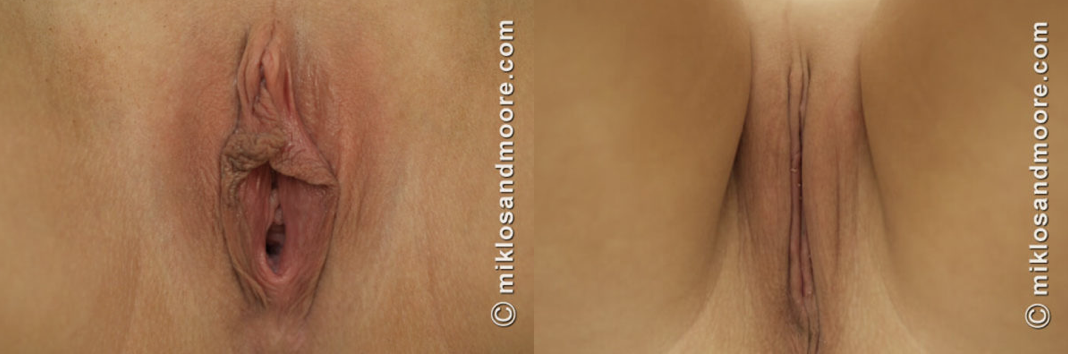
Labiaplasty recovery before and after photographs demonstrating the healed appearance after surgery. Final results become more apparent as swelling resolves and the tissues fully recover. Individual results vary.
How Labiaplasty Heals
Unlike many cosmetic procedures performed elsewhere on the body, labiaplasty involves tissue that is constantly exposed to movement, moisture, and friction. Walking, sitting, exercising, wearing fitted clothing, and even routine daily activities all affect the surgical area during recovery.
Fortunately, the labial tissues also possess one major advantage—they have an exceptional blood supply.
Healthy circulation delivers oxygen and nutrients directly to the healing tissues, helping incisions close efficiently while reducing the risk of delayed healing. This is one reason many patients are surprised by how quickly they begin feeling better.
Healing occurs in three overlapping phases.
Inflammation
Immediately after surgery, the body sends specialized healing cells to the incision.
Blood vessels temporarily expand, allowing increased circulation to reach the surgical site. This inflammatory response causes swelling, warmth, and tenderness, but it is also essential for proper healing.
Without inflammation, the body could not repair itself.
Repair
Over the following weeks, new collagen is produced.
This collagen strengthens the incision and reconnects the tissues that were reshaped during surgery.
During this phase, the labia often feel firmer than expected. Patients sometimes worry that firm tissue means abnormal scarring, but this firmness is typically a normal part of collagen formation.
Remodeling
The longest stage is remodeling.
Over several months, collagen fibers reorganize themselves, swelling continues improving, and the labia become softer and more flexible.
This is why the appearance often continues improving for months after surgery.
The First 24 Hours
The first day is usually less uncomfortable than patients expect.
Because local anesthetic is frequently used during surgery, many women experience only mild soreness immediately afterward. As the anesthetic gradually wears off, the area may begin feeling tender or swollen.
Most women spend the remainder of the day resting at home.
Normal findings during the first day include:
- Mild spotting
- Swelling
- Bruising
- Tenderness while walking
- A feeling of fullness
- Mild burning during urination
Many surgeons recommend gentle walking around the house every few hours to encourage healthy circulation while avoiding prolonged bed rest.
Patients are often eager to see their results immediately after surgery. While it is understandable to be curious, this is not the time to judge the appearance of the labia.
Swelling develops rapidly during the first day and may temporarily make the tissues appear much larger than expected. The final cosmetic outcome cannot be evaluated this early.
The First Week: Why Recovery Looks Worse Before It Looks Better
Perhaps the most important concept to understand is that the first week is usually the most visually dramatic stage of recovery.
Many women are alarmed when they first examine the surgical area because the labia often appear:
- Larger than before surgery
- Puffy
- Firm
- Uneven
- Darker in color because of bruising
This appearance is completely normal.
During the first several days, inflammation reaches its peak. Even a small amount of swelling can significantly change the appearance of the labia because the tissues are naturally soft and delicate.
Patients often assume that swelling means too little tissue was removed or that something has gone wrong.
In reality, swelling is masking the refined contour created during surgery.
Another common concern during the first week is temporary asymmetry. One side almost always swells more than the other. Differences in blood flow, sleeping position, normal anatomy, and activity level all influence how each side heals.
Rather than comparing the two sides during the first week, focus on protecting the incision and allowing your body time to recover.
Finally, it is important to remember that recovery is rarely linear. Some mornings the swelling may appear dramatically improved, only to increase slightly after spending the day walking or sitting for long periods. These fluctuations are expected and usually become less noticeable as healing progresses.
Days 2–7: What Happens During the First Week?
For most women, the first week is when recovery requires the most patience. While discomfort often improves with each passing day, swelling usually reaches its peak during this period before gradually beginning to subside.
It is important to remember that healing during the first week is largely internal. Although you may not see dramatic improvement in the mirror, your body is actively repairing tiny blood vessels, rebuilding collagen, reducing inflammation, and strengthening the surgical site.
Many women worry because the labia appear much larger than expected. Others become concerned because one side looks different from the other or because the incision appears irregular.
These changes are almost always temporary.
The body simply has not had enough time to complete the healing process.
During the first week, patients commonly experience:
- Moderate swelling
- Mild bruising
- Tenderness while walking
- Small amounts of spotting
- A feeling of tightness
- Mild itching as healing begins
Every woman heals differently. Some patients experience very little bruising, while others develop bruising that extends into the surrounding tissues before fading over the next several weeks.
Neither pattern necessarily predicts the final cosmetic outcome.
Week Two: The Turning Point
The second week is often when patients begin feeling much more like themselves.
Walking becomes easier.
Swelling starts becoming softer instead of firmer.
Bruising begins disappearing.
Many women return to office work, social activities, and normal daily routines.
Although improvement is encouraging, this stage can also be frustrating.
Many patients expect the labia to already look “finished.”
Instead, they often continue noticing:
- Mild swelling
- Temporary asymmetry
- Firmness along the incision
- Small areas of thickened tissue
These findings are part of normal healing.
The incision may also appear slightly bumpy during this stage. This is usually caused by collagen production beneath the surface and gradually improves over the following months.
Rather than judging your final result during week two, think of this stage as the transition between early healing and tissue remodeling.
Weeks Three Through Six
By the third week, most women report that recovery becomes much less noticeable.
Simple activities such as walking, sitting, driving, and wearing everyday clothing become increasingly comfortable.
The labia begin looking more natural because swelling continues resolving.
Many patients also notice:
- Softer tissue
- Improved symmetry
- Less tenderness
- Less awareness of the surgical area throughout the day
Even though progress is substantial, healing is still occurring beneath the surface.
Collagen continues strengthening the incision while scar tissue gradually becomes more flexible.
Some women become discouraged because improvement appears slower than it did during the first two weeks.
This is completely normal.
Healing naturally slows as the body transitions from repairing the incision to refining the final cosmetic result.
Months Two Through Six
One of the biggest misconceptions about labiaplasty is that recovery is complete after six weeks.
While many patients have returned to nearly all of their normal activities by this point, the tissues continue changing for several more months.
During this stage, patients commonly notice:
- Continued reduction in swelling
- Softer labial tissue
- Fading scars
- Improved flexibility
- A more natural appearance
Many women also comment that they stop thinking about the surgery altogether.
Instead of constantly checking the area in the mirror, they simply notice that clothing fits more comfortably, exercise feels better, and the self-consciousness they once experienced has disappeared.
For many patients, this emotional improvement becomes just as meaningful as the physical changes.
The Seven Most Common Recovery Concerns
Every week, Dr. Miklos and Dr. Moore answer many of the same postoperative questions. Fortunately, most concerns represent normal healing rather than complications.
Understanding these common situations can make recovery significantly less stressful.
- “My Labia Look Bigger Than Before Surgery.”
This is by far the most common concern.
Immediately after surgery, swelling develops throughout the labial tissues.
Because the labia are naturally thin and delicate, even a small amount of fluid can make them appear much larger than expected.
Ironically, surgery performed to reduce excess tissue often creates a temporary appearance that seems opposite of the intended result.
Fortunately, this swelling gradually resolves over the following weeks, allowing the true contour to become visible.
- “One Side Is More Swollen.”
Perfectly symmetrical swelling almost never occurs.
One side may:
- Swell more
- Bruise more
- Feel firmer
- Heal slightly faster
These differences usually reflect normal healing rather than problems with the surgery itself.
Experienced surgeons rarely evaluate symmetry until healing has progressed for several months.
- “The Incision Looks Bumpy.”
Many women expect the incision to appear perfectly smooth immediately after surgery.
Instead, they often notice:
- Small ridges
- Tiny bumps
- Firm edges
- Slight irregularities
This is usually caused by normal collagen formation and temporary swelling.
As scar tissue remodels, the incision gradually softens and blends into the surrounding tissue.
- “I Can Still See My Stitches.”
Absorbable sutures dissolve at different rates.
Some disappear quickly.
Others remain visible for several weeks.
Patients should never pull on stitches, even if they appear loose.
Removing them prematurely can interfere with healing.
If a suture becomes irritating, your surgeon can determine whether it should simply be left alone or safely trimmed during a follow-up visit.
- “The Area Feels Tight.”
A feeling of tightness is common during the first several weeks.
This sensation develops because new collagen is strengthening the tissues beneath the incision.
As healing continues, the tissues gradually become softer and more flexible.
- “It Itches Constantly.”
Itching is often one of the most reassuring signs of healing.
As the skin repairs itself and tiny sensory nerves recover, itching frequently develops around the incision.
Although scratching should be avoided, patients are often relieved to learn that itching usually indicates normal healing rather than infection.
- “I’m Looking at It Every Day and Driving Myself Crazy.”
This is perhaps the most common recovery mistake.
Many women examine the surgical area multiple times each day hoping to see improvement.
Unfortunately, healing changes very little from morning to evening.
Instead, patients often become anxious because swelling naturally fluctuates throughout the day.
Dr. Miklos and Dr. Moore encourage patients to judge recovery week by week—not hour by hour.
When patients compare photographs taken several weeks apart rather than several hours apart, the progress is usually dramatic.
Returning to Everyday Activities
One of the most common questions after labiaplasty is not whether the surgery was successful, but when life can return to normal. While every woman heals at her own pace, most patients find that recovery becomes noticeably easier with each passing week. The key is understanding that feeling better does not necessarily mean the tissues have completely healed.
The incision on the outside often heals faster than the deeper tissues beneath the surface. Giving your body adequate time to recover helps protect your surgical result and minimizes unnecessary swelling or irritation.
Returning to Work
Most women with office or sedentary jobs return to work within three to seven days, although some prefer taking a full week off to allow swelling and tenderness to improve.
Returning to work is often easier if you:
- Wear loose-fitting clothing.
- Stand and stretch every hour.
- Avoid sitting continuously for long periods.
- Stay well hydrated throughout the day.
Women whose occupations involve heavy lifting, prolonged standing, climbing, or strenuous physical activity may require additional recovery time.
It is important to listen to your body. Mild swelling after a busy workday is common during the first few weeks and usually improves after resting overnight.
Exercise and Physical Activity
One of the biggest mistakes patients make is returning to strenuous exercise simply because they no longer feel sore.
Healing tissues remain vulnerable even after discomfort has improved.
Walking is encouraged almost immediately because it improves circulation and promotes recovery without placing significant stress on the surgical site.
More strenuous activities should be resumed gradually and only after your surgeon confirms that healing is progressing appropriately.
Activities that generally require additional healing include:
- Running
- HIIT workouts
- Cycling
- Spin classes
- Horseback riding
- Rowing
- Heavy weightlifting
- Squats and lunges
- Contact sports
These activities create repeated friction or pressure against the healing labia and may increase swelling if resumed too soon.
When you do return to exercise, begin gradually. Your body will usually tell you if you have done too much. Mild swelling after your first few workouts is not unusual and often resolves with rest.
Choosing Comfortable Clothing
Many women underestimate how much clothing influences recovery.
During the first several weeks, loose, breathable clothing usually provides the greatest comfort.
Patients often prefer:
- Cotton underwear
- Loose athletic shorts
- Soft pajama pants
- Loose dresses or skirts
- Sweatpants without tight seams
Many temporarily avoid:
- Tight leggings
- Skinny jeans
- Thongs
- Compression garments
- Tight athletic wear
As swelling decreases, most women gradually return to their normal wardrobe without difficulty.
Bathing, Hygiene, and Incision Care
Keeping the surgical area clean is important, but healing tissues should always be treated gently.
Most patients are able to shower according to their surgeon’s postoperative instructions.
During recovery it is generally recommended to:
- Allow warm water to flow gently over the incision.
- Avoid scrubbing the area.
- Pat the skin dry instead of rubbing.
- Wear clean, breathable underwear daily.
- Follow all wound-care instructions provided by your surgeon.
Many women also find that rinsing the area with lukewarm water after using the restroom is more comfortable than wiping alone during the first several days.
Bathtubs, swimming pools, hot tubs, lakes, and oceans are generally avoided until the incision has healed completely and your surgeon confirms that immersion is safe.
When Can You Resume Sexual Activity?
One of the most frequently asked questions after labiaplasty is when it is safe to resume sexual intercourse.
Although the skin may appear well healed after several weeks, the deeper tissues continue strengthening long after the incision closes.
Returning to sexual activity too early can:
- Increase swelling.
- Cause discomfort.
- Irritate the incision.
- Delay healing.
- Increase the risk of wound separation.
For these reasons, most surgeons recommend waiting until healing is complete and you have been examined during a follow-up visit.
Many women also experience understandable anxiety before the first sexual encounter after surgery.
Common concerns include:
- Will everything feel normal?
- Will I still have normal sensation?
- Will my partner notice a difference?
- Will intercourse be uncomfortable?
These questions are entirely normal.
Fortunately, as swelling resolves and the tissues soften, most patients find that confidence gradually returns. Temporary sensitivity or mild apprehension during the early stages of recovery is common and usually improves with time.
Long-Term Healing and Scar Maturation
One of the most overlooked aspects of labiaplasty recovery is what happens after the first six weeks.
Although many patients have resumed normal activities by this point, healing continues beneath the surface.
Over the next several months:
- Scar tissue becomes softer.
- Swelling continues decreasing.
- The labia become more flexible.
- Skin color gradually normalizes.
- The final contour becomes more refined.
Many women notice subtle improvements for up to six months and occasionally longer.
The goal of surgery is not simply to remove excess tissue but to create labia that appear natural both at rest and during movement. Achieving that result requires patience while the tissues complete the remodeling process.
When Should You Contact Your Surgeon?
Although complications are uncommon, patients should know which symptoms deserve prompt evaluation.
Contact your surgeon if you experience:
- Heavy bleeding
- Fever greater than 101°F
- Rapidly increasing swelling
- Significant redness spreading beyond the incision
- Thick yellow or green drainage
- A foul odor
- Severe pain that continues worsening
- Difficulty urinating
- Separation of the incision
Most recovery questions ultimately turn out to be part of normal healing, but it is always appropriate to contact your surgeon if something does not seem right or if you have concerns about your progress.
Why Choosing an Experienced Labiaplasty Surgeon Matters
Excellent recovery begins long before surgery.
The precision of the operation itself plays a major role in postoperative comfort, scar quality, and long-term cosmetic results. Careful tissue handling, meticulous surgical planning, and preservation of the natural anatomy all contribute to smoother healing.
Dr. John Miklos and Dr. Robert Moore have spent decades specializing in female pelvic reconstructive and cosmetic gynecologic surgery. Their experience includes thousands of vaginal cosmetic procedures, numerous peer-reviewed scientific publications, and presentations at national and international medical conferences where they teach advanced surgical techniques to physicians worldwide.
Every patient receives individualized postoperative instructions, scheduled follow-up appointments, and direct access to an experienced surgical team throughout the recovery process. Their commitment extends beyond achieving an attractive cosmetic result—it includes helping every patient recover safely while preserving comfort, function, and confidence.
Frequently Asked Questions
How long does labiaplasty recovery take?
Most women return to many normal daily activities within one to two weeks. Complete healing, including scar maturation and resolution of subtle swelling, continues for several months.
When is swelling at its worst?
Swelling is usually greatest during the first several days after surgery before gradually improving over the following weeks.
Why do my labia look larger after surgery?
Postoperative swelling temporarily enlarges the tissues and often masks the final contour. As inflammation subsides, the refined surgical result becomes more apparent.
Is uneven swelling normal?
Yes. One side frequently swells more than the other during recovery. Temporary asymmetry is common and usually improves with time.
When do the stitches dissolve?
Most labiaplasty procedures use absorbable sutures that dissolve naturally over several weeks. Small portions of the sutures may remain visible during the healing process.
Can I speed up recovery?
Following your surgeon’s instructions, avoiding nicotine, eating a balanced diet, staying hydrated, wearing loose clothing, and avoiding strenuous activity all help support healthy healing.
Will my scars be visible?
The labial tissues typically heal exceptionally well because of their excellent blood supply. As scars mature, they usually become increasingly soft and difficult to notice.
When will I see my final results?
Most patients appreciate significant improvement by three months, although subtle changes in softness, scar appearance, and tissue contour may continue for six months or longer.
Schedule a Consultation with Miklos & Moore
Whether you are considering labiaplasty or preparing for surgery, understanding the recovery process can help you approach healing with realistic expectations and greater confidence. Dr. John Miklos and Dr. Robert Moore combine decades of experience in cosmetic gynecology and female pelvic reconstruction with individualized postoperative care designed to support a smooth recovery and natural-looking results.
If you have questions about labiaplasty or would like to learn whether the procedure is right for you, schedule a consultation with Miklos & Moore to receive a personalized evaluation and treatment plan tailored to your goals.