
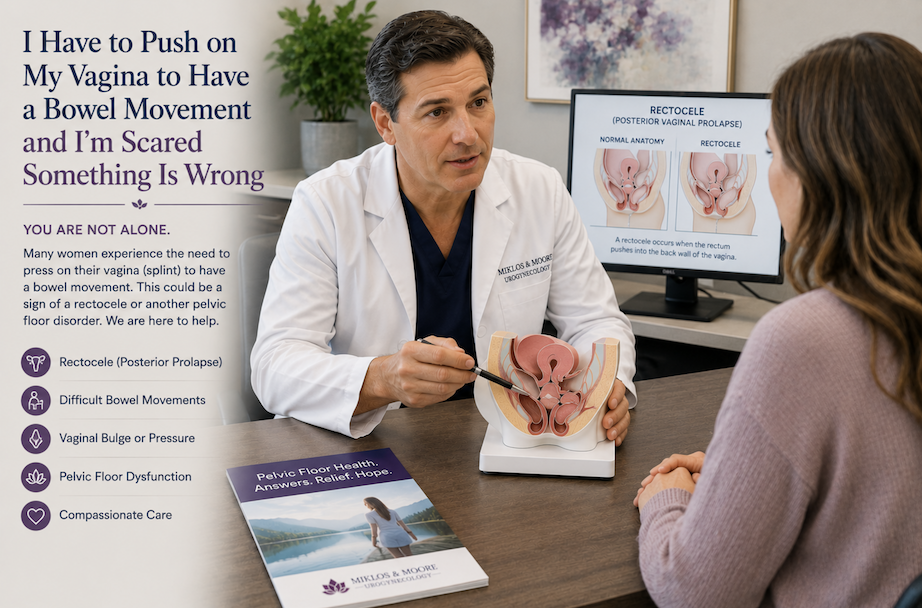
I Have to Push on My Vagina to Have a Bowel Movement and I’m Scared Something Is Wrong
If you’ve ever found yourself pressing on the back wall of your vagina to help pass a bowel movement, you’re not alone.
Many women are embarrassed to talk about it—even with their doctor.
Some wonder:
“Is this normal?”
Others worry:
“Am I doing damage?”
Or perhaps the most common question:
“What is wrong with my body?”
The truth is that needing to push on the vagina during a bowel movement, a technique known medically as vaginal splinting, is often a sign of an underlying pelvic floor disorder. While it can be alarming, it is also a symptom that fellowship-trained urogynecologists diagnose and treat regularly.
The good news is that effective treatment options are available. Understanding why this happens is the first step toward finding relief.
What Is Vaginal Splinting?
Vaginal splinting occurs when a woman places one or more fingers inside or against the vaginal wall to help empty the rectum during a bowel movement.
By applying gentle pressure, stool can move more easily through the rectum.
Although it may seem unusual, vaginal splinting is a well-recognized symptom of pelvic floor disorders and is discussed frequently in urogynecology practices.
Many women feel embarrassed about it, but it is far more common than most people realize.
Why Would Someone Need to Push on the Vagina?
Normally, the muscles and connective tissues between the vagina and rectum provide enough support for stool to pass naturally.
When these tissues become weakened or stretched, the rectum may bulge into the vaginal wall instead of emptying efficiently.
As stool collects in this bulge, it can become difficult to completely empty the rectum without manually supporting the vaginal wall.
This is why some women discover that gently pressing on the vagina allows them to have a bowel movement more easily.
The Most Common Cause: Rectocele
One of the most common reasons for vaginal splinting is a rectocele, also called a posterior vaginal prolapse.
A rectocele occurs when the tissue separating the rectum from the vagina weakens, allowing the rectum to push into the vaginal canal.
Women with a rectocele may notice:
- Difficulty emptying the bowels
- Constipation
- A feeling of incomplete emptying
- Vaginal bulging
- Pelvic pressure
- The need to splint during bowel movements
Not every rectocele requires surgery, but it should be properly evaluated.
Why Does a Rectocele Develop?
Several factors can weaken the pelvic floor over time.
The most common include:
- Vaginal childbirth
- Aging
- Menopause
- Chronic constipation
- Repeated heavy lifting
- Obesity
- Previous pelvic surgery
- Genetics
Many women experience more than one of these risk factors.
Can Childbirth Cause This?
Yes.
Pregnancy and vaginal delivery place significant stress on the muscles and connective tissues that support the pelvic organs.
Although many women heal well after childbirth, some develop stretching or injury that eventually contributes to:
- Rectocele
- Pelvic organ prolapse
- Vaginal laxity
- Urinary incontinence
Symptoms may not appear until years after delivery.
Other Symptoms That Often Occur Together
Women who need to splint frequently experience additional pelvic floor symptoms.
These may include:
- A vaginal bulge
- Pelvic heaviness
- Pressure in the vagina
- Difficulty completely emptying the bladder
- Urinary leakage
- Pain during intercourse
- Lower back discomfort
- Feeling that something is “falling out”
Experiencing several of these symptoms together makes evaluation by a urogynecologist especially important.
Is It Dangerous?
Vaginal splinting itself is not usually dangerous.
However, it is a symptom—not a diagnosis.
Ignoring the underlying cause may allow pelvic floor disorders to gradually worsen over time.
Early evaluation often provides more treatment options and may help prevent progression.
How Is a Rectocele Diagnosed?
A fellowship-trained urogynecologist begins with a detailed medical history and pelvic examination.
The examination evaluates:
- Pelvic organ support
- Vaginal wall strength
- Rectal support
- Pelvic floor muscles
- Bladder function
- Bowel symptoms
Additional testing may occasionally be recommended depending on your symptoms.
Treatment Options
Treatment depends on symptom severity rather than the size of the rectocele alone.
Many women improve with conservative care.
Treatment options include:
- Increasing dietary fiber
- Improving hydration
- Avoiding excessive straining
- Stool softeners when appropriate
- Pelvic floor physical therapy
- Pelvic floor exercises
- Lifestyle modifications
For women with more significant symptoms, surgical repair may be recommended to restore normal support between the rectum and vagina.
Every treatment plan should be individualized.
When Should You See a Urogynecologist?
You should consider scheduling an evaluation if you:
- Regularly splint during bowel movements
- Feel a vaginal bulge
- Experience pelvic pressure
- Have chronic constipation despite treatment
- Leak urine
- Have painful intercourse
- Feel incomplete bowel emptying
- Notice symptoms becoming progressively worse
Many women wait years before discussing these symptoms because they feel embarrassed.
There is no reason to suffer in silence.
Why Choose Miklos & Moore Urogynecology
Needing to push on your vagina during a bowel movement is not something you should ignore or feel embarrassed to discuss. While it may feel like an unusual symptom, it is often associated with pelvic floor disorders that can be accurately diagnosed and effectively treated.
Dr. John Miklos and Dr. Robert Moore are fellowship-trained urogynecologists specializing in Female Pelvic Medicine and Reconstructive Surgery (FPMRS). Their practice is dedicated exclusively to diagnosing and treating pelvic floor disorders, including rectocele, pelvic organ prolapse, urinary incontinence, vaginal laxity, and bowel dysfunction related to weakened pelvic support.
Every patient receives a comprehensive evaluation that looks beyond the symptom itself to identify the underlying cause. Treatment recommendations are personalized and may include dietary changes, pelvic floor physical therapy, nonsurgical management, or advanced reconstructive surgery when appropriate.
Patients from across the United States seek the expertise of Drs. Miklos and Moore because of their extensive experience managing both common and complex pelvic floor disorders with compassion, education, and individualized care.
Frequently Asked Questions
Is it normal to push on my vagina to have a bowel movement?
No. While it is a recognized symptom of pelvic floor disorders, needing to splint regularly should be evaluated by a urogynecologist.
Does this mean I have a rectocele?
Not always, but a rectocele is one of the most common causes. A pelvic examination can determine whether one is present.
Will a rectocele go away on its own?
Generally, no. Mild symptoms may remain stable, but weakened support tissues do not usually repair themselves.
Can pelvic floor therapy help?
Yes. Many women improve with pelvic floor physical therapy, particularly when symptoms are mild to moderate.
Will I need surgery?
Not necessarily. Surgery is considered only when symptoms significantly affect quality of life and conservative treatment has not provided adequate relief.
Can constipation make a rectocele worse?
Yes. Chronic straining places additional stress on the pelvic floor and may contribute to progression over time.
Is vaginal splinting harmful?
The act of splinting itself is usually not harmful, but it is a sign that the underlying pelvic support should be evaluated.
Can menopause contribute to rectocele?
Yes. Declining estrogen and age-related weakening of connective tissue may contribute to pelvic organ prolapse after menopause.
Will insurance cover treatment?
Most medically necessary evaluations and treatments for rectocele and pelvic organ prolapse are covered by insurance, although benefits vary by plan.
The Bottom Line
Having to push on your vagina to have a bowel movement may feel frightening or embarrassing, but it is a common symptom seen by fellowship-trained urogynecologists.
Rather than ignoring the problem or assuming it is simply part of aging or childbirth, seek an evaluation to determine the underlying cause.
Whether your symptoms are related to a rectocele, pelvic organ prolapse, pelvic floor weakness, or another condition, effective treatments are available. With the right diagnosis and individualized care, many women regain normal bowel function, improve pelvic support, and return to living comfortably and confidently.