
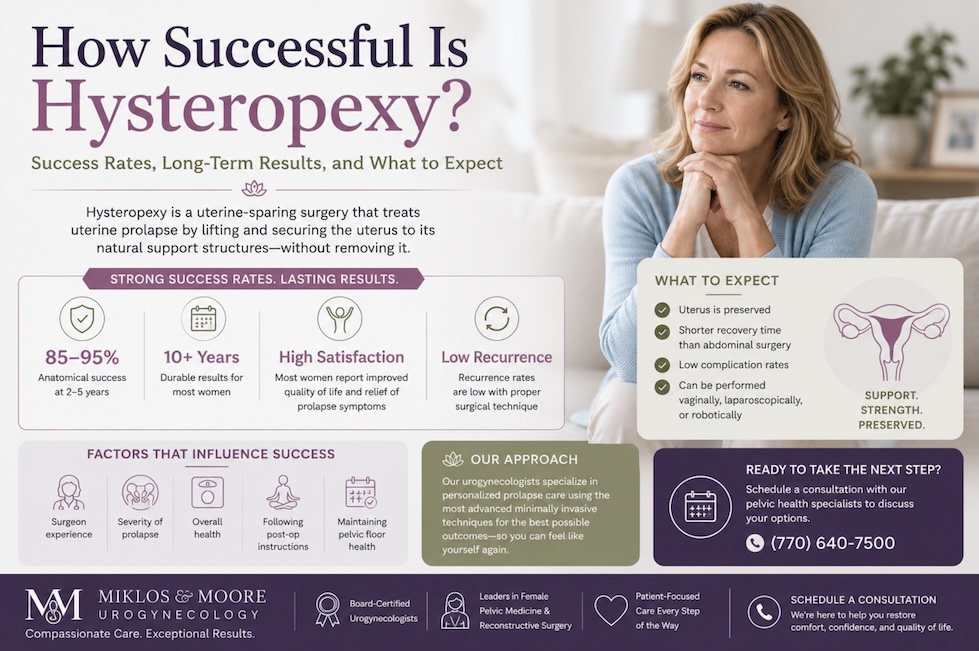
How Successful Is Hysteropexy? Success Rates, Long-Term Results, and What to Expect
Does Hysteropexy Really Work?
If you’ve been diagnosed with uterine prolapse and are considering hysteropexy, one of your biggest questions is probably:
- How successful is hysteropexy?
- Will the prolapse come back?
- Is hysteropexy as effective as a hysterectomy?
These are important questions—and the good news is that, for many women, hysteropexy offers excellent long-term results while preserving the uterus.
Studies have shown that appropriately selected patients can achieve durable prolapse repair and significant improvement in their quality of life with uterus-preserving surgery. However, like any pelvic reconstructive procedure, success depends on much more than simply choosing the operation. Careful patient selection, surgical technique, and surgeon experience all play a major role.
What Is Hysteropexy?
A hysteropexy is a surgical procedure that repairs uterine prolapse without removing the uterus.
Instead of performing a hysterectomy, the uterus is restored to its normal position and secured using specialized pelvic support techniques. Depending on your anatomy, the procedure may be performed vaginally, laparoscopically, or robotically.
The goal is to eliminate the symptoms of prolapse while preserving a healthy uterus.
What Do Studies Show About Hysteropexy Success Rates?
Medical research has shown encouraging outcomes for hysteropexy when it is performed on carefully selected patients.
Many women experience:
- Significant improvement in pelvic pressure
- Resolution of the vaginal bulge
- Better bladder function
- Improved bowel function
- Less discomfort during daily activities
- Better sexual function for many patients
- High patient satisfaction years after surgery
Success is often measured by both the anatomical repair and how much the patient’s symptoms improve. For many women, hysteropexy successfully accomplishes both goals.
What Factors Affect the Success of Hysteropexy?
Every woman is different, and no two prolapse repairs are exactly alike.
Several factors influence long-term success, including:
The Severity of Your Prolapse
Early and moderate prolapse may be corrected differently than advanced prolapse. More severe cases often require additional pelvic floor reconstruction.
The Type of Repair Performed
Different hysteropexy techniques may be appropriate depending on your anatomy, including:
- Sacrohysteropexy
- Sacrospinous hysteropexy
- Uterosacral ligament suspension
- Robotic hysteropexy
- Laparoscopic hysteropexy
- Native tissue repairs
The best procedure is the one that matches your specific condition—not necessarily the newest or most advertised technique.
Repairing All Areas of Prolapse
Many women have more than one type of prolapse.
For example, uterine prolapse may occur along with:
- Bladder prolapse (cystocele)
- Rectocele
- Vaginal vault weakness
- Enterocele
Treating only one problem while leaving others uncorrected can affect the overall outcome. A comprehensive evaluation helps identify all areas that may need repair.
Tissue Quality
Age, genetics, previous childbirth, menopause, connective tissue disorders, and prior pelvic surgery can all influence the strength of pelvic support tissues.
Following Recovery Instructions
After surgery, your body needs time to heal.
Following your surgeon’s instructions regarding lifting restrictions, exercise, constipation prevention, and activity levels helps protect the repair during the healing process.
Can Prolapse Come Back After Hysteropexy?
Although hysteropexy has high success rates, no prolapse surgery can guarantee that prolapse will never recur.
Pelvic organ prolapse develops because the connective tissues and muscles supporting the pelvic organs weaken over time. Even after a successful repair, aging, chronic coughing, constipation, obesity, or heavy lifting can place stress on the pelvic floor.
Fortunately, many women continue to enjoy symptom relief for years after surgery.
Is Hysteropexy as Successful as Hysterectomy?
One of the most common misconceptions is that removing the uterus automatically leads to a stronger prolapse repair.
Current evidence suggests that, in properly selected patients, hysteropexy can provide outcomes comparable to hysterectomy-based prolapse repair.
The overall success of surgery depends far more on:
- Accurate diagnosis
- Appropriate surgical planning
- Repair of all prolapsed compartments
- Surgical expertise
- Patient selection
Simply removing the uterus does not guarantee a better long-term result.
What Symptoms Usually Improve?
Following successful hysteropexy, many women notice improvement in:
- Vaginal bulging
- Pelvic pressure
- Heaviness
- Feeling that something is falling out
- Difficulty inserting tampons
- Urinary symptoms
- Bowel symptoms
- Discomfort during daily activities
The degree of improvement varies depending on the severity of prolapse and whether other pelvic floor disorders are present.
Why Surgeon Experience Can Influence Long-Term Results
Hysteropexy is more than simply lifting the uterus. A durable repair requires restoring the normal support structures of the pelvis while identifying and correcting associated prolapse involving the bladder, rectum, or vaginal apex when necessary.
Drs. John Miklos and Robert Moore have spent decades specializing exclusively in female pelvic reconstructive surgery. Throughout their careers, they have performed thousands of prolapse procedures, developed innovative surgical techniques, published extensively in peer-reviewed medical journals, and trained surgeons around the world. Their practice also serves as a referral center for women seeking second opinions or treatment after previous prolapse surgeries have failed.
Their extensive experience allows them to create individualized surgical plans designed to maximize long-term success while preserving normal pelvic anatomy whenever appropriate.
Why Women Choose Miklos & Moore
Women from across the country seek treatment from Drs. Miklos and Moore because of their experience managing both routine and highly complex pelvic floor disorders.
Patients appreciate:
- Exclusive focus on female pelvic reconstructive surgery
- Expertise in uterus-preserving prolapse repair
- Advanced robotic, laparoscopic, and vaginal surgical techniques
- Individualized treatment recommendations
- Extensive experience with revision prolapse surgery
- International recognition for education, research, and innovation in urogynecology
Their goal is to provide each patient with the procedure that offers the best long-term outcome—not simply the same operation for every woman.
Schedule a Consultation
If you’re considering hysteropexy and want to understand whether it’s the right option for your prolapse, a consultation with an experienced pelvic reconstructive surgeon can help.
Every woman has unique anatomy and treatment goals. A comprehensive evaluation can determine whether hysteropexy is appropriate and what type of repair is most likely to provide lasting symptom relief.
Frequently Asked Questions
How successful is hysteropexy?
For appropriately selected patients, hysteropexy has excellent long-term success rates and provides significant improvement in prolapse symptoms and quality of life.
Can prolapse come back after hysteropexy?
Yes. While hysteropexy is highly effective, no prolapse surgery can guarantee that prolapse will never recur. Maintaining a healthy lifestyle and following your surgeon’s recovery recommendations may help reduce the risk.
Is hysteropexy better than hysterectomy?
Neither procedure is universally better. The most appropriate treatment depends on your anatomy, medical history, symptoms, and personal preferences.
How long do hysteropexy results last?
Many women experience durable symptom relief for years after surgery. Individual outcomes depend on factors such as tissue quality, overall health, and the specific type of prolapse repair performed.
Does preserving the uterus make prolapse surgery less effective?
Not necessarily. Research has shown that uterus-preserving surgery can provide outcomes comparable to hysterectomy-based prolapse repair for many women.
Why choose Drs. Miklos and Moore for hysteropexy?
Drs. Miklos and Moore have devoted their careers exclusively to female pelvic reconstructive surgery and cosmetic gynecology. As internationally recognized, award-winning urogynecologic surgeons, they have performed thousands of prolapse repairs, pioneered advanced reconstructive techniques, authored numerous scientific publications, and trained physicians worldwide. Their experience treating both primary and recurrent prolapse allows them to tailor each surgical plan to the individual patient, helping maximize long-term success while preserving normal pelvic support whenever appropriate.