
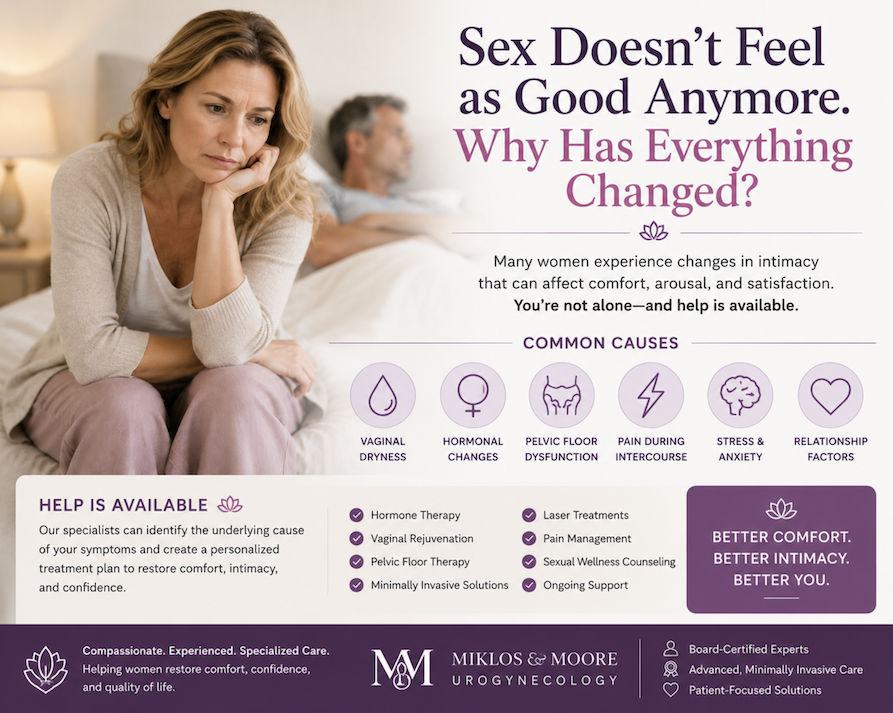
Sex Doesn’t Feel as Good Anymore. Why Has Everything Changed?
When Intimacy Feels Different Than It Used To, You’re Not Imagining It
Many women don’t know exactly how to describe it.
They don’t necessarily have pain.
They can still enjoy being close to their partner.
But something feels…different.
The sensations aren’t as intense.
It takes longer to become aroused.
Orgasms aren’t as strong.
Sometimes they don’t happen at all.
The connection they once felt during intimacy just isn’t the same.
For many women, this change is confusing because it happened gradually.
There wasn’t one specific day when everything changed.
Instead, they simply realized that sex wasn’t as enjoyable as it used to be.
At the practice of Dr. John Miklos and Dr. Robert Moore in Alpharetta, Georgia, women frequently seek answers after noticing changes in intimacy following childbirth, menopause, pelvic floor disorders, or other life events. Patients travel from Georgia, Florida, Alabama, Tennessee, North Carolina, South Carolina, as well as California, Texas, New York, Illinois, and throughout the United States for specialized evaluation.
Why Doesn’t Sex Feel the Same?
Sexual function changes for many reasons.
For some women, the change is subtle.
For others, it’s dramatic.
Possible contributing factors include:
- Hormonal changes during menopause
- Pregnancy and childbirth
- Vaginal laxity
- Pelvic floor muscle dysfunction
- Pelvic organ prolapse
- Vaginal dryness
- Certain medications
- Chronic stress
- Medical conditions affecting nerves or circulation
- Pain during intercourse
- Emotional and relationship factors
Because several factors often overlap, it’s important not to assume there’s only one cause.
Childbirth Can Change More Than You Expect
Pregnancy and vaginal delivery place tremendous stress on the pelvic floor.
Some women recover with few lasting changes.
Others notice:
- Less sensation during intercourse
- Vaginal looseness
- Bladder leakage
- Pelvic pressure
- Difficulty reaching orgasm
These symptoms don’t happen to everyone, but they are common enough that they deserve discussion during a medical evaluation.
Menopause Can Affect Intimacy, Too
As estrogen levels decline, many women notice changes in:
- Vaginal lubrication
- Tissue elasticity
- Comfort during intercourse
- Sexual desire
- Arousal
- Orgasm intensity
These changes vary widely, but they are common and often treatable.
When It Feels Like You’ve Lost Part of Yourself
Many women describe more than physical symptoms.
They describe grief.
They remember how intimacy used to feel.
They miss feeling spontaneous.
They worry that their partner notices the difference.
Some stop initiating sex.
Others avoid it altogether because they fear disappointment.
Those emotional reactions are just as important as the physical changes.
Could a Pelvic Floor Disorder Be Contributing?
For some women, yes.
Conditions involving the pelvic floor may contribute to changes in comfort and sexual function.
These may include:
- Pelvic organ prolapse
- Vaginal laxity
- Pelvic floor muscle dysfunction
- Childbirth-related injuries
- Chronic pelvic pain
Not every woman with these conditions experiences changes in sexual satisfaction, but they are among the possibilities that may be considered during an evaluation.
Why Women Choose Drs. John Miklos and Robert Moore
For decades, Dr. John Miklos and Dr. Robert Moore have specialized in cosmetic gynecology and Female Pelvic Medicine and Reconstructive Surgery.
Women seek their expertise for:
- Vaginal laxity
- Pelvic organ prolapse
- Pain during intercourse
- Difficulty reaching orgasm
- Menopause-related pelvic changes
- Childbirth-related pelvic floor injuries
- Urinary incontinence
- Cosmetic gynecology procedures
- Complex pelvic floor reconstruction
Their evaluations focus on understanding each woman’s symptoms, anatomy, pelvic floor function, hormonal influences, and goals before discussing individualized treatment options.
Women Travel From Across the Country
Located in Alpharetta, Georgia, the practice welcomes women from Georgia, Florida, Alabama, Tennessee, North Carolina, South Carolina, as well as California, Texas, New York, Illinois, and many other states.
Many patients seek care after spending months or years wondering why intimacy has changed.
You Don’t Have to Accept That “This Is Just Aging”
Many women are told that changing sexual function is simply something they have to live with.
While changes can occur with age, childbirth, or menopause, that doesn’t mean your concerns should be dismissed.
Understanding why sex feels different is the first step toward identifying options that may improve comfort, confidence, and intimacy.
Frequently Asked Questions
Is it normal for sex to feel different after menopause?
Many women notice changes in lubrication, tissue elasticity, comfort, and sexual response after menopause, although the experience varies from person to person.
Can childbirth affect sexual sensation?
Yes. Pregnancy and vaginal delivery may change the pelvic floor muscles, connective tissues, and nerves, which can influence sexual sensation for some women.
Can pelvic organ prolapse affect intimacy?
Some women with pelvic organ prolapse report changes in comfort or sexual function, while others do not. A comprehensive evaluation can help determine whether prolapse is contributing to your symptoms.
Should I talk to a specialist if intimacy has changed?
If changes in sexual function are affecting your quality of life or your relationship, it’s reasonable to discuss them with a healthcare professional who evaluates pelvic floor and women’s sexual health concerns.