
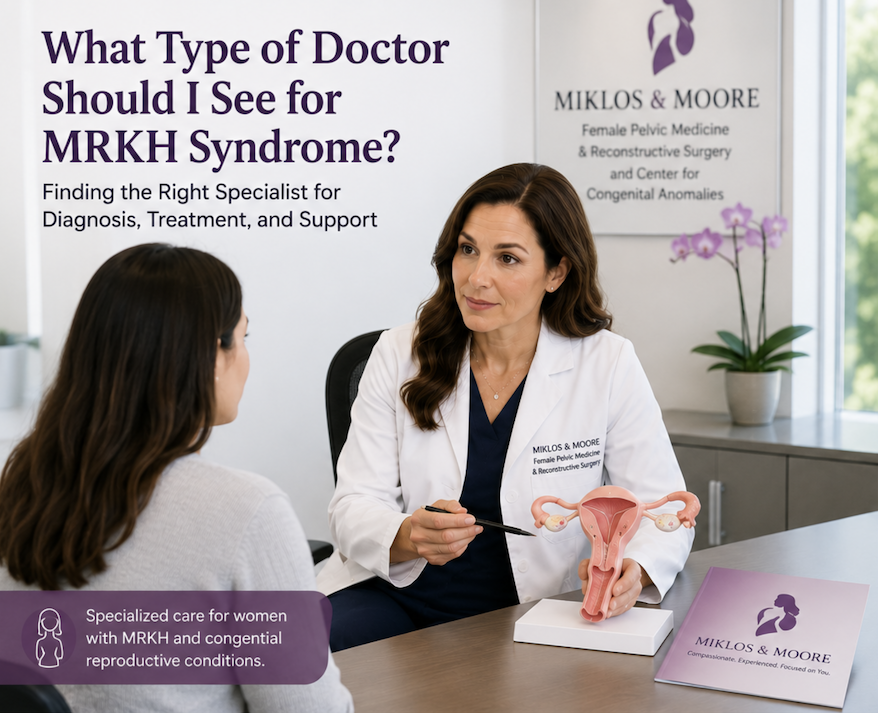
What Type of Doctor Should I See for MRKH Syndrome?
Why Choosing an Experienced Specialist Can Make All the Difference
Learning that you have Mayer-Rokitansky-Küster-Hauser (MRKH) syndrome can be overwhelming. For many women, the diagnosis answers years of questions—but it also creates new ones.
One of the first questions is often:
“What type of doctor should I see for MRKH syndrome?”
Because MRKH is a rare congenital condition, many women quickly discover that not every gynecologist or surgeon has experience treating it. Finding the right specialist is one of the most important decisions you’ll make, especially if you’re considering vaginal reconstruction or want to better understand all of your treatment options.
Patients travel from throughout the United States, Canada, Europe, Australia, South America, Asia, and the Middle East seeking physicians with extensive experience in MRKH syndrome because specialized expertise can be difficult to find close to home.
What Is MRKH Syndrome?
MRKH syndrome is a congenital condition in which a woman is born with an underdeveloped or absent uterus and varying degrees of vaginal development, despite having:
- Normal female chromosomes (46,XX)
- Normally functioning ovaries
- Typical external female genitalia
- Normal breast development and other secondary sexual characteristics
Most women are diagnosed during their teenage years when menstrual periods fail to begin despite otherwise normal puberty.
While MRKH syndrome is uncommon, every woman’s anatomy is unique, making individualized evaluation essential.
Why Finding the Right Doctor Matters
MRKH syndrome involves much more than anatomy alone.
Women often have questions about:
- Vaginal reconstruction
- Non-surgical vaginal dilation
- Sexual function
- Future fertility options
- Emotional well-being
- Long-term pelvic health
- Relationships and intimacy
- Pregnancy through IVF and gestational surrogacy
Because these issues frequently overlap, choosing a physician with experience managing MRKH can provide access to a broader range of treatment options and long-term guidance.
Which Doctors May Be Involved in MRKH Care?
Several specialists may participate in the care of women with MRKH syndrome.
Each brings a different area of expertise.
General Gynecologist (OB/GYN)
Many women first learn they have MRKH syndrome during an evaluation with their gynecologist.
An OB/GYN may:
- Diagnose primary amenorrhea
- Perform an initial pelvic examination
- Order ultrasound or MRI imaging
- Explain the diagnosis
- Coordinate referrals to specialists
Although most gynecologists are familiar with MRKH syndrome, relatively few routinely manage complex vaginal reconstruction or long-term surgical treatment.
Reproductive Endocrinologist and Fertility Specialist
Women interested in having biological children often meet with a reproductive endocrinologist.
This specialist can discuss:
- Ovarian function
- Egg retrieval
- IVF
- Gestational surrogacy
- Fertility preservation
- Family planning
Since women with MRKH usually have functioning ovaries, many are able to have genetically related children through assisted reproductive technology.
Pediatric and Adolescent Gynecologist
Women diagnosed during adolescence may initially receive care from a pediatric or adolescent gynecologist who can help coordinate evaluation, counseling, and referral during the early stages after diagnosis.
Plastic Surgeon
Some plastic surgeons perform reconstructive procedures involving the genital region.
However, MRKH syndrome often requires a comprehensive understanding of vaginal anatomy, pelvic floor support, sexual function, and long-term vaginal health. For this reason, many patients seek specialists whose practices focus specifically on reconstructive surgery of the female pelvis.
Fellowship-Trained Urogynecologist
A urogynecologist is an OB/GYN who completes additional fellowship training in Female Pelvic Medicine and Reconstructive Surgery.
This advanced subspecialty training focuses on:
- Complex vaginal anatomy
- Vaginal reconstruction
- Female pelvic floor disorders
- Pelvic reconstructive surgery
- Congenital vaginal anomalies
- Long-term vaginal function
- Sexual function after reconstruction
For women considering vaginal reconstruction or seeking expert evaluation of MRKH syndrome, a fellowship-trained urogynecologist can provide comprehensive assessment of both anatomy and long-term function.
MRKH Treatment Is Highly Individualized
There is no single treatment that is appropriate for every woman.
Depending on your anatomy and personal goals, treatment may include:
- Education and counseling
- Observation
- Non-surgical vaginal dilation
- Vaginal reconstructive surgery
- Pelvic floor physical therapy
- Fertility counseling
- Long-term follow-up care
The best treatment plan is one developed after a careful evaluation and discussion of all available options.
Questions to Ask Before Choosing an MRKH Specialist
Because MRKH syndrome is uncommon, don’t hesitate to ask about a physician’s experience.
Helpful questions include:
- How many women with MRKH syndrome have you evaluated?
- How often do you perform vaginal reconstruction?
- Do you offer both surgical and non-surgical treatment options?
- What type of long-term follow-up do you provide?
- Will I need other specialists as part of my care?
- Can you explain the advantages and limitations of each treatment approach?
- What can I realistically expect after treatment?
An experienced specialist should be comfortable discussing not only the procedure itself, but also long-term function, intimacy, recovery, and quality of life.
Why Specialized Experience Matters
MRKH syndrome is one of the most complex congenital conditions affecting the female reproductive tract.
Successful treatment requires far more than technical surgical skill.
It requires an understanding of:
- Congenital vaginal anatomy
- Pelvic floor function
- Reconstructive techniques
- Sexual health
- Emotional support
- Long-term outcomes
Because relatively few physicians routinely care for women with MRKH syndrome, many patients choose to travel to surgeons whose practices include significant experience treating this rare condition.
Internationally Recognized MRKH Specialists
Women with MRKH syndrome frequently travel long distances to seek physicians with extensive experience evaluating and treating this rare condition.
Drs. John Miklos and Robert Moore are internationally recognized fellowship-trained urogynecologists specializing in Female Pelvic Medicine and Reconstructive Surgery. Their expertise in congenital vaginal anomalies, vaginal reconstruction, and complex pelvic reconstructive surgery has led women from across the United States and around the world to seek their care.
Patients travel from California, Texas, Florida, New York, Illinois, Georgia, North Carolina, South Carolina, Tennessee, Alabama, and many other states, as well as from Canada, Europe, Australia, South America, Asia, and the Middle East, for comprehensive MRKH evaluations and individualized treatment planning.
Every consultation is tailored to the patient’s unique anatomy, goals, and future plans. Whether discussing non-surgical vaginal dilation, reconstructive surgery, fertility considerations, or long-term pelvic health, Drs. Miklos and Moore believe every woman deserves a thorough understanding of her options before making treatment decisions.
Choosing the Right Specialist Is About More Than Surgery
MRKH syndrome is a lifelong condition, and choosing the right physician means finding someone who can guide you through every stage of care—not simply perform a procedure.
Whether you’re newly diagnosed, exploring treatment options, considering vaginal reconstruction, or seeking a second opinion, working with a physician experienced in MRKH syndrome can provide clarity, confidence, and a personalized treatment plan designed around your individual needs.
Frequently Asked Questions
Should I see a gynecologist or a urogynecologist for MRKH syndrome?
A gynecologist often makes the initial diagnosis and coordinates early care. Women considering vaginal reconstruction, seeking a second opinion, or wanting a comprehensive evaluation of their anatomy and long-term pelvic health often choose to consult a fellowship-trained urogynecologist with experience treating MRKH syndrome.
Can a urogynecologist perform vaginal reconstruction for MRKH syndrome?
Some fellowship-trained urogynecologists have extensive experience performing vaginal reconstructive procedures for women with MRKH syndrome. Because experience varies, it’s appropriate to ask about a surgeon’s background, training, and familiarity with this rare condition.
Will I need more than one specialist?
Possibly. Depending on your goals, your care team may include a gynecologist, reproductive endocrinologist, fertility specialist, pelvic floor physical therapist, psychologist, or other healthcare professionals.
Is surgery the only treatment for MRKH syndrome?
No. Many women are candidates for non-surgical vaginal dilation, while others choose reconstructive surgery. The most appropriate treatment depends on your anatomy, goals, and a detailed discussion with an experienced specialist.