
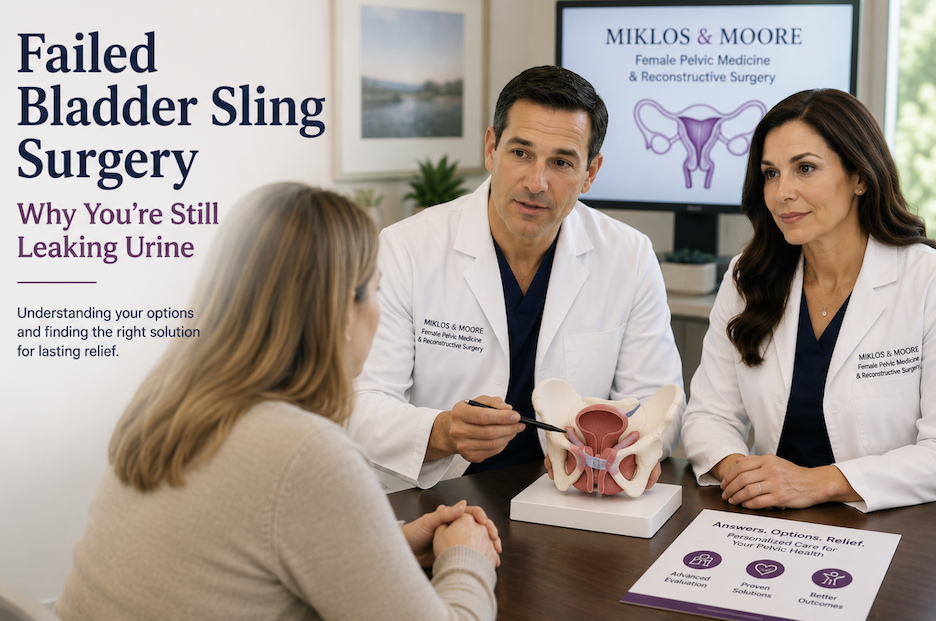
Failed Bladder Sling Surgery: Why You’re Still Leaking Urine and What Your Options Are
Had a Bladder Sling but Still Leak Urine?
Many women undergo bladder sling surgery expecting that their urinary leakage will disappear. While midurethral sling surgery is highly effective for many patients, some women continue to leak urine, develop new urinary symptoms, or experience discomfort months or even years after surgery.
If you’ve been asking yourself:
- Why is my bladder sling not working?
- Can a failed bladder sling be fixed?
- Why am I leaking again after sling surgery?
you’re not alone.
Persistent urinary incontinence after sling surgery does not always mean the procedure “failed.” In many cases, there is an identifiable reason for ongoing symptoms, and treatment options are available.
What Is a Bladder Sling?
A bladder sling, also called a midurethral sling, is a procedure designed to treat stress urinary incontinence (SUI).
During surgery, a supportive sling is placed beneath the urethra to help prevent urine leakage during activities that increase abdominal pressure, such as:
- Coughing
- Sneezing
- Laughing
- Running
- Lifting
- Exercising
For many women, sling surgery significantly improves bladder control and quality of life.
Why Am I Still Leaking After Sling Surgery?
There isn’t one single answer.
Several conditions can cause urinary leakage after a sling procedure.
The Original Diagnosis May Not Have Been Complete
One of the most common reasons women continue to leak urine is that they have more than one type of urinary incontinence.
For example, you may have:
- Stress urinary incontinence
- Overactive bladder
- Urge urinary incontinence
- Mixed urinary incontinence
If urge incontinence was present before surgery but not recognized, a sling alone may not resolve all of your symptoms.
Your Symptoms Have Changed Over Time
Some women initially do very well after surgery but begin leaking again years later.
This may occur because of:
- Aging
- Menopause
- New pelvic floor weakness
- Weight gain
- Chronic coughing
- Additional pregnancies
- Progressive tissue changes
These changes do not necessarily mean the sling itself has failed.
Pelvic Organ Prolapse May Be Contributing
Many women who have urinary leakage also have pelvic organ prolapse.
Conditions such as:
- Bladder prolapse (cystocele)
- Uterine prolapse
- Rectocele
- Vaginal vault prolapse
can change bladder function and contribute to urinary symptoms.
Treating only the sling without evaluating the entire pelvic floor may overlook an important cause of persistent leakage.
The Sling May No Longer Provide Adequate Support
In some cases, the sling may not provide sufficient urethral support.
Possible reasons include:
- Changes in tissue support
- Sling loosening over time
- Technical factors
- Progressive pelvic floor weakness
A careful evaluation is needed before determining whether another procedure is appropriate.
Symptoms That Should Be Evaluated
Contact a pelvic floor specialist if you experience:
- Continued urine leakage
- Leakage that returned after years of improvement
- Difficulty emptying your bladder
- Frequent urinary tract infections
- Pelvic pain
- Pain during intercourse
- Vaginal bleeding
- Feeling exposed mesh
- New urgency symptoms
These symptoms may or may not be related to the sling itself.
How Is a Failed Sling Evaluated?
The first step is understanding why your symptoms are occurring.
Evaluation may include:
- Detailed medical history
- Pelvic examination
- Assessment for pelvic organ prolapse
- Urinalysis
- Post-void residual testing
- Bladder diary
- Urodynamic testing when indicated
- Cystoscopy in selected patients
Not every woman requires every test. The evaluation is tailored to your symptoms.
What Are the Treatment Options?
Treatment depends on the underlying cause—not simply the fact that you’ve had previous surgery.
Options may include:
Pelvic Floor Physical Therapy
Strengthening the pelvic floor may improve symptoms in selected patients.
Medications
Women with urgency or overactive bladder may benefit from medication rather than another surgery.
Urethral Bulking
Injectable bulking agents may help some women with persistent stress urinary incontinence.
Sling Revision
If the sling is contributing to symptoms, a revision procedure may be considered.
Partial or Complete Sling Removal
In women experiencing complications such as pain, mesh exposure, or significant voiding problems, removal of part or all of the sling may be appropriate.
Not every patient with a previous sling requires removal, and the decision should be made only after a comprehensive evaluation.
Additional Reconstructive Surgery
If pelvic organ prolapse or another pelvic floor disorder is contributing to your symptoms, additional reconstructive procedures may be recommended.
Don’t Assume Another Surgery Is the Only Answer
Many women believe they need another operation simply because they’re leaking urine again.
In reality, the cause may be:
- Overactive bladder
- Pelvic organ prolapse
- Incomplete bladder emptying
- Recurrent stress incontinence
- Medication side effects
- Urinary tract infection
Treating the wrong problem can lead to unnecessary procedures and continued frustration.
Why Second Opinions Can Be Valuable
Women who have persistent symptoms after sling surgery are often understandably frustrated. Some have been told they need another operation immediately, while others have been told that nothing more can be done.
A thorough second opinion can help clarify the diagnosis and ensure that every reasonable treatment option has been considered.
Drs. John Miklos and Robert Moore regularly evaluate women who have undergone previous pelvic floor surgery and continue to experience urinary leakage, pain, or other bladder symptoms. Rather than assuming the sling is the problem—or assuming it is not—they perform a comprehensive evaluation of bladder function, pelvic organ support, prior surgical changes, and overall pelvic floor health before recommending treatment. This thoughtful approach helps ensure that decisions are based on the underlying cause of symptoms rather than on assumptions alone.
Find Answers Before Choosing Another Procedure
If you’re still leaking urine after bladder sling surgery, don’t assume you have to live with it—or that another operation is automatically the next step.
An accurate diagnosis is essential. Understanding why your symptoms persist allows you and your physician to develop a treatment plan that addresses the true cause and gives you the best opportunity for lasting improvement.
Frequently Asked Questions
Why am I still leaking after bladder sling surgery?
Persistent leakage may be caused by recurrent stress urinary incontinence, overactive bladder, pelvic organ prolapse, tissue changes, or another underlying condition. A comprehensive evaluation is needed to determine the cause.
Can a failed bladder sling be repaired?
Yes. Depending on the diagnosis, treatment may include pelvic floor therapy, medications, urethral bulking, sling revision, sling removal, or another reconstructive procedure.
Does leaking after a sling mean the surgery failed?
Not necessarily. Some women develop new bladder conditions over time, while others have more than one type of urinary incontinence that requires different treatments.
Should a bladder sling be removed if I’m having problems?
Not always. Sling removal is appropriate only in selected situations, such as mesh exposure, chronic pain, significant voiding dysfunction, or other confirmed complications. Many women improve without removing the sling.
Can pelvic organ prolapse cause bladder symptoms after sling surgery?
Yes. Bladder prolapse, uterine prolapse, or other pelvic floor disorders can contribute to urinary symptoms even after a successful sling procedure.
Why choose Drs. Miklos and Moore for a second opinion?
Persistent urinary symptoms after previous surgery often require looking beyond the original procedure. Drs. Miklos and Moore evaluate the entire pelvic floor—including bladder function, pelvic organ support, prior surgical changes, and urinary symptoms—to determine why problems continue. Their comprehensive approach helps women understand all available treatment options before deciding whether additional surgery is necessary.