
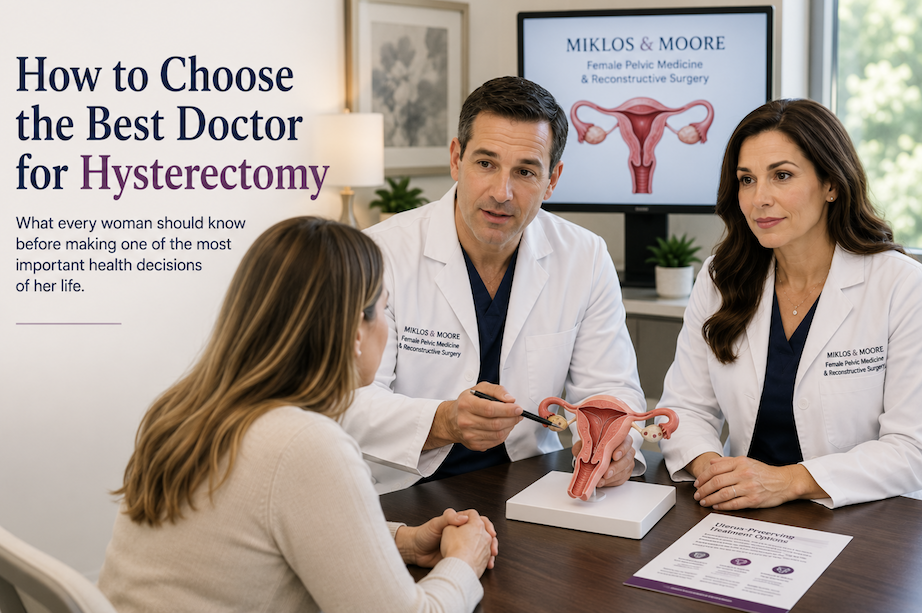
How to Choose the Best Doctor for Hysterectomy
What Every Woman Should Know Before Choosing a Specialist
If you’ve been told you need a hysterectomy, or you’re considering one because of fibroids, pelvic organ prolapse, abnormal bleeding, endometriosis, chronic pelvic pain, or another gynecologic condition, one of the first questions you may ask is, “How do I choose the best doctor?”
Choosing the right physician is an important decision because a hysterectomy is major surgery, and every woman’s medical condition, anatomy, and treatment goals are different. In some cases, a hysterectomy is the most appropriate treatment. In others, alternative treatments—including uterine-preserving procedures—may be available.
At Miklos & Moore, Dr. John Miklos and Dr. Robert Moore are board-certified urogynecologists specializing in Female Pelvic Medicine and Reconstructive Surgery (FPMRS). They evaluate women with pelvic floor disorders, pelvic organ prolapse, and other gynecologic conditions to determine whether hysterectomy—or another treatment—is the best option based on each patient’s diagnosis and long-term goals.
This guide explains what a hysterectomy is, who performs the procedure, and what to consider when choosing a doctor.
What Is a Hysterectomy?
A hysterectomy is a surgical procedure to remove the uterus.
Depending on the reason for surgery, additional structures may also be removed, including:
- Cervix
- Fallopian tubes
- Ovaries
The procedure may be performed through several different approaches depending on the patient’s condition.
Why Do Women Need a Hysterectomy?
A hysterectomy may be recommended for several medical conditions, including:
- Uterine fibroids
- Abnormal uterine bleeding
- Adenomyosis
- Endometriosis
- Chronic pelvic pain
- Certain gynecologic cancers
- Pelvic organ prolapse
- Uterine prolapse
However, not every woman with these conditions requires a hysterectomy.
Many treatment options are available depending on your diagnosis.
Does Pelvic Organ Prolapse Always Require a Hysterectomy?
No.
One of the biggest misconceptions about pelvic organ prolapse is that every woman needs her uterus removed.
For many women with uterine prolapse, uterine-preserving prolapse surgery may be an appropriate option.
Whether preserving the uterus is possible depends on:
- The severity of prolapse
- Overall pelvic anatomy
- Other gynecologic conditions
- Future treatment goals
- Personal preference
Discussing all available options helps ensure that treatment aligns with your goals and medical needs.
Who Performs Hysterectomy?
Several specialists perform hysterectomies, including:
- General gynecologists
- Gynecologic surgeons
- Gynecologic oncologists
- Urogynecologists
Women with pelvic organ prolapse or complex pelvic floor disorders may benefit from consultation with a board-certified urogynecologist, particularly when reconstructive surgery may also be needed.
What Should You Look for in a Hysterectomy Doctor?
Choosing the right physician involves more than finding someone who performs hysterectomies.
Specialized Experience
Look for a physician who regularly performs hysterectomy and treats conditions similar to yours.
Individualized Treatment
A hysterectomy should never be recommended simply because it is one available option.
A thoughtful physician will discuss:
- Whether surgery is necessary
- Alternatives to hysterectomy
- Uterine-preserving procedures
- Risks and benefits
- Expected recovery
Comprehensive Evaluation
Your consultation should include:
- Medical history
- Pelvic examination
- Imaging review when appropriate
- Discussion of symptoms
- Review of treatment goals
- Explanation of all available treatment options
Communication
Choose a physician who encourages questions and explains every option clearly so you can make an informed decision.