
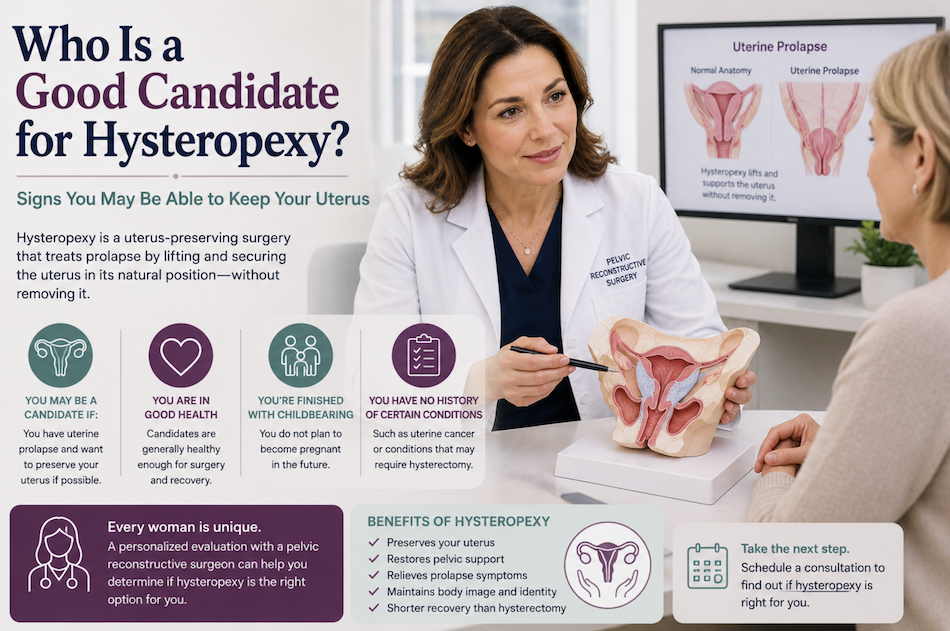
Who Is a Good Candidate for Hysteropexy? Signs You May Be Able to Keep Your Uterus
Am I a Candidate for Hysteropexy?
After learning you have uterine prolapse, one of the first questions you may ask is:
“Can I keep my uterus?”
For many women, the answer is yes.
Hysteropexy is a uterus-preserving surgical procedure that treats uterine prolapse without removing the uterus. While not every woman is a candidate, many patients with pelvic organ prolapse can successfully undergo hysteropexy and achieve excellent long-term outcomes.
The key is determining whether uterus-preserving surgery is the safest and most effective option for your specific condition.
At Miklos & Moore, treatment recommendations are based on your anatomy, symptoms, medical history, and goals—not a one-size-fits-all approach.
What Is a Hysteropexy?
A hysteropexy is a reconstructive pelvic floor procedure that restores the uterus to its normal position while preserving it.
Rather than removing the uterus through a hysterectomy, the surgeon repairs the weakened pelvic support structures and secures the uterus using advanced reconstructive techniques.
Depending on your needs, hysteropexy may be performed:
- Vaginally
- Robotically
- Laparoscopically
- Using native tissue support
- Using specialized suspension techniques
The procedure selected depends entirely on your pelvic anatomy and the severity of your prolapse.
Signs You May Be a Good Candidate
Many women are surprised to learn they may qualify for uterus-preserving surgery.
You may be a good candidate if you:
You Have Uterine Prolapse
Hysteropexy is designed specifically to treat uterine prolapse.
Whether your prolapse is mild, moderate, or advanced, preserving the uterus may still be an option after a thorough evaluation.
Your Uterus Is Healthy
Women who do not have significant uterine disease are often excellent candidates.
Examples include women who do not have:
- Uterine cancer
- Precancerous conditions
- Large symptomatic fibroids
- Severe adenomyosis
- Persistent abnormal uterine bleeding
A healthy uterus can often be safely preserved.
You Want to Keep Your Uterus
Many women simply prefer not to undergo a hysterectomy.
Reasons include:
- Personal preference
- Emotional attachment
- Religious beliefs
- Cultural beliefs
- Desire to preserve normal anatomy
- Avoiding removal of a healthy organ
These preferences are important and should be part of your treatment discussion.
You’re Healthy Enough for Surgery
As with any operation, your overall health matters.
Your surgeon will consider:
- Heart and lung health
- Diabetes
- Smoking history
- Previous surgeries
- Body weight
- Medications
- Other medical conditions
The safest procedure is always the priority.
Who May Not Be a Candidate?
Although hysteropexy is an excellent option for many women, it is not appropriate for everyone.
A hysterectomy may be recommended if you have:
- Endometrial cancer
- Cervical cancer
- Precancerous uterine disease
- Large symptomatic fibroids
- Severe adenomyosis
- Chronic abnormal bleeding
- Certain hereditary cancer syndromes
In these situations, removing the uterus may provide the safest long-term treatment.
Can You Still Have Other Types of Prolapse?
Yes.
Many women with uterine prolapse also have:
- Bladder prolapse (cystocele)
- Rectocele
- Vaginal laxity
- Enterocele
- Urinary incontinence
These conditions do not automatically prevent uterus-preserving surgery.
In many cases, all of these problems can be evaluated and treated during the same operation if appropriate.
Does Age Matter?
Not necessarily.
Women of many different ages undergo hysteropexy.
Your overall health, pelvic anatomy, and goals are usually more important than age alone.
Both younger and older women may be candidates depending on their individual circumstances.
Does the Stage of Prolapse Matter?
Women often assume advanced prolapse means they must have a hysterectomy.
That is not always true.
Some women with more advanced prolapse can still undergo uterus-preserving surgery, while others may benefit from different reconstructive procedures.
Only a comprehensive pelvic examination can determine the most appropriate approach.
Why a Comprehensive Evaluation Is So Important
Choosing the right prolapse surgery requires more than identifying that the uterus has descended.
An experienced pelvic reconstructive surgeon evaluates:
- The uterus
- Bladder support
- Vaginal support
- Rectal support
- Connective tissue strength
- Urinary symptoms
- Bowel function
- Sexual function
- Prior surgeries
- Overall pelvic floor anatomy
This complete assessment helps ensure that every aspect of prolapse is addressed—not just the most obvious problem.
Why Women Choose Miklos & Moore for Hysteropexy
Drs. John Miklos and Robert Moore have dedicated their careers exclusively to female pelvic reconstructive surgery. Their extensive experience allows them to evaluate women with both straightforward and highly complex pelvic floor disorders, including patients seeking second opinions after being told they require a hysterectomy.
Throughout their careers, they have:
- Performed thousands of prolapse procedures
- Developed innovative reconstructive surgical techniques
- Published numerous peer-reviewed scientific articles
- Trained surgeons from around the world
- Treated many complex and recurrent prolapse cases referred by other physicians
Rather than recommending hysteropexy for every woman—or hysterectomy for every woman—they focus on identifying the procedure that offers the safest, most durable, and most individualized solution.
Schedule a Consultation
If you’ve recently been diagnosed with uterine prolapse and would like to know whether you can preserve your uterus, the first step is a comprehensive evaluation by an experienced pelvic reconstructive surgeon.
At Miklos & Moore, every patient receives an individualized treatment plan based on her anatomy, symptoms, lifestyle, and long-term goals. If hysteropexy is an appropriate option, they will explain the benefits, risks, and expected outcomes so you can make an informed decision.
Frequently Asked Questions
Who is a good candidate for hysteropexy?
Women with uterine prolapse who have a healthy uterus and wish to preserve it are often good candidates. A comprehensive examination is necessary to determine whether hysteropexy is appropriate.
Can I have hysteropexy if I also have a bladder prolapse?
Yes. Many women have both uterine prolapse and bladder prolapse. These conditions can often be repaired during the same operation when appropriate.
Do I have to be younger to qualify for uterus-preserving surgery?
No. Age alone does not determine candidacy. Your overall health, anatomy, and treatment goals are more important factors.
Can advanced prolapse still be treated without a hysterectomy?
Sometimes. Even women with more advanced prolapse may be candidates for uterus-preserving surgery depending on their pelvic anatomy and overall condition.
How do I know which surgery is right for me?
A consultation with an experienced pelvic reconstructive surgeon is the best way to determine whether hysteropexy, hysterectomy with prolapse repair, or another reconstructive procedure is most appropriate for your situation.
Why choose Drs. Miklos and Moore?
Drs. Miklos and Moore are internationally recognized leaders in female pelvic reconstructive surgery and cosmetic gynecology. Their decades of experience include thousands of prolapse repairs, pioneering minimally invasive surgical techniques, publishing extensively in medical journals, and educating surgeons worldwide. Their expertise allows them to carefully evaluate each patient and recommend the treatment that best matches her anatomy, symptoms, and long-term goals—whether that involves preserving the uterus or performing another advanced reconstructive procedure.