
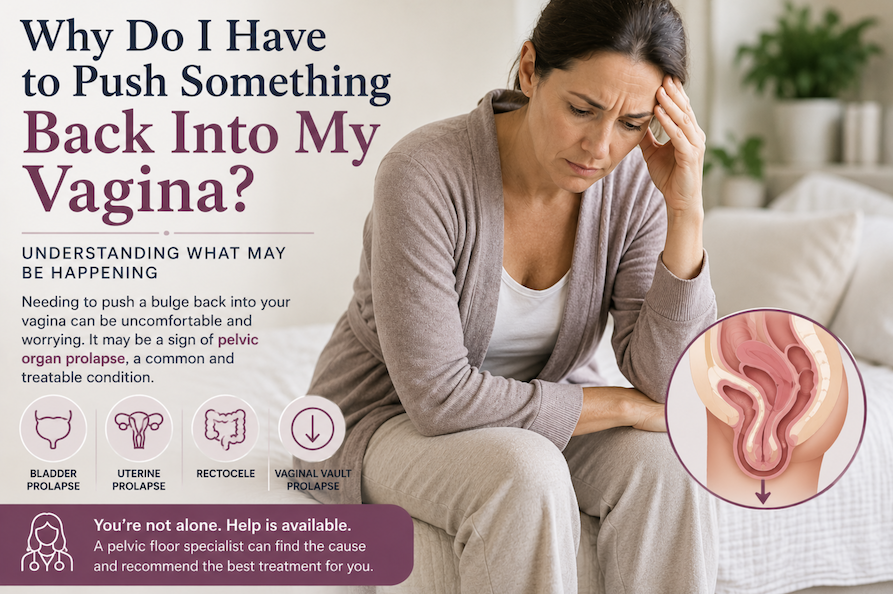
Why Do I Have to Push Something Back Into My Vagina? Understanding What May Be Happening
“I never thought I’d have to do this.”
Many women describe the same experience.
You go to the bathroom.
You wipe.
You feel something.
At first, you think it must be swelling.
Maybe tissue from childbirth.
Maybe a hemorrhoid.
But over time, you realize something is actually bulging into your vagina.
Sometimes it disappears when you lie down.
Sometimes it becomes worse after standing all day.
Some women gently push it back inside because it feels more comfortable.
Then it happens again.
If you’ve searched “Why do I have to push something back into my vagina?”, you’re probably looking for reassurance as much as answers.
The first thing to know is this:
You’re not alone, and you’re not the first woman to experience this.
Although this symptom can feel frightening, there are several possible explanations. The most common involve changes in the pelvic floor that often develop after childbirth, aging, menopause, previous surgery, or years of normal wear on the body’s support structures.
The important step isn’t guessing what’s happening.
It’s understanding why it’s happening.
Women Describe This in Many Different Ways
Most women don’t say:
“I think I have pelvic organ prolapse.”
Instead they say:
- Something is coming out.
- I have to push it back in.
- It feels like a ball.
- There’s a bulge.
- It gets worse at the end of the day.
- I feel pressure when I stand.
- Something keeps falling down.
- It feels like my insides are dropping.
Every one of these descriptions is important.
They tell us what you’re experiencing—but they don’t necessarily tell us the diagnosis.
One of the Most Common Causes Is Pelvic Organ Prolapse
Pelvic organ prolapse happens when the muscles, ligaments, and connective tissues supporting the pelvic organs become weakened or stretched.
Instead of remaining in their normal position, one or more organs may begin to descend into the vagina.
Depending on which structure is involved, you may have:
- Bladder prolapse (cystocele)
- Rectocele
- Uterine prolapse
- Vaginal vault prolapse (after hysterectomy)
Many women don’t know which type they have.
They simply know that something is bulging.
Why Does It Feel Better After I Push It Back?
This is one of the questions women ask most often.
When a prolapse is gently repositioned, the pressure on surrounding tissues may temporarily decrease.
That can make walking, sitting, or even emptying your bladder feel easier for a while.
However, pushing it back in doesn’t treat the underlying problem.
It simply relieves the symptom temporarily.
If you’re finding yourself doing this regularly, it’s a sign that your pelvic floor deserves a proper evaluation.
Why Does It Usually Get Worse Later in the Day?
Gravity plays a major role.
As you spend hours:
- Standing
- Walking
- Lifting
- Exercising
the weakened support structures are placed under increasing stress.
Many women tell us:
“I feel fine in the morning.”
“By evening, it’s much worse.”
That pattern is extremely common in women with pelvic support disorders.
Could It Be Something Besides Prolapse?
Yes.
Although prolapse is one of the most common causes, other conditions may create similar symptoms.
These include:
- Vaginal cysts
- Large polyps
- Pelvic floor muscle dysfunction
- Certain rectal conditions
- Scar tissue after childbirth or surgery
This is why it’s important not to diagnose yourself based solely on symptoms.
Other Symptoms You May Notice
Women who manually push tissue back into the vagina often experience additional symptoms, including:
- Pelvic pressure
- A feeling of heaviness
- Difficulty emptying the bladder
- Urinary leakage
- Constipation
- Difficulty with bowel movements
- Lower back discomfort
- Pain or pressure during intimacy
Every symptom adds another piece to the diagnostic puzzle.
What Happens During Your Evaluation?
One of the first questions we’ll ask isn’t “Which surgery do you want?”
Instead, we’ll ask:
“Tell us what you’ve been experiencing.”
When did you first notice the bulge?
Does it happen every day?
Does it improve when you lie down?
Do you have trouble emptying your bladder or bowels?
Have you had children?
Previous pelvic surgery?
These answers help guide the next step: a comprehensive pelvic floor examination.
During your evaluation, we assess how each part of the pelvic floor is functioning—not just whether a bulge is present. We evaluate the bladder, uterus or vaginal vault, rectum, vaginal walls, pelvic floor muscles, connective tissues, and support structures because more than one compartment may be involved. It’s not unusual for women to have both prolapse and urinary incontinence, or prolapse combined with pelvic floor muscle weakness.
Understanding exactly which structures have changed—and how those changes relate to your symptoms—is what allows us to recommend the most appropriate treatment.
This diagnostic approach is central to the care provided by Dr. John Miklos and Dr. Robert Moore. Throughout their careers, they have focused on treating women with complex pelvic floor disorders, including many patients who have previously been told they had “just prolapse” when multiple conditions were actually present. Their experience caring for women from across the country, contributing to peer-reviewed research, and teaching reconstructive pelvic surgery has reinforced the importance of creating a treatment plan based on the individual patient—not just the diagnosis.
Treatment Depends on the Cause
Once the diagnosis is clear, treatment may include:
- Observation for mild prolapse
- Pelvic floor physical therapy
- Lifestyle modifications
- Pessary fitting
- Robotic prolapse surgery
- Vaginal prolapse repair
- Native tissue reconstruction
- Treatment for urinary incontinence when present
- Combination procedures for women with multiple pelvic floor disorders
Not every woman needs surgery.
Not every woman should avoid surgery.
The right treatment depends on your symptoms, anatomy, health, and goals.
Don’t Feel Embarrassed
Many women tell us they’ve been quietly pushing the bulge back inside for months—or even years—before seeking help.
They worried it was too embarrassing to mention.
Or they assumed nothing could be done.
In reality, pelvic floor specialists hear this concern every day.
It’s one of the most common—and most important—reasons women schedule an evaluation.
Frequently Asked Questions
Is it normal to push a bulge back into my vagina?
While many women with pelvic organ prolapse do this to relieve symptoms, it isn’t something you should simply ignore. It deserves a proper evaluation.
Does this always mean I have prolapse?
No. Although prolapse is a common cause, other pelvic conditions can produce similar symptoms.
Why does the bulge disappear when I lie down?
Lying down reduces the effects of gravity on the pelvic floor, allowing the prolapsed tissue to move back into a more natural position.
Can physical therapy help?
Pelvic floor physical therapy may improve symptoms in some women, particularly when muscle weakness contributes to the problem.
Will I automatically need surgery?
No. Treatment depends on the type and severity of the prolapse, your symptoms, and your personal goals.
Can prolapse affect my bladder or bowels?
Yes. Some women notice difficulty emptying the bladder, constipation, or urinary leakage along with the bulge.
Conclusion
If you’ve found yourself pushing a bulge back into your vagina, your body is giving you an important signal that something has changed. While that symptom is often associated with pelvic organ prolapse, it can have several possible causes, and each requires a different approach to treatment.
The most important step isn’t trying to manage the symptom on your own—it’s understanding what’s causing it. A comprehensive pelvic floor evaluation can identify the underlying problem and help you develop a treatment plan designed specifically for your needs, allowing you to return to everyday life with greater comfort and confidence.