
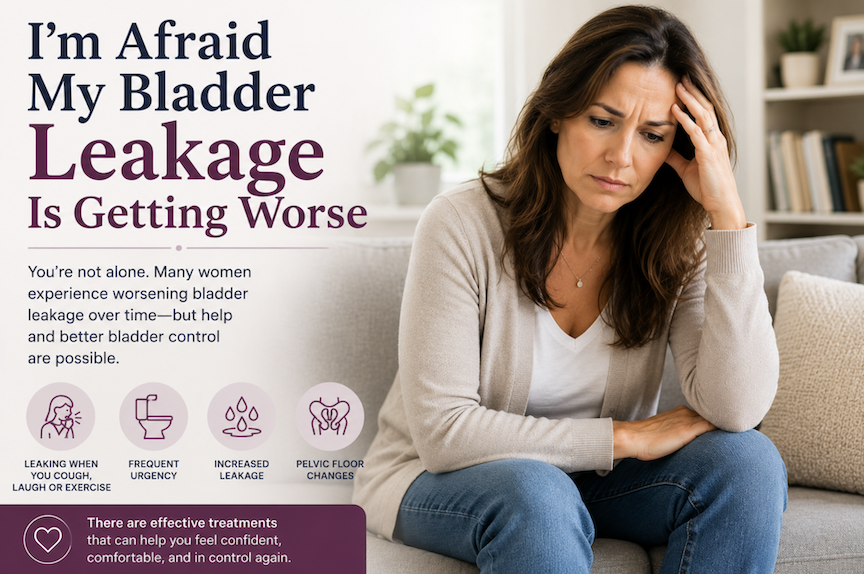
“I’m Afraid My Bladder Leakage Is Getting Worse”
When Occasional Leaks Become Something You Think About Every Day
It didn’t start all at once.
At first, it was just a few drops when you laughed really hard.
Maybe you leaked while sneezing.
Or during a workout.
You told yourself it wasn’t a big deal.
You wore a thin liner “just in case.”
You stopped jumping.
You crossed your legs before coughing.
You memorized where the bathrooms were.
Then one day, you realized something had changed.
It wasn’t just the leakage anymore.
It was how often you thought about it.
Many women quietly ask themselves:
“Is my bladder getting worse?”
“Why is this happening more often?”
“Is this just because I’m getting older?”
“Will it eventually happen all the time?”
If these thoughts sound familiar, you’re not alone.
At the practice of Dr. John Miklos and Dr. Robert Moore in Alpharetta, Georgia, women from Georgia, Florida, Alabama, Tennessee, North Carolina, South Carolina, as well as California, Texas, New York, Illinois, and throughout the United States often describe this exact progression. They don’t simply notice bladder leakage—they notice how it begins to shape their daily lives.
When Is Bladder Leakage Considered Normal?
Many women assume that leaking urine after childbirth or during menopause is simply something they have to accept.
While bladder leakage is common, it is not something you have to ignore.
Leaking urine may occur because of:
- Stress urinary incontinence (leaking with coughing, laughing, sneezing, or exercise)
- Overactive bladder (a sudden urge to urinate that is difficult to control)
- Mixed urinary incontinence (a combination of both)
- Pelvic organ prolapse
- Pelvic floor muscle dysfunction
- Other urinary or pelvic floor conditions
Determining the cause is the first step toward finding the right treatment.
The Real Fear Isn’t the Leak
Many women tell us the leakage itself isn’t what bothers them most.
It’s the uncertainty.
Questions begin to take over.
“What if I leak during an important meeting?”
“What if someone notices?”
“What if I can’t make it to the bathroom?”
“What if it keeps getting worse?”
That constant planning can become exhausting.
Small Changes That Signal a Bigger Impact
You may notice you’ve started to:
- Wear pads every day.
- Avoid long walks.
- Stop running or exercising.
- Limit how much water you drink before leaving home.
- Sit near the restroom at restaurants or events.
- Skip activities that involve jumping or lifting.
- Decline invitations because you’re worried about leaking.
These adjustments often happen so gradually that they begin to feel normal.
Why Women Wait to Seek Help
Many women postpone making an appointment because they believe:
“It’s just part of aging.”
“Everyone who had kids leaks a little.”
“It’s embarrassing to talk about.”
“I don’t want surgery.”
“I can live with it.”
The good news is that bladder leakage has many possible causes, and treatment depends on identifying the one affecting you. Some women benefit from pelvic floor physical therapy, behavioral changes, medications, minimally invasive procedures, or surgery, while others simply gain reassurance after a thorough evaluation.
Why Women Choose Drs. John Miklos and Robert Moore
For more than twenty years, Dr. John Miklos and Dr. Robert Moore have focused exclusively on Female Pelvic Medicine and Reconstructive Surgery and cosmetic gynecology.
Their practice evaluates women experiencing:
- Stress urinary incontinence
- Overactive bladder
- Mixed urinary incontinence
- Pelvic organ prolapse
- Vaginal laxity
- Childbirth-related pelvic floor injuries
- Menopause-related pelvic changes
- Revision pelvic surgery
- Complex pelvic floor disorders
Because they see these conditions every day, they understand that bladder leakage isn’t simply a medical issue—it’s something that can affect confidence, social activities, exercise, travel, and quality of life.
Women Travel From Across the Country
Located in Alpharetta, Georgia, the practice cares for women from Georgia, Florida, Alabama, Tennessee, North Carolina, South Carolina, as well as California, Texas, New York, Illinois, Arizona, Virginia, Colorado, Pennsylvania, Ohio, and beyond.
Many women travel because they want a comprehensive evaluation from physicians who focus specifically on female pelvic floor disorders and reconstructive surgery.
You Don’t Have to Keep Wondering
If you’ve found yourself thinking more about your bladder than you ever imagined you would, that’s worth paying attention to.
Whether your symptoms are occasional or becoming more frequent, understanding the reason behind them can help you make informed decisions about your health.
The goal isn’t simply to stop the leaks.
It’s to help you get back to living without constantly planning your life around them.
Frequently Asked Questions
Is bladder leakage a normal part of aging?
Bladder leakage becomes more common with age, but it should not automatically be accepted as something you simply have to live with. An evaluation can help identify the underlying cause and discuss available treatment options.
Why is my bladder leakage getting worse?
Symptoms may change over time because of pelvic floor weakness, hormonal changes, childbirth-related injuries, prolapse, or other urinary conditions. A specialist can determine the cause.
Does bladder leakage always require surgery?
No. Many women improve with pelvic floor physical therapy, lifestyle modifications, medications, pessaries, or minimally invasive treatments. Surgery is only one of several possible options.
Should I see a specialist if I only leak occasionally?
If the leakage is affecting your confidence, activities, exercise, or quality of life, it’s reasonable to seek an evaluation—even if it seems mild.