
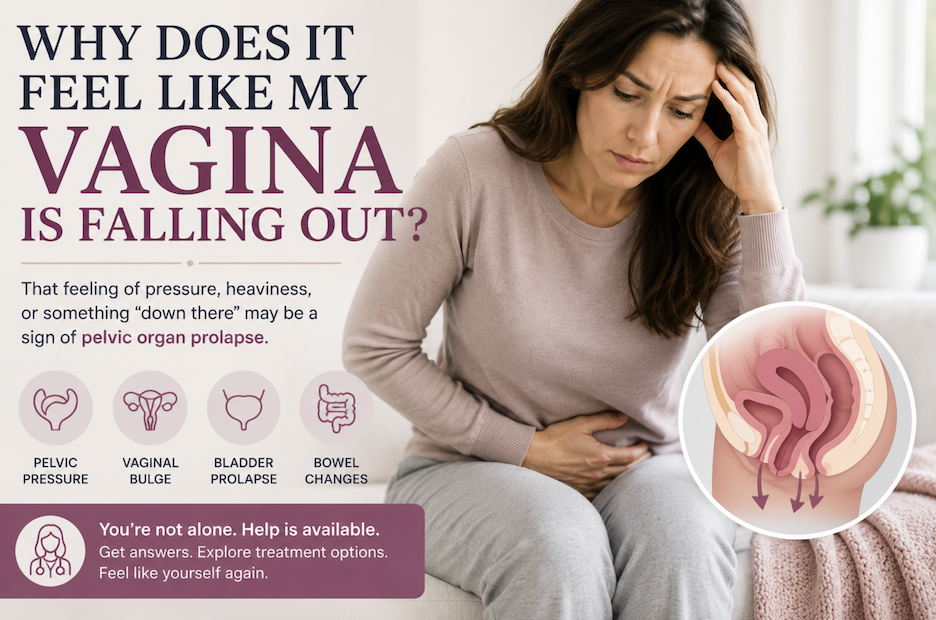
Why Does It Feel Like My Vagina Is Falling Out?
Understanding the Sensation of Vaginal Pressure, Bulging, or Something Dropping
Few symptoms are as alarming as feeling like your vagina is “falling out.”
For many women, the sensation appears gradually. You may first notice it after a long day on your feet, after lifting something heavy, or while exercising. Others feel it after childbirth or during menopause, while some women simply wake up one day and realize that something feels very different.
If you’ve searched “Why does it feel like my vagina is falling out?”, you’re not alone. This is one of the most common ways women describe symptoms before they receive a diagnosis.
The sensation can be frightening, but it does not automatically mean that something serious or dangerous has happened. In many cases, it is related to a pelvic floor condition that can be evaluated and, when appropriate, treated.
At their practice in Alpharetta, Georgia, Dr. John Miklos and Dr. Robert Moore evaluate women with pelvic organ prolapse, bladder problems, menopause-related pelvic floor changes, vaginal reconstruction concerns, and complex pelvic floor disorders. Patients travel from throughout Georgia, Florida, Alabama, Tennessee, North Carolina, South Carolina, as well as California, Texas, New York, Illinois, and across the United States for specialized care.
What Does “Falling Out” Usually Feel Like?
Women describe this symptom in many different ways, including:
- “It feels like something is dropping.”
- “I feel a bulge when I stand.”
- “It feels like a tampon is slipping out.”
- “There’s pressure between my legs.”
- “I feel something at the opening of my vagina.”
- “By the end of the day, everything feels heavy.”
Although these descriptions vary, they often point toward changes in pelvic support.
The Most Common Cause: Pelvic Organ Prolapse
One of the leading causes of this sensation is pelvic organ prolapse.
The pelvic floor is made up of muscles, ligaments, and connective tissue that support the bladder, uterus, rectum, and vagina. When these structures weaken or stretch, one or more pelvic organs can descend into the vaginal canal.
Depending on the type of prolapse, this may involve:
- The bladder (cystocele)
- The rectum (rectocele)
- The uterus (uterine prolapse)
- The top of the vagina after a hysterectomy (vaginal vault prolapse)
Many women have more than one type of prolapse at the same time.
Other Conditions That Can Cause Similar Symptoms
Not every woman who feels pressure has prolapse.
Other possible causes include:
Pelvic Floor Muscle Dysfunction
Overly tight or poorly coordinated pelvic floor muscles can create a sensation of heaviness, fullness, or pressure.
Menopause
Hormonal changes may reduce tissue elasticity and make existing pelvic support problems more noticeable.
Childbirth-Related Changes
Pregnancy and vaginal delivery can stretch or injure the muscles and connective tissues that support the pelvic organs. Symptoms may appear soon after childbirth—or years later.
Previous Pelvic Surgery
Scar tissue or changes following hysterectomy or prolapse repair may alter the way the pelvic floor feels and functions.
Because several conditions can produce similar symptoms, an accurate diagnosis is essential.
When Is the Feeling Most Noticeable?
Many women report that symptoms are worse:
- Late in the day
- After standing for long periods
- During exercise
- After lifting heavy objects
- When coughing repeatedly
- During episodes of constipation
Others notice improvement after lying down or resting, which can be another clue that pelvic support changes are contributing to the sensation.
How Is the Cause Diagnosed?
A thorough evaluation may include:
- A detailed discussion of your symptoms
- Review of pregnancies and deliveries
- Previous pelvic surgeries
- Assessment of pelvic organ support
- Evaluation of bladder and bowel symptoms
- Examination of pelvic floor muscle function
- Review of hormonal influences such as menopause
Looking at the entire pelvic floor—not just one symptom—helps determine the most appropriate treatment plan.
Treatment Depends on Your Diagnosis
Not every woman with pelvic pressure requires surgery.
Depending on the underlying cause, treatment may include:
- Observation
- Pelvic floor physical therapy
- Lifestyle modifications
- Vaginal estrogen therapy when appropriate
- Pessary fitting
- Treatment for bladder conditions
- Surgical repair when symptoms significantly affect quality of life
The best treatment is one that addresses your specific diagnosis and personal goals.
Why Women Choose Drs. John Miklos and Robert Moore
For more than twenty years, Dr. John Miklos and Dr. Robert Moore have focused exclusively on Female Pelvic Medicine and Reconstructive Surgery.
They specialize in diagnosing and treating:
- Pelvic organ prolapse
- Stress urinary incontinence
- Overactive bladder
- Vaginal reconstruction
- Menopause-related pelvic floor changes
- Childbirth-related injuries
- MRKH syndrome
- Revision pelvic surgery
- Complex pelvic floor disorders
Their comprehensive approach considers how the bladder, pelvic floor muscles, vaginal tissues, connective tissue, and previous surgeries interact, allowing them to develop individualized treatment plans for each patient.
Women Travel From Across the United States
Although based in Alpharetta, Georgia, Drs. Miklos and Moore regularly care for women from across the country.
Patients travel from:
Georgia
Atlanta, Alpharetta, Roswell, Johns Creek, Sandy Springs, Marietta, Cumming, Gainesville, Athens, Augusta, Savannah, Macon, Columbus, Valdosta, and nearby communities.
Florida
Jacksonville, Orlando, Tampa, Miami, Naples, Sarasota, Fort Myers, Boca Raton, Fort Lauderdale, Tallahassee, Pensacola, and surrounding cities.
Alabama
Birmingham, Huntsville, Montgomery, Mobile, Auburn, Tuscaloosa, and neighboring areas.
Tennessee
Nashville, Chattanooga, Knoxville, Memphis, Franklin, Murfreesboro, and surrounding communities.
North Carolina
Charlotte, Raleigh, Durham, Greensboro, Asheville, Wilmington, Cary, and nearby cities.
South Carolina
Greenville, Spartanburg, Columbia, Charleston, Hilton Head, Myrtle Beach, Rock Hill, and surrounding communities.
Women also seek care from California (Los Angeles, Pasadena, Glendale, Beverly Hills, Newport Beach, Orange County, San Diego, San Francisco), Texas (Dallas, Houston, Austin, Fort Worth, San Antonio), New York (New York City, Long Island, Buffalo, Rochester, Albany), Illinois (Chicago, Naperville, Schaumburg, Springfield), and many other states.
International patients also travel to Alpharetta for consultations involving complex pelvic floor disorders, vaginal reconstruction, MRKH syndrome, and revision surgery.
You Don’t Have to Wonder What’s Happening
Feeling like your vagina is falling out can be frightening, but it doesn’t necessarily mean you have a serious emergency.
What it does mean is that your body is signaling a change that deserves evaluation.
Whether the cause is pelvic organ prolapse, menopause-related tissue changes, pelvic floor dysfunction, or another condition, understanding what’s happening allows you to make informed decisions about your care and regain confidence in your daily life.
Frequently Asked Questions
Does feeling like my vagina is falling out always mean prolapse?
No. Pelvic organ prolapse is a common cause, but pelvic floor muscle dysfunction, menopause-related changes, and other conditions can produce similar symptoms.
Is pelvic organ prolapse dangerous?
Pelvic organ prolapse is usually not life-threatening, but it can significantly affect comfort, bladder function, bowel function, intimacy, and quality of life if symptoms become bothersome.
Can this feeling come and go?
Yes. Many women notice that symptoms worsen with prolonged standing, exercise, or lifting and improve after resting.
Should I wait before seeing a specialist?
If the sensation persists, worsens, or interferes with your daily activities, scheduling an evaluation can help determine the cause and discuss appropriate treatment options.