
Why Can’t I Hold a Tampon Anymore? Common Reasons It Keeps Falling Out
“I’ve used tampons my entire life…why won’t they stay in anymore?”
For many women, this is one of the first signs that something has changed.
At first, you might think you’re inserting it incorrectly.
You try a different brand.
A different size.
You reposition it several times.
But it still feels like it’s slipping out.
Or maybe it doesn’t fall out completely, but it never feels like it used to.
Instead, you constantly notice it’s there.
Some women describe it as:
“It feels like there’s nothing holding it in anymore.”
Others say:
“It keeps sliding down.”
Or:
“I’ve never had this problem until after having my baby.”
If this sounds familiar, you’re not alone.
Difficulty keeping a tampon in place is a symptom many women experience, yet very few talk about it. While it may seem like a problem with the tampon itself, it’s often your body telling you that something has changed.
The important question isn’t “Which tampon should I buy?”
The important question is:
“Why is this happening now when it never happened before?”
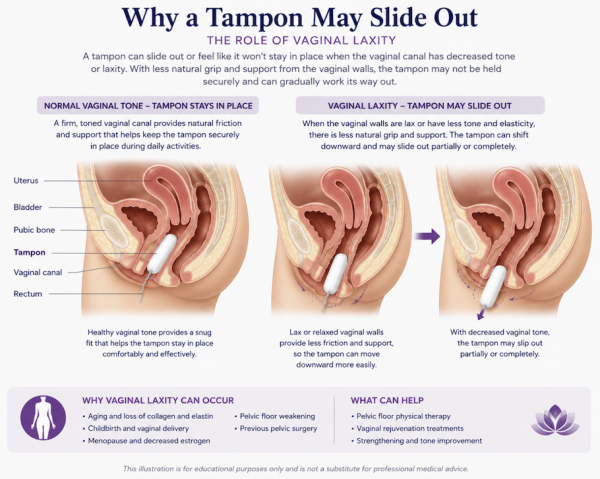
Medical illustration showing how decreased vaginal tone and vaginal laxity may contribute to difficulty keeping a tampon comfortably in place.
A Tampon Usually Doesn’t Change…
Your Body Does.
Most women use tampons for years without any problems.
That’s why it’s important to pay attention when something suddenly feels different.
Changes may occur:
- After childbirth
- During menopause
- Following pelvic surgery
- As part of the natural aging process
- After significant weight loss
- When pelvic floor conditions develop
A tampon that once stayed comfortably in place may suddenly feel loose, slide downward, or even fall out.
That symptom deserves attention—not because the tampon is the problem, but because it may reveal something about the support structures inside the pelvis.
One Symptom…Several Possible Causes
Many women immediately assume:
“My vagina must be stretched.”
Sometimes that’s true.
But there are several other possibilities.
Vaginal Laxity
Childbirth can stretch the muscles and connective tissues surrounding the vagina.
Some women describe this as:
- Feeling more open
- Feeling wider
- Less support
- Reduced friction
- Difficulty keeping tampons in place
For women with significant vaginal laxity, everyday activities—not just intimacy—may begin to feel different.
Pelvic Organ Prolapse
This is one of the most common causes physicians consider.
When the bladder, uterus, rectum, or vaginal walls lose support, they may begin to descend into the vaginal canal.
Instead of recognizing prolapse immediately, many women first notice:
“My tampon won’t stay in.”
Sometimes this happens years before they realize they have prolapse.
Pelvic Floor Muscle Weakness
The muscles of the pelvic floor help support the organs above them.
When those muscles become weakened after pregnancy, childbirth, chronic straining, or aging, support throughout the pelvis may change.
Some women notice:
- Tampons slipping
- Mild urinary leakage
- Pelvic heaviness
- Less support during exercise
Hormonal Changes
During menopause, declining estrogen levels affect:
- Vaginal tissue thickness
- Elasticity
- Moisture
- Collagen
Although menopause doesn’t usually cause tampons to fall out by itself, hormonal changes can contribute to sensations that feel different than they once did.
Childbirth Is Often the Turning Point
Many women tell us:
“Everything was normal until I had my baby.”
Pregnancy and vaginal delivery place tremendous stress on the pelvic floor.
During delivery, the muscles and connective tissues stretch dramatically.
Some recover completely.
Others heal with lasting changes.
You may notice:
- Tampons slipping
- Less support
- Pressure
- A feeling of openness
- Changes during intimacy
- Mild bladder leakage
These symptoms don’t necessarily appear immediately after delivery.
Some women don’t notice them until years later.
Don’t Assume You Need Surgery
One of the biggest mistakes women make is trying to match a symptom to a procedure.
A tampon falling out doesn’t automatically mean you need vaginal tightening surgery.
It also doesn’t automatically mean you have prolapse.
The same symptom can have several different causes.
That’s why the first goal is identifying what has changed, not choosing a treatment.
What Happens During Your Evaluation?
One of the first things we ask women is when they first noticed the change.
Was it after childbirth?
After menopause?
Following surgery?
Did it happen suddenly or gradually?
Those answers often provide important clues.
Next comes a comprehensive pelvic floor examination.
Rather than focusing only on the vagina, we evaluate the entire support system—including the bladder, vaginal walls, uterus (when present), rectum, pelvic floor muscles, connective tissues, and areas of previous childbirth injury or scarring. Women are often surprised to learn that the same symptom can have several completely different causes.
A woman whose tampon keeps slipping may have mild vaginal laxity.
Another may have early bladder prolapse.
Someone else may have pelvic floor weakness without significant prolapse at all.
Understanding the difference is what allows us to recommend the right treatment instead of simply recommending a procedure.
Over decades of caring for women with pelvic floor disorders, Dr. John Miklos and Dr. Robert Moore have developed an evaluation process that focuses on identifying why a symptom is occurring before discussing treatment. Their experience treating complex pelvic floor conditions, performing revision surgery, publishing peer-reviewed research, and teaching reconstructive techniques to physicians has reinforced a simple principle: the best outcomes begin with the right diagnosis.
Treatment Depends on the Cause
Once the underlying condition has been identified, treatment may include:
- Pelvic floor physical therapy
- Observation
- Hormonal therapy
- Lifestyle modifications
- Pessary treatment
- Vaginal rejuvenation
- Pelvic reconstructive surgery
- Combination treatment when multiple conditions are present
Every woman deserves a treatment plan designed specifically for her anatomy, symptoms, and goals.
You’re Not Imagining It
One of the most reassuring things women hear during their visit is:
“Yes…what you’re describing makes sense.”
Many patients worry they’re overthinking the problem.
They’re not.
When your body suddenly starts behaving differently, it’s worth understanding why.
Whether the cause is childbirth, pelvic floor weakness, prolapse, or another condition, identifying the source of the problem is the first step toward finding a solution.
Frequently Asked Questions
Is it normal for a tampon to start falling out?
No. While it doesn’t always indicate a serious condition, it’s a change that deserves evaluation if it persists.
Does this mean I have prolapse?
Not necessarily. Several pelvic floor conditions can cause this symptom.
Can childbirth cause this years later?
Yes. Pelvic floor changes sometimes become more noticeable years after delivery.
Can pelvic floor therapy help?
Many women benefit from pelvic floor physical therapy depending on the underlying diagnosis.
Should I stop using tampons?
Not necessarily. However, if tampons suddenly become difficult to use or repeatedly fall out, it’s reasonable to schedule an evaluation.
Will I need surgery?
Many women do not. The appropriate treatment depends entirely on the cause of your symptoms.
Conclusion
If you’ve been wondering why your tampon no longer stays in place, don’t ignore the change or assume it’s “just aging.” Your body may be giving you an early clue that something has changed within your pelvic floor.
The important step isn’t guessing the diagnosis or choosing a procedure on your own. It’s understanding why the symptom developed. Once the cause is identified, a personalized treatment plan can help address the problem and restore your comfort, confidence, and quality of life.