
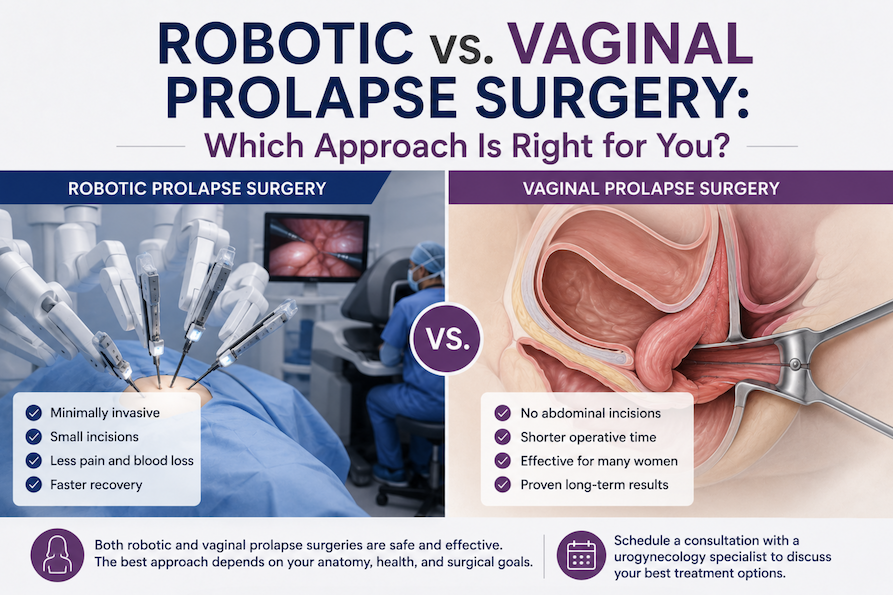
Robotic vs. Vaginal Prolapse Surgery: Which Approach Is Right for You?
Understanding Your Surgical Options for Pelvic Organ Prolapse
If you’ve been diagnosed with pelvic organ prolapse and conservative treatment is no longer providing enough relief, your physician may recommend surgery.
At that point, many women ask an important question:
“Should I have robotic surgery or vaginal surgery?”
The answer is not always straightforward.
Both robotic and vaginal prolapse surgery are well-established approaches that can provide excellent outcomes when performed for the right patient. However, they are different procedures with different advantages, limitations, recovery considerations, and surgical goals.
The most appropriate approach depends on many factors, including:
- Which pelvic organs have prolapsed
- The severity of the prolapse
- Whether you have had a previous hysterectomy
- Your overall health
- Prior pelvic surgeries
- Your anatomy
- Your personal treatment goals
At Miklos & Moore, every woman undergoes a comprehensive pelvic floor evaluation before surgery is recommended. Dr. John Miklos and Dr. Robert Moore are fellowship-trained urogynecologists specializing in Female Pelvic Medicine and Reconstructive Surgery (FPMRS). Because they have extensive experience with both robotic and vaginal reconstructive techniques, they are able to recommend the approach that best fits each patient’s unique condition rather than relying on a single surgical method.
Is One Procedure Better Than the Other?
One of the biggest misconceptions surrounding prolapse surgery is that there is a single “best” operation.
In reality, there isn’t.
The best procedure is the one that addresses your specific type of prolapse, your anatomy, and your long-term goals.
For some women, a vaginal approach is an excellent choice.
For others, a robotic procedure may offer important advantages.
The key is choosing the operation that is most appropriate for you, not simply the newest or most commonly discussed technique.
What Is Robotic Pelvic Reconstructive Surgery?
Robotic pelvic reconstructive surgery is a minimally invasive surgical approach that allows the surgeon to repair pelvic organ prolapse using specialized robotic technology controlled entirely by the surgeon.
Small abdominal incisions are used to insert a camera and surgical instruments, providing a highly magnified view of the pelvic anatomy.
Depending on the condition being treated, robotic surgery may be used for procedures such as:
- Robotic sacrocolpopexy
- Vaginal vault prolapse repair
- Apical prolapse repair
- Multi-compartment prolapse reconstruction
- Complex recurrent prolapse surgery
Potential advantages of a robotic approach may include:
- Small incisions
- Excellent visualization of pelvic anatomy
- Precise surgical movements
- Treatment of complex prolapse in selected patients
- Minimally invasive access
The specific benefits vary depending on the procedure being performed and the individual patient’s anatomy.
What Is Vaginal Prolapse Surgery?
Vaginal prolapse surgery is performed through the vagina without abdominal incisions.
Depending on the type of prolapse, vaginal surgery may involve repairing weakened tissues, restoring support, or reconstructing different compartments of the pelvic floor using native tissue or other techniques when appropriate.
Common vaginal procedures include:
- Anterior repair (cystocele repair)
- Posterior repair (rectocele repair)
- Vaginal vault suspension
- Uterine-preserving prolapse surgery in selected patients
- Native tissue prolapse repair
Because surgery is performed through the vaginal opening, there are no visible abdominal incisions.
For many women, a vaginal approach provides excellent long-term symptom relief while avoiding abdominal surgery.
How Do Surgeons Decide Which Approach Is Best?
The decision is based on much more than the stage of prolapse.
During your consultation, factors that may influence the recommendation include:
- Which pelvic organs have prolapsed
- Whether multiple compartments are involved
- Previous pelvic surgeries
- History of hysterectomy
- Tissue quality
- Bladder function
- Bowel function
- Presence of urinary incontinence
- Overall medical health
- Your expectations and treatment goals
No two women have identical pelvic floor anatomy.
That is why treatment should always be individualized rather than based on a one-size-fits-all philosophy.
Why Experience Matters More Than the Surgical Approach
Women often spend weeks comparing robotic surgery with vaginal surgery.
A more important question is:
“Who is performing my surgery?”
Excellent outcomes begin with:
- An accurate diagnosis
- A comprehensive understanding of pelvic floor anatomy
- Appropriate procedure selection
- Careful surgical planning
- Experience managing both routine and complex prolapse
At Miklos & Moore, Dr. John Miklos and Dr. Robert Moore evaluate every aspect of the pelvic floor before recommending treatment. Their goal is not to favor one technique over another, but to recommend the approach that offers the greatest opportunity to restore pelvic support, improve function, and achieve durable, long-term results for each individual patient.
Which Procedure Has the Better Recovery?
Recovery is one of the biggest concerns women have when considering prolapse surgery.
Questions we frequently hear include:
- How long will I be off work?
- When can I exercise again?
- When can I lift my grandchildren?
- When can I have sex again?
- Is robotic surgery easier to recover from than vaginal surgery?
The answer depends on more than the surgical approach.
Recovery is influenced by:
- The type of prolapse being repaired
- Whether multiple procedures are performed
- Your overall health
- Previous pelvic surgery
- The complexity of your reconstruction
- How your body heals
For some women, robotic surgery offers certain recovery advantages.
For others, vaginal surgery may be the simpler and more appropriate option.
The goal is not to choose the operation with the shortest recovery—it is to choose the operation most likely to provide a safe, durable, and successful result.
Recovery After Robotic Prolapse Surgery
Because robotic surgery is performed through several small abdominal incisions, many women experience:
- Small incisions
- Less postoperative discomfort compared with larger abdominal operations
- Earlier walking
- A relatively short hospital stay for many patients
- Gradual return to normal daily activities
Even though the incisions are small, extensive healing is taking place internally.
Patients still need to avoid:
- Heavy lifting
- High-impact exercise
- Strenuous physical activity
- Sexual intercourse until cleared by their surgeon
Protecting the repair during the healing process is critical for long-term success.
Recovery After Vaginal Prolapse Surgery
Vaginal surgery avoids abdominal incisions altogether because the repair is performed through the vaginal canal.
Recovery often involves:
- Temporary vaginal soreness
- Swelling
- Light spotting
- Activity restrictions during healing
Although there are no abdominal incisions, vaginal surgery is still reconstructive surgery involving important pelvic floor tissues.
Patients should carefully follow all postoperative instructions to allow the repair to heal properly.
Does One Recovery Take Longer?
Not necessarily.
Recovery depends much more on:
- The complexity of the repair
- Whether multiple pelvic floor conditions are treated simultaneously
- Individual healing
- Following postoperative instructions
A straightforward robotic procedure may involve a quicker recovery than a complex vaginal reconstruction.
Likewise, a simple vaginal repair may involve an easier recovery than an extensive robotic reconstruction.
Every patient’s recovery timeline is unique.
Which Procedure Lasts Longer?
Another common question is:
“Which operation has better long-term success?”
There is no universal answer.
Long-term outcomes depend on:
- Selecting the correct operation
- The specific type of prolapse
- Tissue quality
- Surgical technique
- Patient factors
- Protecting the repair during recovery
The operation that provides the most durable result for one woman may not be the best choice for another.
This is why individualized surgical planning is so important.
Why Women Choose Dr. John Miklos & Dr. Robert Moore
One of the greatest advantages of seeking care at Miklos & Moore is that treatment recommendations are driven by what is best for the patient—not by a preference for one surgical technique.
Dr. John Miklos and Dr. Robert Moore are fellowship-trained urogynecologists specializing in Female Pelvic Medicine and Reconstructive Surgery (FPMRS). They have extensive experience performing both robotic and vaginal pelvic reconstructive procedures, allowing them to tailor treatment to each woman’s specific condition.
Their expertise includes:
- Robotic sacrocolpopexy
- Vaginal prolapse repair
- Native tissue reconstruction
- Multi-compartment prolapse repair
- Vaginal vault prolapse surgery
- Bladder prolapse repair
- Rectocele repair
- Uterine prolapse surgery
- Complex recurrent prolapse
- Revision pelvic floor surgery
Rather than recommending the same procedure for every patient, they perform a comprehensive evaluation of the bladder, bowel, vaginal support, pelvic floor muscles, connective tissues, urinary continence, and prior surgical history.
This individualized approach helps ensure that each woman receives a treatment plan designed to restore pelvic support while preserving bladder, bowel, and sexual function whenever possible.
Women travel from Atlanta, throughout Georgia, across the United States, and internationally because of Dr. Miklos and Dr. Moore’s reputation for treating both routine and highly complex pelvic floor disorders with advanced reconstructive techniques and personalized care.
Robotic vs. Vaginal Surgery: Which Is Right for You?
The most important decision is not choosing robotic surgery or vaginal surgery.
The most important decision is choosing the right operation for your specific condition.
Every woman deserves a thorough evaluation that considers:
- Her symptoms
- Her anatomy
- The type of prolapse
- Previous surgeries
- Bladder and bowel function
- Lifestyle and activity level
- Long-term goals
When treatment is individualized rather than standardized, women are better positioned to achieve lasting improvements in comfort, function, and quality of life.
The best surgical approach is the one that is thoughtfully selected for you after a comprehensive evaluation by a fellowship-trained urogynecologist experienced in the full spectrum of pelvic reconstructive surge