
Perineoplasty vs. Vaginoplasty: Which Procedure Is Right for You?
Understanding the Differences—and Why Choosing the Right Surgeon Matters
If you’ve been researching vaginal rejuvenation, you’ve probably come across two procedures again and again:
- Perineoplasty
- Vaginoplasty
At first glance, they may appear to be the same surgery.
Many websites use the terms interchangeably, while others provide only a brief description of each procedure without explaining which one may actually be appropriate for your specific concerns.
The reality is that perineoplasty and vaginoplasty are two different procedures designed to treat different anatomical problems.
Some women benefit from one procedure.
Others benefit from both.
The key is determining why your symptoms developed in the first place.
Whether your concerns began after childbirth, aging, menopause, or previous pelvic surgery, the best treatment starts with an accurate diagnosis—not simply choosing a procedure based on information found online.
At Miklos & Moore, every consultation begins with a comprehensive pelvic floor evaluation. Dr. John Miklos and Dr. Robert Moore are fellowship-trained urogynecologists specializing in Female Pelvic Medicine and Reconstructive Surgery (FPMRS). Their expertise in pelvic reconstructive surgery, cosmetic gynecology, childbirth injuries, and vaginal rejuvenation allows them to identify the true cause of a woman’s symptoms and recommend the procedure—or combination of procedures—that best restores anatomy, function, and confidence.
Many Women Don’t Know Which Procedure They Need
One of the most common things women say during their consultation is:
“I know something doesn’t feel right, but I don’t know which surgery I need.”
That is completely understandable.
Most women are not expected to know the difference between the vaginal canal, the vaginal opening, the perineal body, or the muscles that support the pelvic floor.
What many women describe as a “loose vagina” may actually be:
- Injury to the perineal body
- Vaginal laxity
- Pelvic floor muscle separation
- Pelvic organ prolapse
- Scar tissue following childbirth
- A combination of several conditions
Although these problems may produce similar symptoms, they often require very different treatments.
This is one of the reasons choosing an experienced fellowship-trained urogynecologist is so important.
Rather than recommending the same procedure to every patient, Dr. Miklos and Dr. Moore determine exactly which structures have been affected before discussing treatment options.
Understanding the Female Anatomy
Before comparing the procedures, it helps to understand the anatomy involved.
The Vaginal Canal
The vaginal canal is the muscular passage extending from the vaginal opening to the cervix.
During childbirth, the muscles and connective tissues supporting the vaginal canal stretch dramatically.
For many women, these tissues recover naturally.
Others develop permanent stretching known as vaginal laxity, which may reduce support and alter sensation during intercourse.
The Vaginal Opening
The vaginal opening is the entrance to the vagina.
This area is commonly affected during vaginal childbirth.
Some women notice:
- A wider opening
- Reduced support
- Visible anatomical changes
- Less friction during intimacy
- Difficulty retaining tampons
These concerns often involve structures closer to the vaginal entrance than the deeper vaginal canal.
The Perineal Body
One of the most important—and least understood—structures is the perineal body.
Located between the vagina and the anus, the perineal body serves as a central attachment point for several pelvic floor muscles.
It plays a critical role in supporting the vaginal opening and maintaining normal pelvic floor anatomy.
During childbirth, this structure may stretch, tear, or heal improperly.
When that happens, women may experience:
- A widened vaginal opening
- Reduced support
- Changes during intimacy
- A feeling that the vaginal entrance is more open than before childbirth
Because the perineal body is so important, it should be carefully evaluated before recommending surgery.
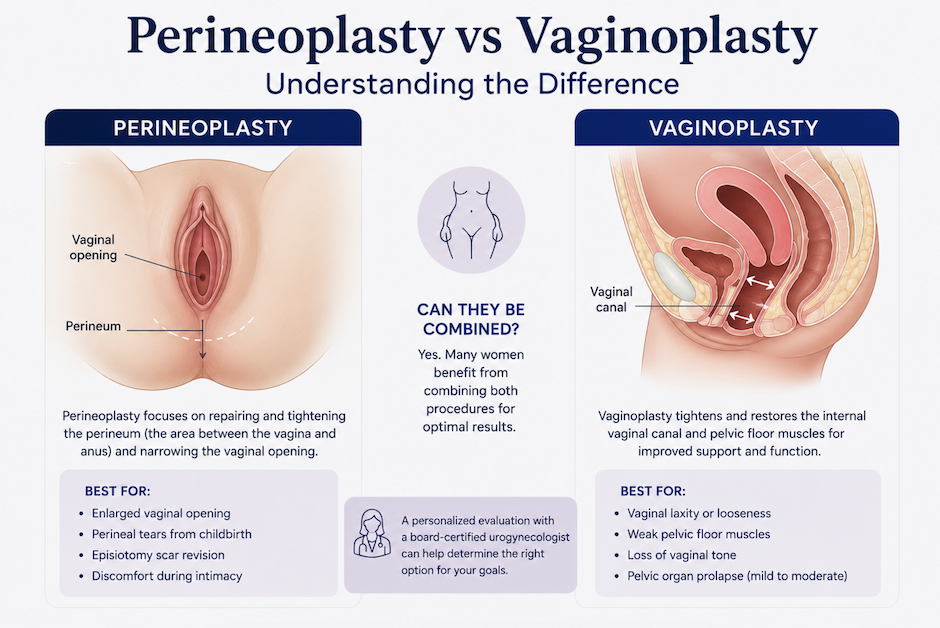
What Is Perineoplasty?
Perineoplasty is a reconstructive procedure that restores the perineal body and repairs the tissues surrounding the vaginal opening.
See before and after photos of perineoplasty.
Unlike vaginoplasty, which focuses on the deeper vaginal canal, perineoplasty addresses the entrance of the vagina where childbirth frequently causes stretching or injury.
Women who benefit from perineoplasty commonly notice:
- A larger vaginal opening
- Poor healing after childbirth
- Scarring from tears or episiotomy
- Reduced support
- Less friction during intercourse
- Cosmetic changes that affect confidence
The procedure is designed to reconstruct damaged tissues, restore support, and improve both function and appearance while preserving the natural anatomy.
Who Is a Good Candidate for Perineoplasty?
You may be a candidate for perineoplasty if you:
- Have a widened vaginal opening following childbirth.
- Experienced significant tearing or an episiotomy.
- Feel that the entrance of the vagina has permanently changed.
- Have reduced support near the vaginal opening.
- Experience decreased friction during intimacy.
- Are bothered by cosmetic changes after childbirth.
Not every woman with these symptoms requires surgery, but when structural damage to the perineal body is present, perineoplasty may provide meaningful improvement.
What Is Vaginoplasty?
Vaginoplasty is a reconstructive procedure designed to tighten and restore the deeper vaginal canal.
Rather than focusing on the vaginal opening, vaginoplasty repairs stretched muscles and connective tissues inside the vagina that may have been weakened during childbirth or through the natural aging process.
Women considering vaginoplasty often report:
- Vaginal laxity
- Decreased tightness
- Reduced sensation during intercourse
- Childbirth-related stretching
- Loss of confidence
The goal is not simply to “tighten” the vagina, but to restore healthy anatomy and improve pelvic floor function when appropriate.
Why Proper Diagnosis Comes First
Although many women arrive believing they need one specific procedure, the examination often tells a different story.
Some women need only perineoplasty.
Others need only vaginoplasty.
Some benefit from a combination of procedures.
Others discover that pelvic organ prolapse, scar tissue, or pelvic floor muscle injury is the primary source of their symptoms.
This is why treatment should never begin with selecting a procedure.
It should begin with identifying the cause.
At Miklos & Moore, Dr. John Miklos and Dr. Robert Moore perform a detailed evaluation of the vaginal canal, vaginal opening, perineal body, pelvic floor muscles, connective tissues, and pelvic organ support before making any recommendations. Their goal is not to perform more surgery—it is to recommend the right surgery, if surgery is appropriate at all.
Can You Need Both Procedures?
Absolutely.
In fact, many women who seek treatment after childbirth have changes involving both the vaginal canal and the vaginal opening.
During pregnancy and vaginal delivery, multiple structures of the pelvic floor may be stretched or injured at the same time. The deeper muscles supporting the vaginal canal may weaken, while the perineal body and tissues surrounding the vaginal opening may also become stretched or torn.
As a result, some women experience:
- Vaginal laxity
- A widened vaginal opening
- Childbirth-related perineal injuries
- Reduced sensation during intercourse
- Loss of pelvic support
- Pelvic organ prolapse
When more than one structure has been affected, combining procedures may provide the most complete restoration of anatomy and function.
The goal is never to perform additional surgery unnecessarily. Instead, treatment should be based on identifying every condition contributing to your symptoms so that each concern is addressed appropriately.
How Do You Know Which Procedure Is Right for You?
This is one of the most important questions women ask—and one that simply cannot be answered by reading about procedures online.
Two women may have nearly identical symptoms but require completely different treatment plans.
For example:
A woman who notices only a widened vaginal opening after childbirth may benefit primarily from perineoplasty.
Another woman with decreased vaginal tightness throughout the vaginal canal may be a better candidate for vaginoplasty.
A third woman may have both conditions along with pelvic organ prolapse, requiring a combination of reconstructive procedures.
This is why choosing the correct procedure begins with an accurate diagnosis—not with selecting surgery based on internet research.
Common Misconceptions About Vaginal Rejuvenation Surgery
Unfortunately, there is a great deal of misinformation online regarding vaginal rejuvenation.
Misconception #1: Every Woman Needs the Same Surgery
No two women have identical anatomy or childbirth experiences.
The best procedure depends on the structures that have actually been affected.
Misconception #2: Surgery Is Only Cosmetic
While appearance may be one reason women seek treatment, reconstructive procedures are often performed to restore normal anatomy, improve pelvic support, and address childbirth-related injuries that affect daily life and intimacy.
Misconception #3: Vaginal Tightening Fixes Everything
Simply tightening tissue without identifying the underlying problem may leave important issues untreated.
Symptoms caused by pelvic organ prolapse, scar tissue, muscle separation, or perineal body injury often require a completely different surgical approach.
Misconception #4: Kegel Exercises Can Repair Structural Damage
Pelvic floor exercises strengthen muscles and are extremely valuable for many women.
However, they cannot repair torn connective tissue, childbirth injuries, or a damaged perineal body.
When structural changes are present, surgery may provide the most predictable long-term improvement.
Why Women Choose Dr. John Miklos & Dr. Robert Moore
Choosing the right surgeon may be the most important decision you make during your treatment journey.
The success of vaginal rejuvenation is not determined simply by the operation performed—it depends on selecting the procedure that best addresses your unique anatomy, symptoms, and goals.
This is where Miklos & Moore are different.
Dr. John Miklos and Dr. Robert Moore are fellowship-trained urogynecologists who have devoted their careers exclusively to Female Pelvic Medicine and Reconstructive Surgery (FPMRS). Unlike surgeons who perform vaginal rejuvenation as only one part of a broader cosmetic or gynecologic practice, they specialize in diagnosing and treating complex pelvic floor disorders every day.
Their expertise includes:
- Vaginal laxity
- Perineoplasty
- Vaginoplasty
- Pelvic organ prolapse
- Childbirth-related pelvic floor injuries
- Pelvic floor reconstruction
- Cosmetic gynecology
- Revision surgery after previous unsuccessful procedures
Because of this extensive experience, they understand that successful surgery begins with an accurate diagnosis—not simply choosing the most popular procedure.
Every woman who visits Miklos & Moore receives a comprehensive evaluation of the vaginal canal, vaginal opening, pelvic floor muscles, connective tissues, and pelvic organ support before treatment recommendations are made.
Rather than recommending the same surgery for every patient, Dr. Miklos and Dr. Moore develop an individualized treatment plan designed around each woman’s anatomy, lifestyle, symptoms, and personal goals.
This personalized approach has made Miklos & Moore a destination practice for women from Atlanta, throughout Georgia, across the United States, and internationally who are seeking advanced care for both routine and highly complex pelvic floor conditions.
Recovery: Perineoplasty vs. Vaginoplasty
Although recovery varies from one patient to another, both procedures require time for the tissues to heal properly.
Most women can expect:
- Mild swelling during the first several days.
- Temporary soreness and discomfort.
- Gradual improvement over several weeks.
- Activity restrictions while healing occurs.
- Temporary avoidance of sexual intercourse until cleared by their surgeon.
Women undergoing combined procedures or pelvic reconstructive surgery may require a slightly longer recovery depending on the extent of treatment.
Following postoperative instructions carefully is one of the most important factors in achieving the best possible outcome.
What Results Can Women Expect?
The goals of surgery extend far beyond simply making the vagina “tighter.”
Depending on the procedure performed, treatment may help:
- Restore normal pelvic anatomy.
- Reconstruct the perineal body.
- Improve vaginal support.
- Increase comfort during intimacy.
- Improve confidence.
- Correct childbirth-related anatomical changes.
- Address associated pelvic floor disorders.
Successful surgery is measured not only by appearance, but by restoring healthy anatomy, improving function, and helping women return to the activities they enjoy with greater confidence.
At Miklos & Moore, treatment is always centered on achieving results that are both functional and natural while respecting each patient’s individual goals.