
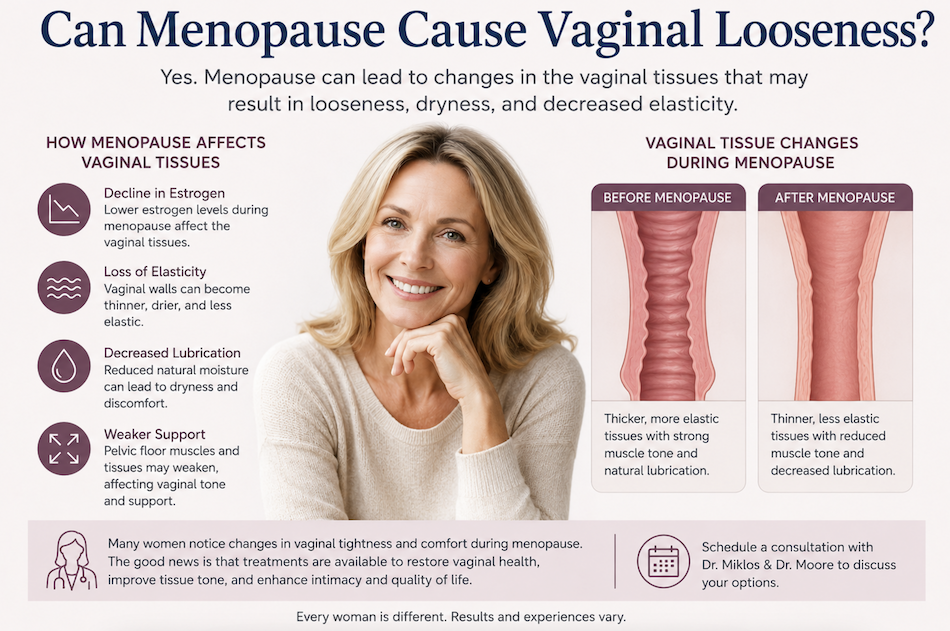
Can Menopause Cause Vaginal Laxity? Causes, Symptoms & Treatment Options
Understanding How Menopause Changes the Pelvic Floor
Many women expect menopause to bring hot flashes, night sweats, or changes in their menstrual cycle.
What often comes as a surprise are the changes that occur in the vagina and pelvic floor.
Some women begin to notice:
- Their vagina feels looser than it used to.
- Intercourse feels different.
- The vaginal opening appears wider.
- They experience vaginal dryness or discomfort.
- Bladder leakage becomes more common.
- They feel pressure or heaviness in the pelvis.
- Their confidence during intimacy has changed.
These symptoms can be frustrating—and for many women, unexpected.
A common question is:
“Can menopause actually cause vaginal laxity?”
The answer is yes, menopause can contribute to changes in the vaginal tissues and pelvic floor. However, menopause is often only one part of the picture. Many women also have childbirth-related stretching, age-related changes in collagen, or pelvic floor disorders that become more noticeable after menopause.
At Miklos & Moore, Dr. John Miklos and Dr. Robert Moore understand that vaginal changes during menopause are rarely caused by a single factor. As fellowship-trained urogynecologists specializing in Female Pelvic Medicine and Reconstructive Surgery (FPMRS), they perform a comprehensive pelvic floor evaluation to determine whether symptoms are related to menopause, vaginal laxity, pelvic organ prolapse, childbirth injuries, or a combination of conditions. This individualized approach allows them to recommend treatment that addresses the underlying cause rather than simply the symptoms.
What Happens to the Body During Menopause?
Menopause marks the end of a woman’s reproductive years and is accompanied by a gradual decline in estrogen production.
Estrogen plays an essential role in maintaining the health of the vaginal tissues and pelvic floor by helping to support:
- Collagen production
- Tissue elasticity
- Blood flow
- Vaginal lubrication
- Healthy muscle function
As estrogen levels decrease, the tissues naturally change.
Many women notice that the vagina feels different—not because they have done anything wrong, but because these changes are part of the normal aging process.
Can Menopause Cause Vaginal Laxity?
It can contribute to it.
Although menopause does not usually cause the dramatic stretching associated with vaginal childbirth, it can reduce the strength, elasticity, and support of the tissues that make up the pelvic floor.
As collagen decreases and muscles naturally weaken with age, some women notice:
- A feeling of vaginal looseness
- Reduced sensation during intimacy
- Changes in pelvic support
- Less muscle tone
- A wider-feeling vaginal opening
For women who previously experienced childbirth-related stretching, menopause often makes those earlier changes more noticeable.
Vaginal Laxity vs. Vaginal Dryness
Many women assume that every menopausal vaginal symptom is caused by dryness.
In reality, vaginal dryness and vaginal laxity are different conditions.
Vaginal dryness is primarily related to reduced estrogen and decreased natural lubrication.
Women commonly experience:
- Burning
- Irritation
- Pain during intercourse
- Increased sensitivity
- Recurrent urinary tract infections
Vaginal laxity, on the other hand, involves changes in the muscles and connective tissues that support the vagina.
Women are more likely to notice:
- Reduced tightness
- Less sensation during intimacy
- A wider vaginal opening
- Changes in pelvic support
- Vaginal air during exercise or intercourse
Some women have one condition.
Others have both.
Understanding the difference is essential because treatment options are not the same.
Other Symptoms Women May Notice After Menopause
In addition to vaginal laxity, menopause may contribute to several other pelvic floor changes, including:
- Vaginal dryness
- Pain during intercourse
- Urinary urgency
- Stress urinary incontinence
- Pelvic pressure
- Mild pelvic organ prolapse
- Reduced vaginal elasticity
- Decreased lubrication
- Changes in sexual function
Because many of these symptoms overlap with pelvic floor disorders, a comprehensive evaluation is often the best way to determine the underlying cause.
Why Proper Diagnosis Matters
Many women assume that all menopausal vaginal symptoms are simply a normal part of aging.
While menopause certainly causes important changes, it can also uncover conditions that have been developing for years, including vaginal laxity, pelvic organ prolapse, or childbirth-related pelvic floor injuries.
Treating the wrong condition may leave symptoms unresolved.
This is why Dr. John Miklos and Dr. Robert Moore evaluate the entire pelvic floor—not just the symptom that brought a woman into the office.
Their goal is to identify exactly why your body feels different and develop a personalized treatment plan that restores function, comfort, and confidence.
What Treatments Are Available for Vaginal Laxity After Menopause?
The best treatment depends on what is causing your symptoms.
Some women primarily experience vaginal dryness related to declining estrogen.
Others have weakened pelvic floor muscles.
Some have childbirth-related stretching that becomes more noticeable after menopause.
Others develop pelvic organ prolapse.
Because several conditions may occur together, treatment should always begin with an accurate diagnosis rather than assuming every symptom is caused by menopause alone.
Can Hormone Therapy Improve Vaginal Laxity?
This is one of the most common questions women ask.
The answer is:
Hormone therapy may improve the health of vaginal tissues, but it does not repair stretched muscles or damaged pelvic floor support.
For appropriate candidates, local vaginal estrogen or other hormone therapies may help improve:
- Vaginal dryness
- Tissue thickness
- Elasticity
- Lubrication
- Comfort during intercourse
- Urinary symptoms related to menopause
However, hormone therapy cannot:
- Repair childbirth-related muscle injuries
- Restore a damaged perineal body
- Correct pelvic organ prolapse
- Reverse significant vaginal laxity
Many women benefit from hormone therapy as part of an overall treatment plan, but it is not a substitute for reconstructive treatment when structural damage is present.
Can Pelvic Floor Physical Therapy Help?
For many menopausal women, absolutely.
Pelvic floor physical therapy is often recommended for women experiencing:
- Mild pelvic floor weakness
- Stress urinary incontinence
- Urinary urgency
- Mild pelvic pressure
- Early vaginal laxity
A specially trained pelvic floor therapist can help improve:
- Muscle strength
- Coordination
- Endurance
- Bladder control
- Pelvic support
For women whose symptoms are primarily muscular, therapy may provide significant improvement without surgery.
When Is Surgery Recommended?
Not every woman with menopausal changes needs surgery.
However, surgery may be appropriate when symptoms are caused by structural changes that cannot be corrected with conservative treatment.
Examples include:
- Significant vaginal laxity
- Injury to the perineal body
- Pelvic organ prolapse
- Childbirth-related muscle separation
- Persistent symptoms despite therapy
- Reduced quality of life
The goal of surgery is not simply to tighten tissue.
The goal is to restore normal anatomy, improve pelvic floor support, and help women regain comfort and confidence.
What Procedures May Be Recommended?
Depending on your diagnosis, treatment may include:
Perineoplasty
Designed to reconstruct the vaginal opening and repair injury to the perineal body.
Vaginoplasty
Repairs stretched muscles and connective tissues within the vaginal canal to improve support and restore anatomy.
Pelvic Organ Prolapse Repair
If menopause has revealed bladder prolapse, rectocele, uterine prolapse, or vaginal vault prolapse, reconstructive surgery may be recommended to restore normal pelvic support.
Combination Procedures
Many women benefit from addressing more than one condition during the same operation.
Treatment is always based on the structures affected—not simply on the symptoms described.
Why Menopause Often Reveals Earlier Childbirth Injuries
Many women tell us,
“I felt fine for years, and then everything seemed to change after menopause.”
This is a very common experience.
Pregnancy and childbirth may stretch the pelvic floor decades earlier.
While younger tissues often compensate remarkably well, the natural decline in collagen, muscle strength, and tissue elasticity that occurs with menopause can make previous childbirth injuries more noticeable.
This is why some women first develop symptoms such as:
- Vaginal looseness
- Pelvic pressure
- A vaginal bulge
- Bladder leakage
- Reduced sensation during intimacy
Years—even decades—after having children.
Understanding this relationship helps explain why menopause does not necessarily create these problems but can make pre-existing weaknesses more apparent.
Why Women Choose Dr. John Miklos & Dr. Robert Moore
Women experiencing menopausal pelvic floor changes often discover that they need more than reassurance—they need answers.
Dr. John Miklos and Dr. Robert Moore are fellowship-trained urogynecologists specializing in Female Pelvic Medicine and Reconstructive Surgery (FPMRS). They have dedicated their careers to diagnosing and treating pelvic floor disorders, vaginal laxity, pelvic organ prolapse, childbirth-related injuries, urinary incontinence, and cosmetic vaginal concerns.
Rather than assuming menopause is the only cause of your symptoms, they perform a comprehensive pelvic floor evaluation to determine exactly what has changed.
Their assessment includes:
- Vaginal tissue health
- Pelvic floor muscle function
- Perineal body support
- Vaginal anatomy
- Pelvic organ support
- Evidence of prolapse
- Childbirth-related injuries
- Previous pelvic surgery
This thorough approach allows them to develop an individualized treatment plan tailored to each woman’s anatomy, symptoms, medical history, and goals.
Women travel from Atlanta, throughout Georgia, across the United States, and internationally because of their extensive experience in both reconstructive pelvic surgery and cosmetic gynecology, as well as their commitment to personalized, patient-centered care.
There Is No One-Size-Fits-All Solution
One of the biggest misconceptions about menopause is that every woman requires the same treatment.
Some women improve with education and reassurance.
Others benefit from hormone therapy.
Some respond well to pelvic floor rehabilitation.
Others achieve the best results with reconstructive surgery.
The key is identifying the true cause of your symptoms before deciding on a treatment plan.
A personalized evaluation ensures that recommendations are based on your unique anatomy and goals—not simply on your age or menopausal status.