
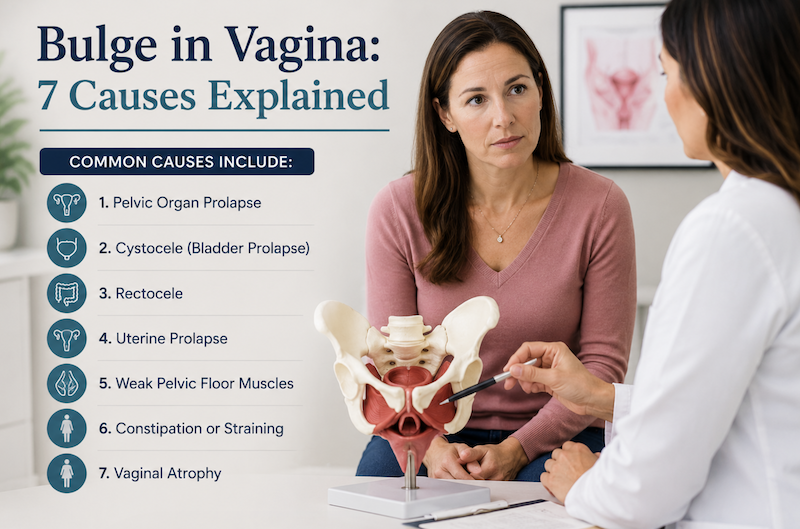
Bulge in Vagina: 7 Causes Explained (Symptoms, Diagnosis, and Treatment Options)
Feeling or seeing a bulge in the vaginal area can be alarming. Many women describe it as:
- “A lump down there”
- “Something is coming out”
- “A pressure or fullness I can feel when I stand”
- “A tampon that won’t stay in”
If you’re experiencing this, you’re not alone—and you’re right to pay attention.
A vaginal bulge is not considered normal, but it is common and highly treatable once properly diagnosed. The key is understanding what’s causing it, because not all bulges are the same—and treatment depends entirely on the underlying issue.
What Does a Vaginal Bulge Mean?
A bulge in the vagina usually indicates a structural or tissue-related change inside the pelvic floor.
The pelvic floor supports:
- The bladder
- The uterus
- The rectum
- The urethra
- The vaginal walls
When this support system weakens, stretches, or changes, tissues or organs can shift—creating the sensation or visible appearance of a bulge.
In most cases, the cause is pelvic organ prolapse, but there are several other possibilities that need to be considered.
The 7 Most Common Causes of a Vaginal Bulge
Understanding these causes is critical, because each one requires a different approach to treatment.
- Pelvic Organ Prolapse (Most Common Cause)
Pelvic organ prolapse is the leading cause of a vaginal bulge.
It occurs when the muscles and connective tissues supporting the pelvic organs weaken, allowing one or more organs to descend into the vaginal canal.
Types of Prolapse
- Cystocele (Bladder prolapse):
The bladder lacks support and falls into the vaginal canal - Rectocele:
The rectum lacks support and bulges into the vaginal canal - Urethrocele
- The urethra lacks support and falls down into the vaginal canal
- Uterine prolapse:
The uterus descends downward into the vaginal canal - Vaginal vault prolapse:
Occurs after hysterectomy – the deepest part of the vagina known as the apex/vault falls downward into the vaginal canal
What It Feels Like
- A soft bulge you can feel or see
- Pressure or heaviness
- Worse when standing
- Better when lying down
This position-based change is one of the strongest indicators of prolapse.
- Cystocele (Bladder Prolapse – Ceiling Wall Bulges)
A cystocele is one of the most common specific types of prolapse.
Symptoms:
- Bulge in the front (anterior) or ceiling of the vagina
- Urinary leakage
- Frequent urination
- Feeling of incomplete emptying
Why It Happens:
- Weakening of the tissue between the bladder and vagina
- Often related to childbirth or aging
Many women don’t realize their urinary symptoms and bulge are connected.
- Rectocele (Back Wall Bulge)
A rectocele occurs when the rectum pushes into the vaginal canal due to a weakening of the vaginal floor
Symptoms:
- Bulge in the back (posterior) vaginal wall
- Difficulty with bowel movements
- Feeling of incomplete evacuation
Unique Clue:
Some patients need to apply pressure inside the vagina, buttocks or perineum to help pass stool.
This is a classic sign of rectocele.
- Uterine Prolapse (Central Bulge)
Uterine prolapse occurs when the uterus descends into the vaginal canal.
Symptoms:
- Central bulge
- Pelvic heaviness
- Sensation of something “dropping”
- Feeling that something is being hit during intercourse
- Lower back pain as the day progresses
- Inability to keep a tampon inside the vagina
Advanced Cases:
The uterus may approach or extend outside the vaginal opening.
- Vaginal Cysts or Benign Masses
Not all bulges are prolapse.
Some are localized growths, such as:
- Gartner duct cysts
- Inclusion cysts
- Bartholin gland cysts
- Hymenal skin tags
Characteristics:
- Usually firm
- Localized
- Not affected by position
Unlike prolapse, these do NOT change with standing or lying down.
- Postpartum Tissue Changes
After childbirth, temporary changes may cause a bulge-like sensation.
Causes:
- Swelling
- Tissue stretching
- Temporary weakness
Important:
- Some cases improve over time
- Others may develop into prolapse
Persistent symptoms after recovery should be evaluated.
- Rare Tumors or Abnormal Growths
While uncommon, a vaginal bulge can occasionally be caused by:
- Benign tumors ( such as Fibroids)
- Malignancies
Warning Signs:
- Rapid growth
- Bleeding
- Pain
- Firm, fixed mass
These cases require prompt medical evaluation.
Soft vs Firm Bulge: A Critical Clue
One of the simplest ways to differentiate causes:
- Soft, reducible bulge → likely prolapse
- Firm, fixed mass → cyst or other growth
What Happens Inside the Body
As support structures weaken:
- The bladder falls into the vagina canal from the ceiling
- The rectum pushes upward into the vaginal canal from the floor
- The uterus may descend into the vaginal canal
This creates the visible or palpable bulge.
Key Symptom Patterns That Point to Prolapse
You’re more likely dealing with prolapse if:
- The bulge is worse when standing
- It improves when lying down
- You feel pressure or heaviness
- You have urinary or bowel symptoms
- Lower back pain
- Feeling as if something is being hit during intercourse
A Frequently Missed Symptom: Pain During Sex
Many women with a vaginal bulge also experience deep pain during intercourse, known as collision dyspareunia.
This occurs when:
- Internal structures shift
- Organs are impacted during penetration
This is often overlooked—but highly important.
When Is a Vaginal Bulge NOT Normal?
A bulge is never something to ignore.
Even mild cases can:
- Progress over time
- Affect bladder and bowel function
- Impact sexual health
How Is the Cause Diagnosed?
Proper diagnosis requires:
- Physical examination
- Identification of all compartments involved
- Symptom correlation
This is critical because:
Many patients have multiple types of prolapse at once
Why Expertise Matters
Not all evaluations are the same.
Specialists like Miklos and Moore Urogynecology focus on:
- Complex and multi-compartment prolapse
- Failed prior surgeries
- Sexual function preservation
- Advanced reconstruction techniques
This level of expertise significantly affects outcomes.
Treatment Options for a Vaginal Bulge
Treatment depends entirely on the cause.
Non-Surgical Options
- Pelvic floor physical therapy
- Pessary (support device)
Best for:
- Mild prolapse
- Patients avoiding surgery
Surgical Options
- Native tissue repair
- Reconstructive prolapse surgery
- Hysteropexy (uterus-preserving)
- Advanced repairs for complex cases
Surgery is often highly effective when performed correctly.
Can a Vaginal Bulge Go Away on Its Own?
- Mild postpartum cases → sometimes
- True prolapse → typically does not reverse fully without treatment
When Should You Seek Medical Evaluation?
You should be evaluated if:
- You feel or see a bulge
- Symptoms persist
- You have urinary or bowel issues
- You have pain during intercourse
Final Takeaway
A bulge in the vagina is your body signaling a structural change.
It’s common
It’s not “normal aging”
And it’s often highly treatable
Next Step: Get the Right Diagnosis at Miklos and Moore
Understanding the exact cause is the most important step.
A proper evaluation can:
- Identify the type of bulge
- Determine severity
- Provide clear treatment options